Emaho: You studied Visual Design at HAW Hamburg, and a freelance profile linked to your website describes about five years across freelance work, agency jobs and in-house design before painting took over. Design is all about clarity and clients, and painting is neither. What did design leave in your hands that you still use, and what did you have to unlearn once you were standing in front of a blank canvas?
Jana Neumann: This is an interesting question and it’s definitely something I have thought about a lot. I grew up in northern Germany in a social environment where the possibility of being a professional artist was never really part of my reality. Choosing graphic design was probably, subconsciously and intuitively, the closest I could get to being an artist. Just within the familiar framework that I had been conditioned to believe was the right path for me.
I studied visual design and worked as a designer for many years in several roles, which included creative work, but of course within a very corporate, structured environment. It taught me a lot about structure, presentation, communication and the business side of working creatively, all of which are incredibly valuable skills to have as an independent artist. But creatively, it was a very different world. I was used to working towards a defined outcome, usually with a specific message or purpose. Creativity existed within a certain framework.
You can definitely see my roots in graphic design looking at my work. I love playing with the juxtaposition between detailed realism and abstract graphic shapes. That contrast is often a recurring element in my practice. When I decided to do art full-time, one of the biggest things I had to unlearn was the need to know where I was going before I even started. I got to rediscover a sense of play, experimentation and surrender, allowing myself to create without everything needing to serve a specific purpose. This allowed the purpose to emerge naturally from the process.
Emaho: You began sharing your paintings publicly in 2022 and have since moved fully into your studio practice. Going from painting privately to putting work out for strangers is a big step. Do you remember the first painting you showed, and how did it feel to watch someone else look at it?
Jana Neumann: When I first started selling my work, I was mainly showing my paintings online. I rarely got to experience what it felt like to have a group of people, especially strangers, encounter my art together in a physical space.
That changed when I showed a body of work called Conversations with Self. I hadn’t quite anticipated how powerful it would feel to bring these paintings together into one room and invite people in. My studio periods are usually long and very introspective. I spend a lot of time in a dialogue with myself, with the figures in my paintings, and with all these different parts of myself that come up through the work. So coming out of that and having such personal work witnessed by strangers can feel incredibly raw and vulnerable.
But what surprised me most were the conversations that emerged. People entered the room with their own experiences and interpretations, and all of a sudden, what had previously been a dialogue between me and my paintings became an exchange with others. People I had never met before began sharing deeply personal stories with me, simply because my work had resonated with them. I found that incredibly beautiful. It’s easy to forget that we all carry our own versions of these experiences. To then have someone else’s story reflected back to me through work that came from my own experience created this incredible feeling of connection. Going from these long stretches of solitude and introspection to meeting complete strangers on such a deep level, sometimes within minutes, is probably one of my favourite parts of what I do. It excites me so much.
Emaho: You describe your work as grounded in embodied experience and the evolving language of the feminine. Language is an interesting word to use for painting. What does that language look like on the canvas, and how has it changed since you first started?
Jana Neumann: For me, language in this context is something that can communicate through emotion and physical experience rather than words. My work is deeply connected to identity, transformation and the process of becoming. I started finding my own artistic language as I approached my thirties, which was quite a transformative period for me, and I think for many other people as well.
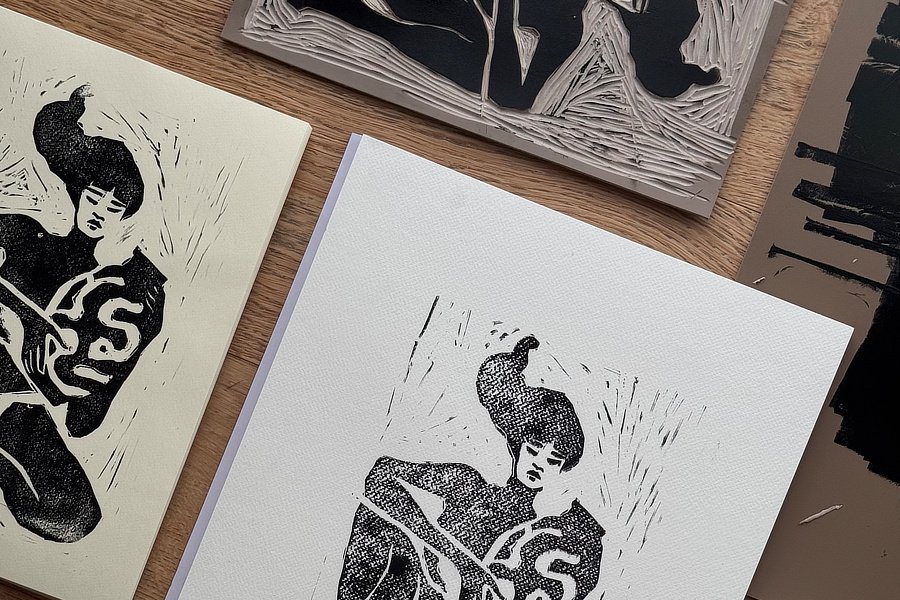
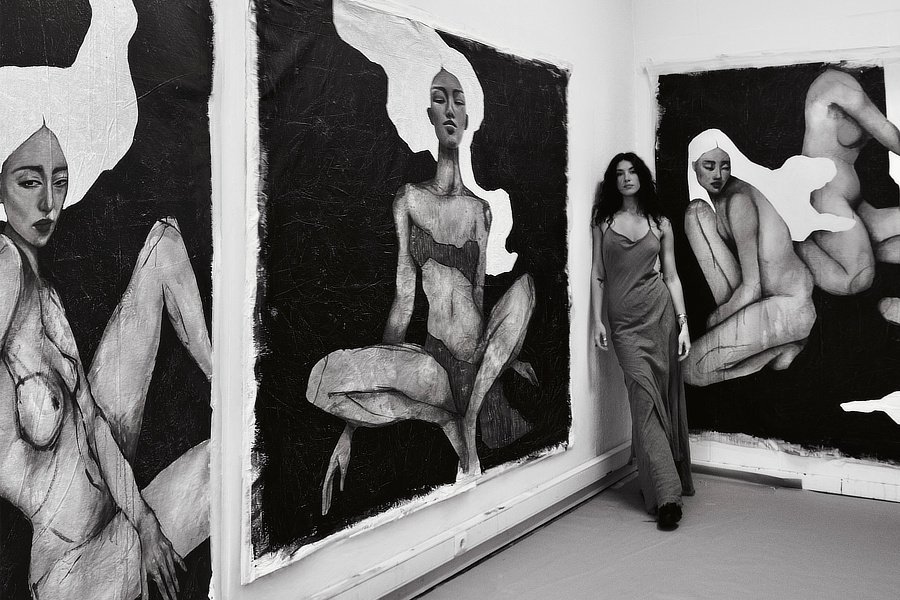
And as I changed internally, my paintings began changing too. I started experimenting a lot more with textures, fabrics, sand, raw surfaces and other materials, inspired by the idea of moving away from perfection. I think there’s something quite interesting about that, especially as a woman. I became more interested in the imperfect, the organic, the things that couldn’t be controlled. Scale and texture became really important in my work. I want people to experience my paintings physically in a room rather than only looking at an image of them. I invite people to touch my paintings, to get really close and to enter a dialogue with them.
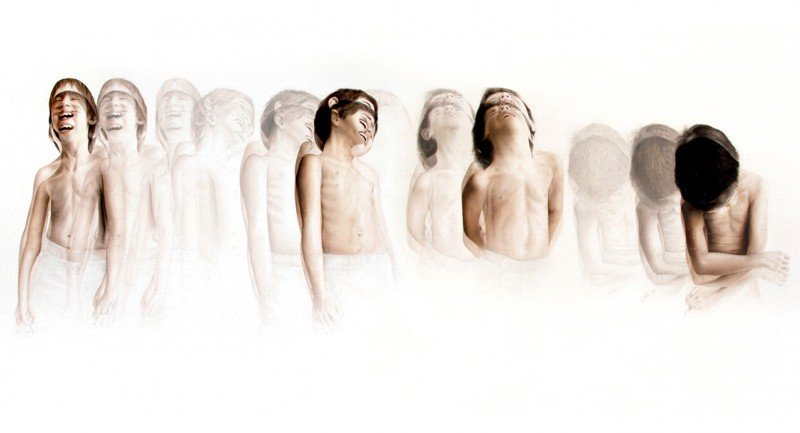
The experiences that go into my art are deeply personal, yet they’re also incredibly universal. And the question I keep asking myself within my work is: What does feminine strength actually feel like? This language manifests on the canvas through different forms. It can come through a full surrender to softness and vulnerability, through the strength of meeting oneself with true honesty and embracing all parts of oneself equally. It can show up as a woman emerging in power, lifting herself up, rising with a strong expression on her face. A woman showing her vulnerability can be just as strong as one standing tall and commanding attention. Strength can take many different forms. It can be loud, but it can also be a gentle feeling rising from the ground, filling a room and making you feel held.
Emaho: Your work grows out of long periods of inquiry and lived transformation, and you say inner states shape the form, the surface and the scale. When you’re in the middle of a hard stretch, do you paint your way through it, or do you have to wait until it’s over before anything usable comes out?
Jana Neumann: It’s definitely an interplay between the two. I’ve come to understand that both my creative process and my existence as a human being are very cyclical. I go through periods of withdrawal and deep introspection, which I need in order to step back out into the world and expand again. I like to compare it to breathing in and breathing out, making yourself smaller for a while in order to grow bigger again. Understanding this rhythm has helped me become more accepting of where I am at any given moment, rather than constantly trying to push myself into a different state.
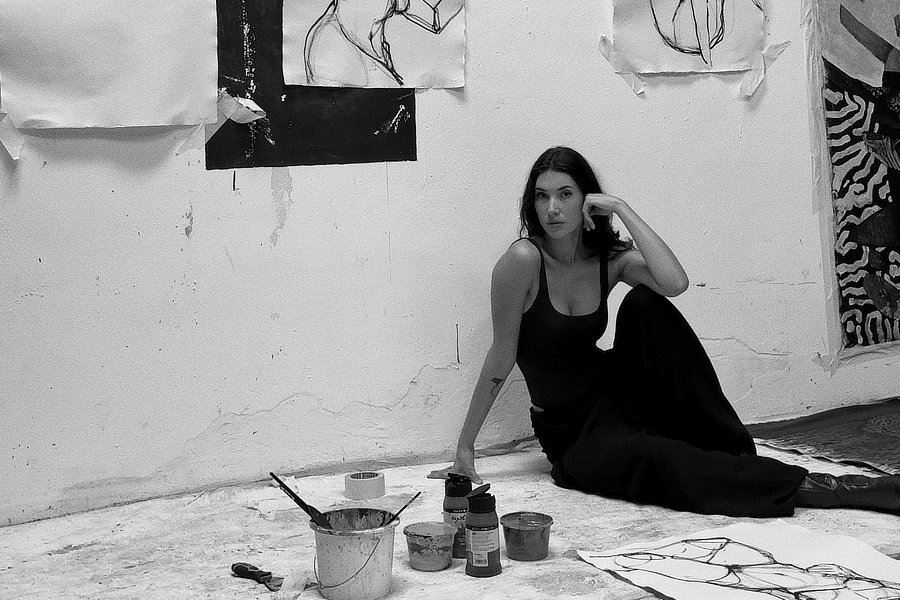
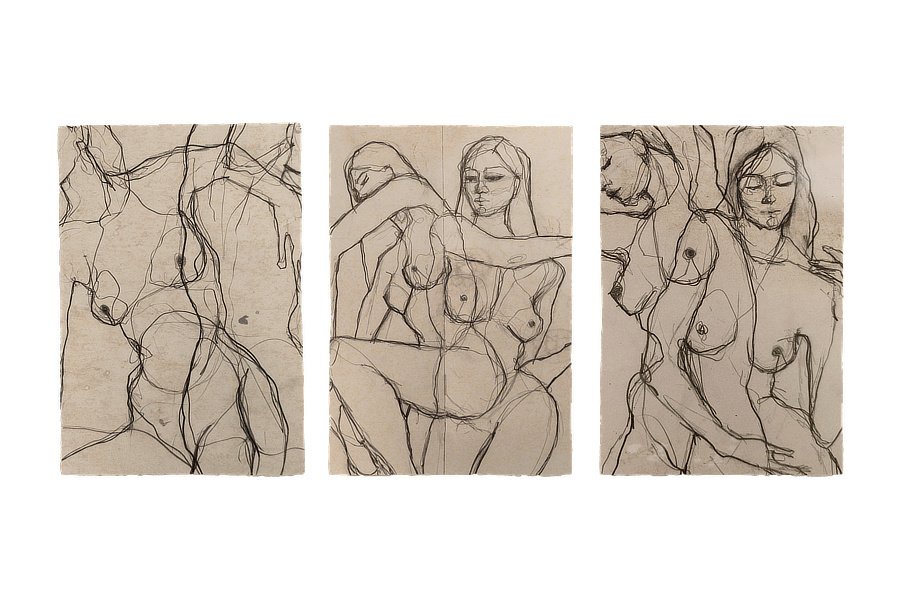
During these introspective periods, I usually start by writing and making small sketches. It’s a way of bringing my thoughts and ideas onto paper without them needing to become anything in particular. I collect shapes, colours and impressions, often quite subconsciously. It’s really just a stream of consciousness.
A little later in the process, the larger paintings begin to emerge. I often work on several large paintings simultaneously, creating a physical space filled with the figures I’m painting. These figures represent different parts of myself, different identities and aspects of who I am, and I can enter into a dialogue with them. Often, while I’m painting, I don’t fully understand what’s actually happening yet. I’m in a constant back-and-forth between my internal process and the act of painting. It’s usually only with some distance that I’m able to put the true context and meaning of the paintings into words. Finishing a body of work often coincides with a feeling of lightness within myself. So I do think painting truly helps me move through whatever is present for me at that moment. It’s both a reflection of my inner process and an active part of it.
Emaho: Your titles read almost like sentences spoken to yourself: Sit With Me, Change in Narrative, The Storm Is Loud, I Am Louder, Landscapes of the Mind. How do the titles arrive for you, and do you ever worry that a title says too much and takes something away from the painting?
Jana Neumann: I see the titles of my paintings more as poetic invitations rather than descriptions. It’s quite important to me not to give away too much, but to offer just enough information for viewers to form their own interpretations without limiting them.
Usually, while I’m in the process of creating, certain words or fragments of sentences appear. Some of them come from notes I’ve written at the beginning of the creative process, but the final title usually emerges after the painting is finished, once I understand its meaning more clearly.
I generally prefer to keep the titles on an abstract or metaphorical level. I love leaving space for people to discover their own meaning, even though their interpretations are often surprisingly close to my original intention.
Emaho: Reflections on Self, from 2025, is described as born out of a season of introspection, shedding and rawness, and a desire to find truth. If you’re comfortable sharing, what did that season look like in the studio day to day, and did the paintings visibly change as you went through it?
Jana Neumann: At the time, I had just spent around a year and a half living in Ibiza and made the decision to leave the island, at least for the time being.
I spent the following autumn and winter months in Lisbon, working practically every day in my studio from morning until evening. It was a deeply introspective and transformative period, centred around self-worth, limiting beliefs, vulnerability and releasing old identities. I was doing a lot of inner work, confronting hidden parts of myself and questioning old narratives and beliefs. When I enter that kind of studio flow, I tend to go all in. The studio becomes almost my entire world for a while, and I allow myself to become completely immersed in the process.
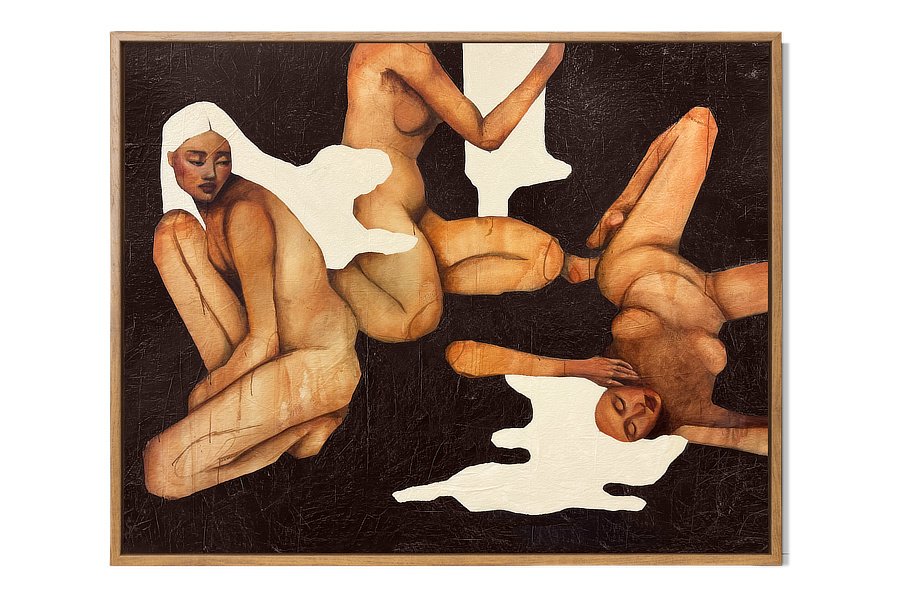
For the first time, I felt I was creating a cohesive body of work that genuinely reflected what was happening within me. Interestingly, the paintings followed my internal transformation. Reflections on Self and The Listening Room carry a very different energy from Activated, as they were created at different stages of my process. The first two explore vulnerability and self-encounter, different identities and the process of accepting or releasing parts of oneself, whereas Activated, which came later, carries a more powerful, activated energy. I worked extensively on raw canvas, incorporating sand, building up layered textures and scratching into the surfaces. I created a lot of texture by practically living with these paintings.
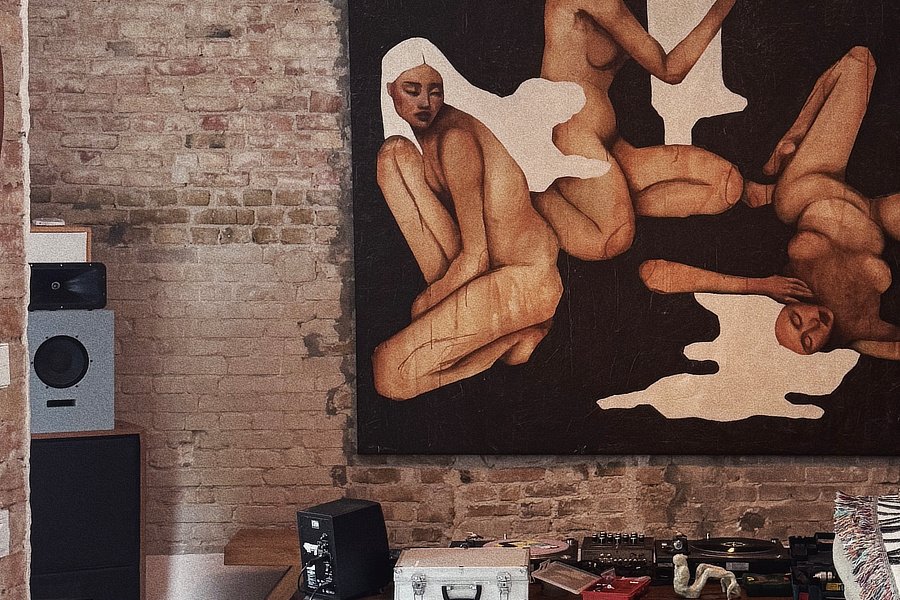
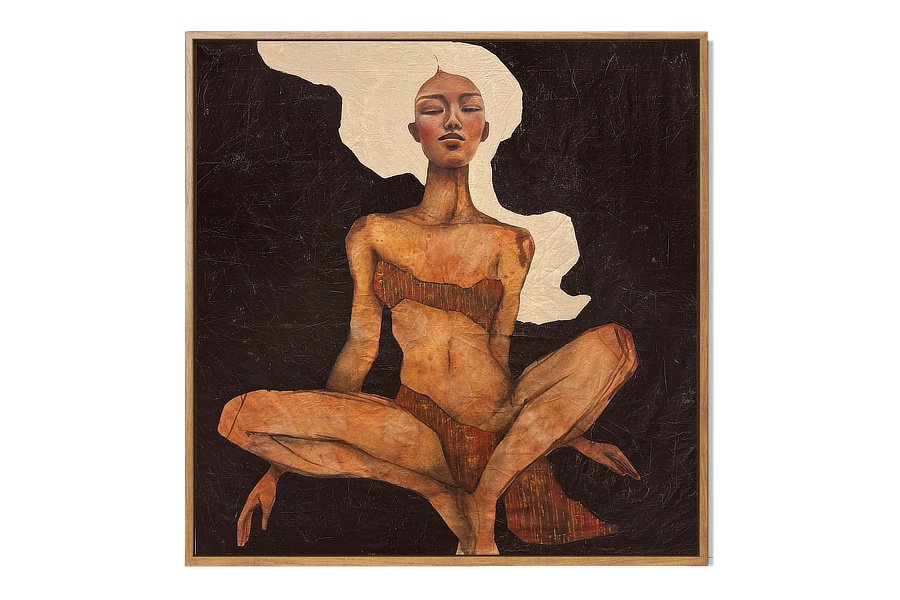
Emaho: The Listening Room, also from 2025, is a square canvas nearly two metres on each side. You describe it as a space for different parts of yourself to come together and be seen. What does it physically feel like to paint at that scale, and does a canvas that big change how honest you can be?
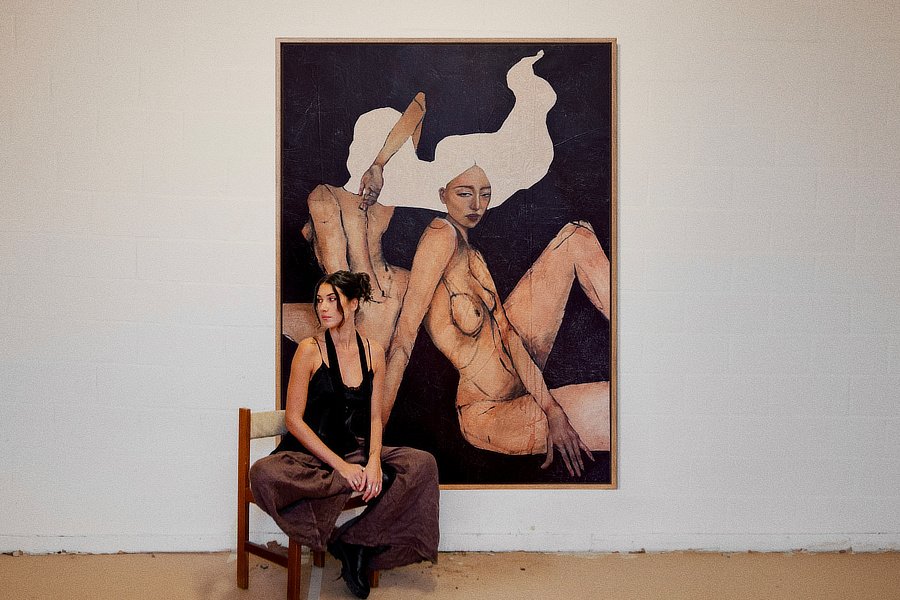
Jana Neumann: I’ve always loved painting big. It’s always felt like the most natural way for me to work. What I love about it most is that I get to meet the figures in my paintings at life size, which I find incredibly exciting. They come from small sketchbooks, and all of a sudden I get to experience them within a physical space, as big as I am.
I also appreciate the fact that I get to move my body when I paint big. Movement is very important to me, and finding myself in a space surrounded by several large paintings of mine just excites me so much. I get to move around, I get to dance, and my work becomes very physical. Working at this scale allows me to be a lot more expressive, to spill paint, to use my whole body, my hands, my arms, and really create through big, expressive movements. I do think that the bigger my paintings are, the more honest I get to be within them. Once that feeling of vulnerability manifests on such a large canvas, it becomes immediately tangible in the space. It’s a level of vulnerability that you cannot escape because the figures have such a strong presence.
The Listening Room was exhibited at ikii Berlin last June, a beautiful listening bar with a really lovely energy, where people come together to listen to music, drink tea or natural wine and spend time together. I really loved how the scale of that painting created such a calm presence within the space, which many visitors also mentioned to me. For me, there is something so beautiful and honest in showing vulnerability and rawness. I do think we live in some sort of epidemic of nonchalance, where the prevailing ideal seems to be one of effortless detachment. I find myself yearning for more people to openly express their sensitivity and vulnerability. To me, true power lies in the ability to embrace and integrate our own sensitivity and vulnerability. These are the very things that make us human, and I wish we gave them more space.
Emaho: You’ve been developing a new body of work during extended studio periods in Ibiza, Lisbon and Mexico City, with a focus on natural materials and texture. What does each of those places give you that your usual studio doesn’t, and are there materials in the new paintings that you could only have found in one of them?
Jana Neumann: Traveling and exposing myself to different cultures and ways of living have always been essential to who I am, not only as an artist but also as a person. New experiences and environments create new perspectives and help me stay curious and inspired, and keep returning to that field of play. Different places can bring out different parts of my identity, which then naturally find their way into my work.
Ibiza has always felt like home to me, ever since I was a little child. I spent a big part of my childhood there, and the island has an incredibly grounding energy. The countryside, the sea, the sunlight, the people and their way of interacting with the world have always inspired me deeply. A series I developed there was influenced by the strata of the rocks surrounding one of my favourite spots, a small cove where I went swimming almost every day. Different places create different frameworks for me. In Lisbon, I had a wonderful studio and the opportunity to really immerse myself in my work during that time.
Mexico has always been incredibly inspiring to me, but in a very different way. I’m drawn to the intensity and contrasts of the place, but equally to the earthy textures and natural materials I’ve encountered there. When I was painting in Tepoztlán, for example, I incorporated actual earth from the land into my paintings. I also love the contrast of moving between the city and the countryside. They speak to very different sides of who I am, and I find both equally inspiring. While travelling, I don’t always have access to a fully equipped studio, which has forced me to improvise and work within certain limitations. This has definitely shaped my creative process, sometimes leading me to experiment with materials and techniques I might not have considered otherwise. I’m increasingly drawn to the idea of bringing elements of a place into my work, especially through natural materials. Now that I’ve moved back to Berlin, I’m very curious to see where the energy of this city will take me creatively and how it will influence my work.
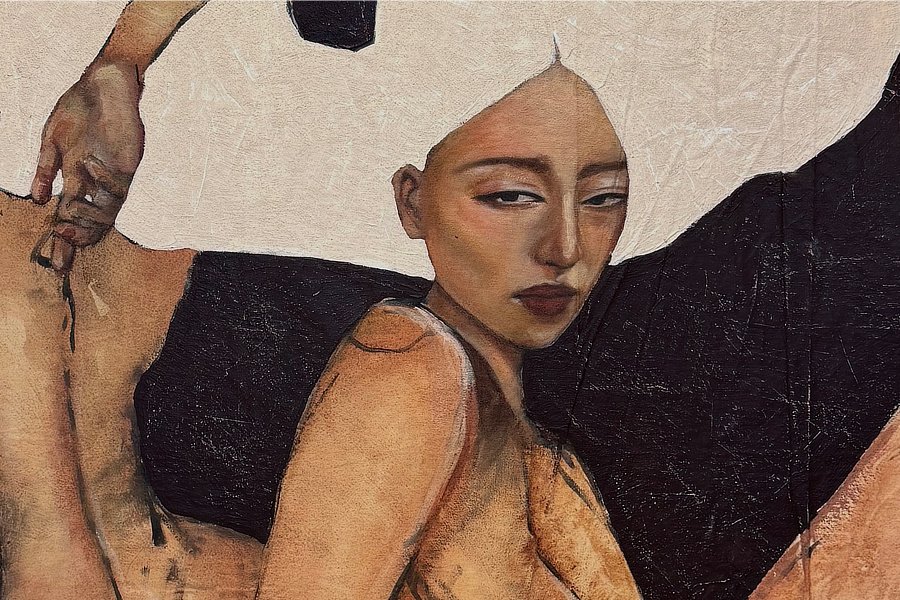
Emaho: Your paintings sit somewhere between the figure and abstraction. Your site talks about being face to face with self and other, but the forms can also feel like fragments of memory. When you start a painting, do you know if it’s going to be a figure, or does that only show up while you’re painting?
Jana Neumann: My practice has always been rooted in figurative painting. When I was a little child, I would often draw stories about girls or women that, interestingly, almost always involved some sort of transformation. Usually, it was a girl living an ordinary life who would suddenly transform into a mermaid, a princess, or another version of herself. I find it fascinating how those early stories were already exploring similar themes that are present in my work today.
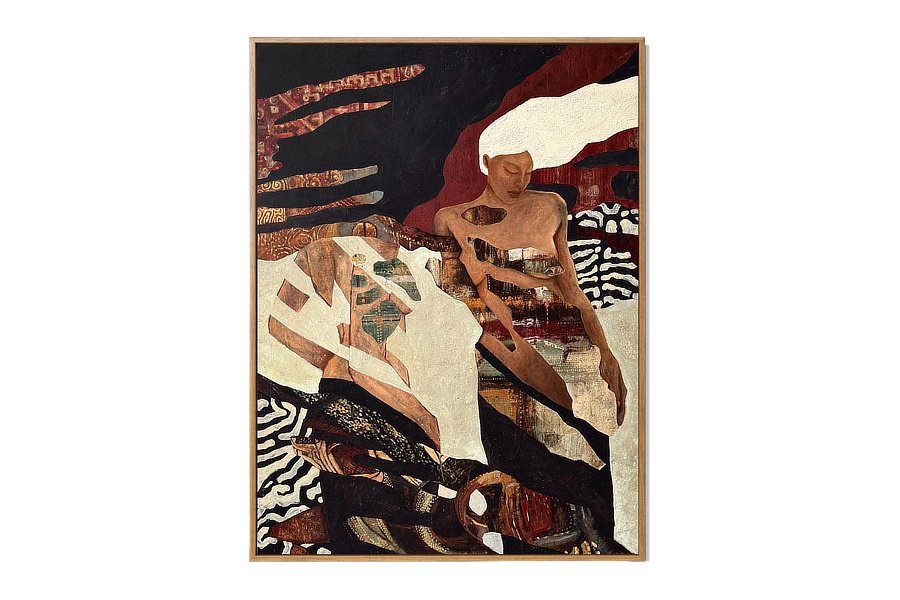
I love the play between abstraction and figuration, as the abstract elements often create an emotional landscape around the figures I’m showing. Sometimes, though, I deliberately leave the space around them completely blank to create a certain sense of emptiness or nakedness, speaking to their vulnerability. A lot of my figures first appear as small sketches in my sketchbooks. They can be inspired by photographs of friends, myself, or just fragments of things I find along the way. Sometimes an idea comes to me in a sudden flash, often right before I fall asleep or in the most unexpected moments. I usually just scribble it into a little sketchbook before it disappears.
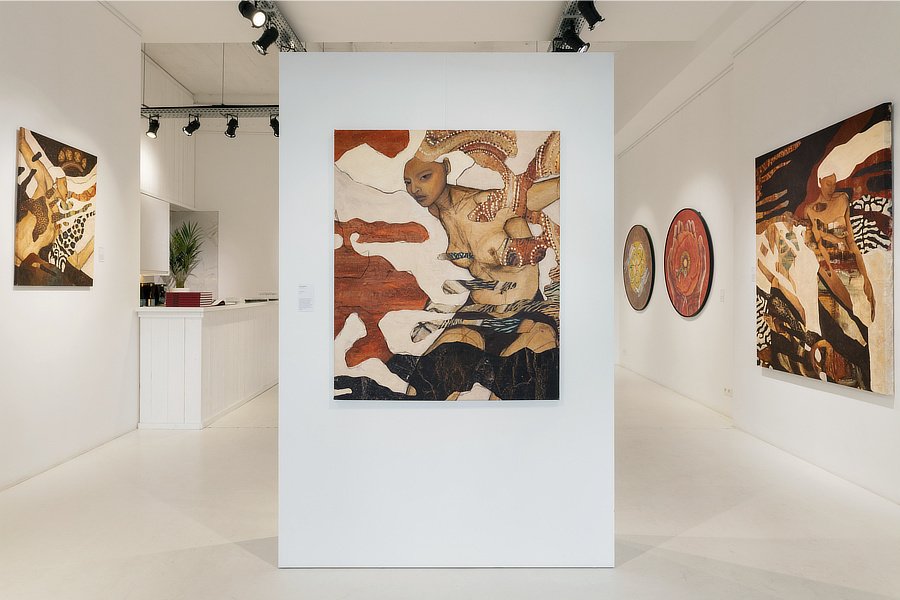
Before I start a large painting, there’s a process of distilling the figure and her energy. I usually do this with charcoal, pencil or ink, working in black and white on paper. Through repeatedly exploring and refining the idea, the energy of the figure starts to emerge, and I begin to understand what kind of energy I want her to carry in the larger work. At that point, I still don’t know the details or what her face will look like. Those things usually emerge while I’m painting. I recently created a new body of work for a show in Antwerp, where I explored the concept of emotional landscapes even further. I had been collecting fragments from different places – textures, patterns, old rugs, ceramics and little things that inspired me – and began incorporating these elements into my new paintings.
Emaho: Your work has been commissioned by private collectors and shown internationally, including at Galerie Benjamin Eck in Munich. Work this personal is hard to commission. How do you keep a commission honest, and is there something you’re quietly working toward that no one has asked you to make yet?
Jana Neumann: I’ve only accepted a small number of commissions, as I’ve sometimes found them creatively challenging. My practice needs a certain level of freedom to develop in unexpected directions. I usually have an initial vision, but the painting almost always develops its own direction. I find that really beautiful, and it’s something I want to preserve in my work.
Commissions can sometimes bring back the client feedback loops I experienced during my graphic design career, which can feel quite restrictive in my fine art practice. I love the idea of someone discovering an existing painting of mine and connecting with something that emerged entirely from my own world. I still feel like I’m very much at the beginning of my artistic journey. As I continue to grow as a person, my art will grow with me, and I really want to embrace that evolution.
Living in a time when so much visual content can be generated by AI has only intensified my desire to get my hands dirty and experiment further with natural dyes and pigments, textiles, sewing, colour and unconventional materials. I’m curious to see how my work might eventually move beyond the canvas into something more immersive. I want my art to be felt and received as something that was made by a human and shaped by human hands, created from a place of authenticity and experimentation. I’m also becoming more fascinated by the ritualistic potential of art, both in the process of making it and in the spaces it can create. How can a work of art open up a space for conversation, connection and shared experience? The older I get, the more I realise how much there still is to learn and discover and I want to stay curious and open to all the forms of expression I can’t yet imagine.
Photos © Jana Neumann