Emaho: You are a self-taught artist, creative since childhood, who moved in and out of various artistic expressions throughout your late teenage years and early adulthood, exploring installation, sculpture, digital work and illustration before solidifying a more formal, regular painting practice in which you now work full time. That is a long and exploratory runway before committing to the canvas. Most artists describe that period of moving between forms as frustrating in retrospect. looking back, do you think those years of not settling were necessary, or do you think you could have arrived at painting earlier if something had pushed you there sooner?
Holly Terry: It’s been a while since I have reflected on this time as a solid foundation for building my practice! While I was finishing my VCE and entering early adulthood, my work centred around my deep interest and commentary on global politics. At that time, prior to the rise of Instagram and social media at large, it was drilled into me that finding paid work as an ‘artist’ was an incredibly difficult thing to do. In retrospect, my teachers were right in saying this. The type of work I was making would have lent itself to public art spaces or galleries with more of a political slant. Because of this belief I diverted from the arts and went on to study politics at university, not Fine Arts. It wasn’t until I entered the workforce and felt myself burning out that I discovered a painting practice for the first time. So no, I don’t find this period of exploration frustrating at all. In some ways it feels like a different part of my practice entirely, very conceptual and provoking. Not that my work isn’t now, my message is just entirely different.
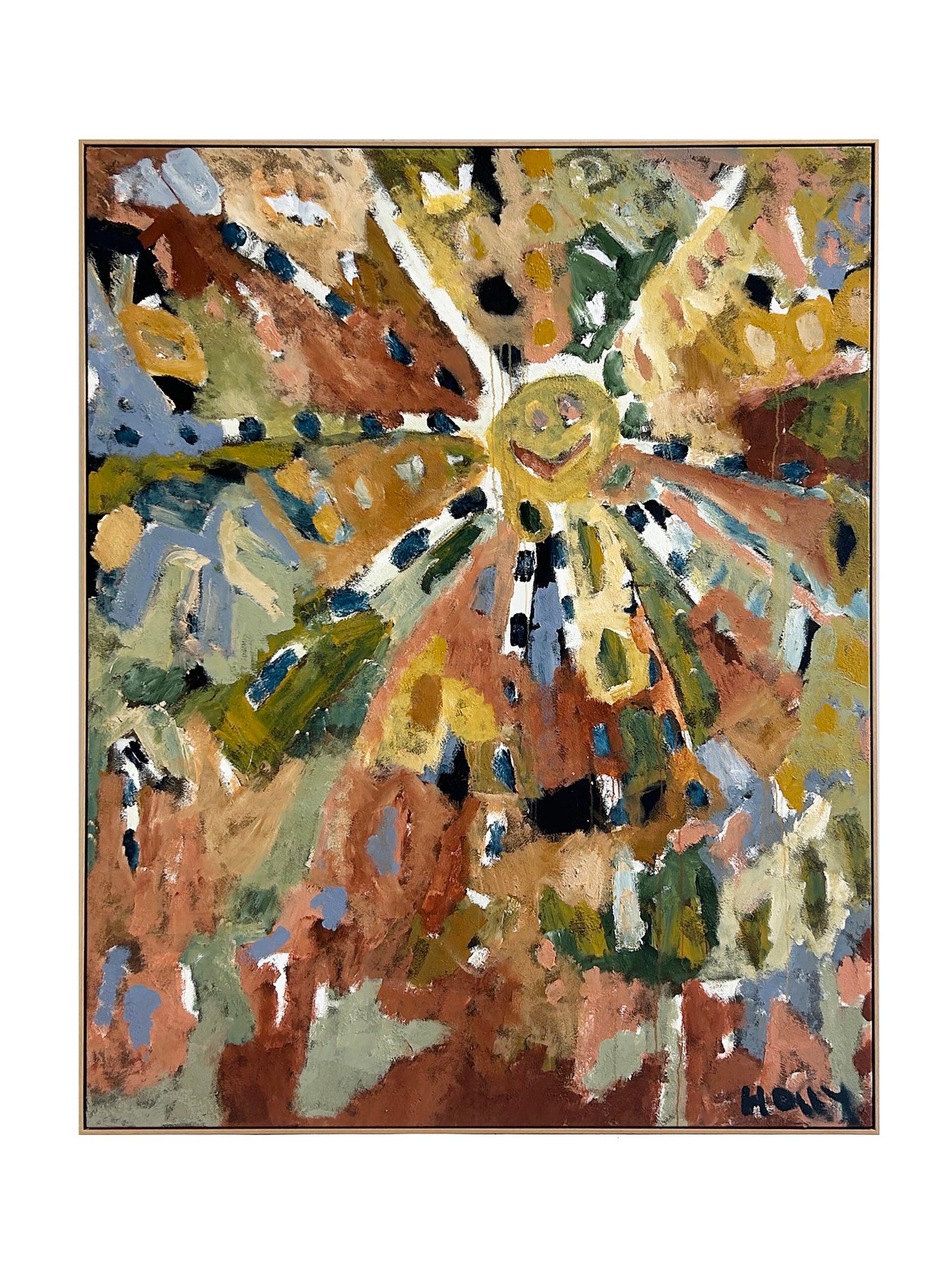
Emaho: Your practice resists traditional narrative frameworks, instead operating as an intuitive visual language through which you explore the notion of energetic exchange. Drawing loosely from the rhythms and nuances of everyday life, your work seeks to uncover moments of playfulness, lightness and subtle contradiction, often emerging through slogans and repetitive motifs which function as visual anchors and fragments of meaning within your compositions. Slogans inside an abstract painting are a very deliberate and somewhat unusual formal choice. They are language inside a practice that resists narrative. What do slogans do for the work that pure abstraction alone cannot, and where do those phrases come from?
Holly Terry: When I speak of traditional narrative, I’m not speaking of narrative entirely. My works certainly have a narrative, otherwise they would be purely decoration. What I mean by resisting traditional narrative is the heavy and unrelatable ‘arts’ jargon that so often comes with art critique and statements. My goal is for my works to feel relatable and accessible when it comes to meaning and understanding. I spend my life deeply thinking, critiquing and conversing, so in a way, my practice is an avenue to create lightness where things feel heavy, a space to bring play into places we sometimes forget to. The slogans and motifs act as a tool for the starting point of abstraction, an anchor which allows me to create and develop ideas around the works. My paintings observe the everyday, relatable moments, and I’m particularly interested in poking fun at the idiosyncrasies of human nature. This is usually where the motifs and slogans come from, something I’ve witnessed or a phrase I’ve heard and pondered on. Often times, they will end up being the titles, or the mood that develops the title or body of work. That being said, this idea of traditional narrative, like all things is ever-evolving. As my practice continues, the depth of conversation between myself, the material and the works themselves is developing and increasing. I find the further I go into my painting practice, the louder and more confident I am with my voice and what it is I have to say.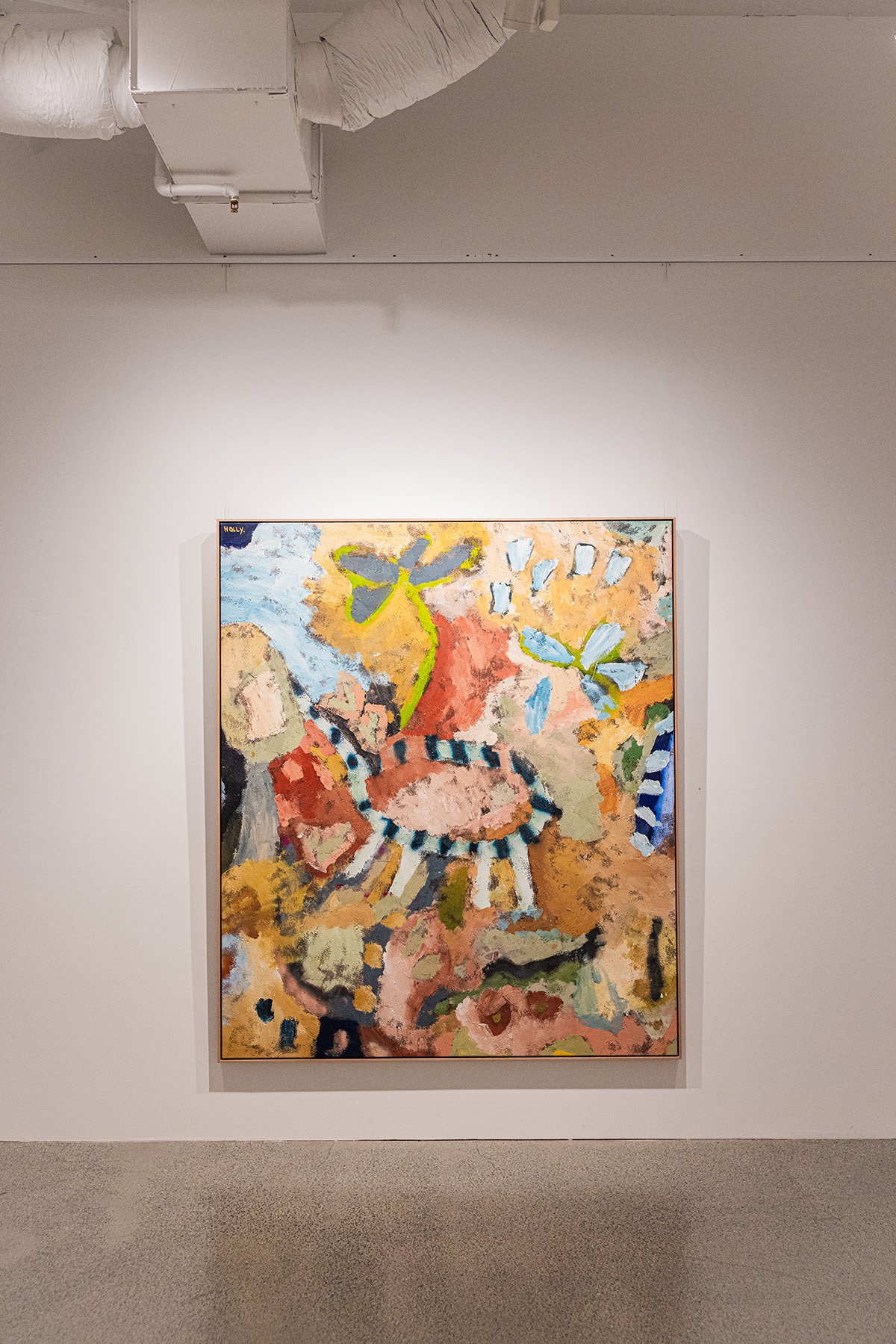
Emaho:You have two studios on the Sunshine Coast, one at home for when you need quiet time and a shared space with lots of creative people, and you have said the life of a painter can sometimes be lonely and the shared space is essential to fill your cup and get out of your own head. Most painters describe the studio as the place they most want to be alone. You seem to need both registers simultaneously. How do you know which kind of studio day you are having before you walk in, and what does each one produce that the other cannot?
Holly Terry: Yes, I am very fortunate to have two studios, and both have very different functions. I think I would go mad if I spent every day alone! When we built the home studio, my long term goal was to slowly transition out of the shared space and into the home space permanently, however, my works are evolving and becoming very big! They no longer fit in my home space entirely. I love the social aspect of the shared space, too. Surrounding yourself with other creatives is hugely important and very advantageous. Not only do you have others to bounce off when things feel uncertain, the energy of what each person is doing is infectious. I really find that we build each other up in such a beautiful way. At the moment, the dividing of time is purely logistical. If I am working on large scale works, they are all stored at the shared space, while the smaller pieces (although still big, haha) are at home.
Emaho:Artists Kate Florence and Rosie Woods are two huge inspirations for you, dear friends who you shared a studio with for the first four years of your career. The first four years of an artist’s practice, before critical recognition or commercial success, are often the most formative and the most fragile. What did sharing that specific period of uncertainty with two other artists give you that making it alone would not have, and is there something about your work now that you can trace directly back to those four years in that shared studio?
Holly Terry: The confidence and courage to go for things that I wanted. Those four years were so important in my development as an artist and also a person at large. Rosie and Kate are two absolute power houses and have developed a very clear language and position within the industry. They also are incredible at paving their own way. Being surrounded by each other every day created an significant energetic momentum that I don’t think would have existed had I been alone. I’ll forever be grateful for those years.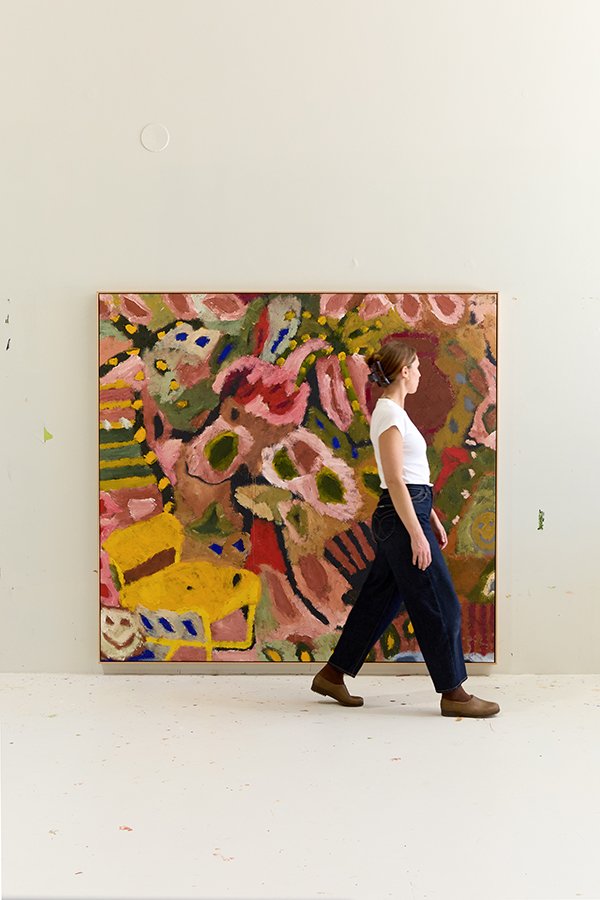
Emaho:Your debut solo exhibition The Awakening opened at Saint Cloche in Sydney in 2022, followed by While I Wait at Fenton and Fenton in Melbourne in the same year, and Between Moments supported by Hunter and Folk at HAKE House of Art in Sydney in 2003. Three solo shows in two years is an unusually fast pace for a painter still in the early stages of their career. What did each of those titles, The Awakening, While I Wait and Between Moments, reveal about where you were in your own life and practice at the moment you made that work, and do you see them now as chapters of a single continuous investigation?
Holly Terry: Yes, looking back, this was an incredibly rapid pace to be exhibiting at such an early point in my career. I will never believe in ‘mistakes’, as I do think things happen for a reason, however, this pace did not allow me to spend time developing my style and my voice as a painter. It wasn’t long after this that I experienced quite severe burnout and made a drastic shift away from what I was painting at the time.
My works are deeply personal and reflective of my understanding of life and internal landscape at any given time. During those years, as a person, I was far less confident about life itself but particularly my place within the art world, so early in my career. The titles and works are reflective of this learning and development and were created during a time I was establishing an identity, a visual narrative and understanding about who I am and what I have to say. While the works feel quite separate to how I paint now, both in energy and meaning, they were certainly a result of continuous exploration and growth. Without these works, I wouldn’t be where I am today.
Emaho: In 2024 your work was included in the Queensland Regional Art Awards Emerging Artist Award Exhibition in Brisbane, you showed in the Summer Group Show at Galleri Christoffer Egelund in Copenhagen and in July 2025 you participated in Unbound Terrain, a group show at Galerie Ground in Los Angeles. That is a genuinely international reach for a painter based on the Sunshine Coast. How does your work travel across those very different contexts and audiences, and is there something about the way your paintings are received in Los Angeles or Copenhagen that surprises you or that you did not anticipate when you were making the work in Queensland?
Holly Terry: I am always so excited about an international acquisition or gallery partnership, and I believe the way we consume content online dissolves any disconnect between creator and audience that is caused by location. Four years ago, I never would have dreamed to be sending works across the world. I can’t say for certain how and why my work seems to appeal to different audiences and contexts, but I hope that it’s due to my efforts to create works which are relatable and feel curious rather than certain in their language. I really believe that the world needs more play, more light, and I think that is felt by the population as a whole, no matter the location.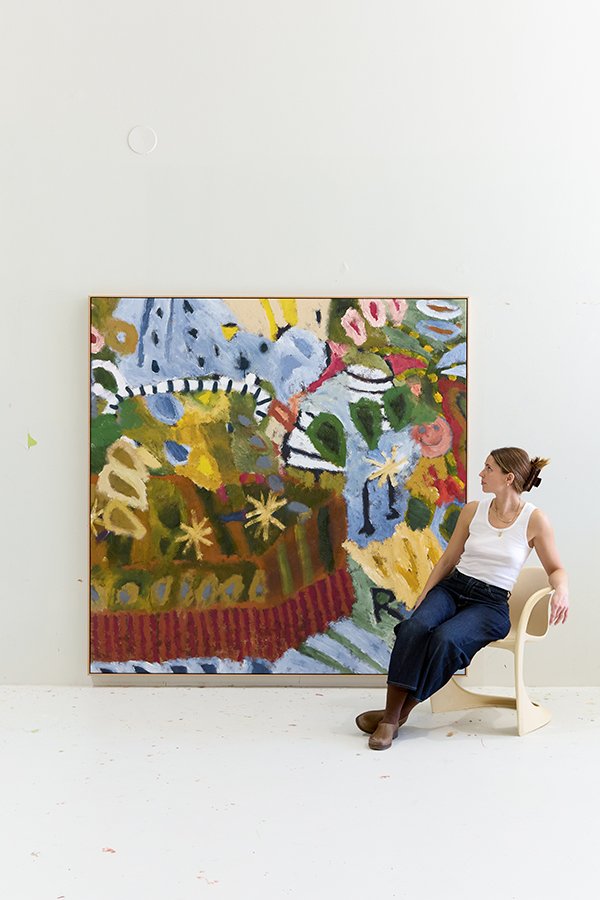
Emaho:Your large-scale abstract works are inspired by your journey through life and learning how to live with contentment. Contentment is an unusual and interesting primary subject for a painter, a state that most art historically has treated as the enemy of creativity rather than its source. What drew you to contentment as a subject rather than its more dramatically photographable neighbours, conflict, longing or transformation, and do you think a painting about contentment asks something different of the viewer than a painting about suffering does?
Holly Terry: I have never really thought about the theme of contentment and it’s juxtaposition with most artistic themes. My fascination with contentment began with my studies of yoga (I used to be a yoga teacher). As a person, I have deep rooted tendencies towards perfection and achievement, so I view contentment as a real goal and something I am continuously working towards. That being said, as I get older and more comfortable with who I am, my work is evolving in a way that lends itself to themes that are more relatable, or ‘it is what it is’ in nature. I am becoming more interested in themes which are part of human nature and that includes ideas like suffering, conflict and longing. In this way, my work is becoming a little bolder, louder and there is a clear tension developing within my visual language. If you view my works in sequential order, you’ll see the narrative evolving in this way.
Emaho: You are also an art and design writer. Writing about other people’s art and making your own are two very different relationships to the creative act, one analytical and one generative, and most practitioners of both describe a productive tension between them. Has writing about art changed how you make it, and is there a piece of writing you have done about another artist’s work that you think directly altered the direction of your own painting practice?
Holly Terry: I haven’t written about other people’s art in a few years, but still love writing and have transitioned this practice into my own forum on Substack, titled ‘Order Of Art’. This is for no other reason than time limitations, and is something I’d love to return to one day, time permitting. At the time, writing about others work didn’t directly alter the way I made art, but it did act as a point of internal discussion about the way I view my work and my relationship with it. It also was a great way to connect with other artists and establish relationships within the art world. Something that I believe is critical regardless of location, however, more so as I live in a relatively ‘rural’ area.
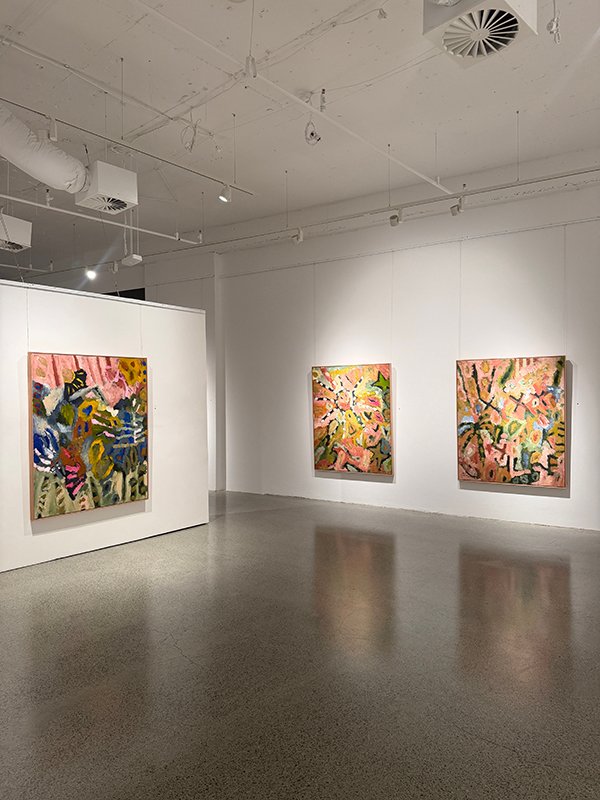
Emaho:You had a solo show at Wentworth Galleries in Sydney in May 2026, following your April 2025 solo there. Returning to the same gallery within a year with new work is a statement about pace and about the relationship between you and that specific audience. What did the 2026 show need to say that the 2025 show did not, and is there a body of work you are currently building toward that feels like the most honest thing you have made so far?
Holly Terry: These days I try to exhibit once a year, so I don’t think my 2026 show was an extension of the 2025 show, or provided context where the previous one did not. I always have a lot to day! My style of working is very honest in practice, and is typically made quite rapidly. When making works, I try to make sure I spend time absorbing life, enough so to give me context for the next body of works. The actual making is quicker than you would think, and this is very intentional to ensure the works are relatable and contextually clear. Overworking is the number one killer of my works.
Emaho: You describe your work as an energetic and visual representative of your internal landscape, exploring the depths and layers of the human experience and what it is to exist within this physical and spiritual life. The Sunshine Coast is a long way from the centres of the contemporary art world in Sydney, Melbourne, New York or London, and you have built a practice of genuine international reach from that specific geography. What does living and working on Kabi Kabi land give your practice that you do not think you could find in any of those larger cities, and is there anything you have had to build for yourself precisely because of the distance?
Holly Terry: Sometimes I do worry about being geographically too far away from artistic hubs like New York or London, however, I’ve lived in the city for much of my life prior to moving to the Sunshine Coast, and I don’t think I’m built for it. As I mentioned above, I think the way information is shared online does most of the legwork when it comes to closing the gaps between art hubs and more rural artists, however, I have made more of an effort this year to visit cities to view artworks and take in more inspiration. This year I visited Paris for the first time since I was a child, and now it is a major goal of mine to exhibit there one day.