Emaho: Your work grows from countless hand-sewn fabric elements into large, interconnected forms. You’ve described your process as “the sum of repeated gestures.” How does repetition shape not just the work’s structure, but its meaning for you?
Serena: Repetition is essential to my process because, for me, it functions as an active form of meditation. Repetitive actions bring me into a state that goes beyond mere productivity; it becomes a way of inhabiting the present and working with time itself.
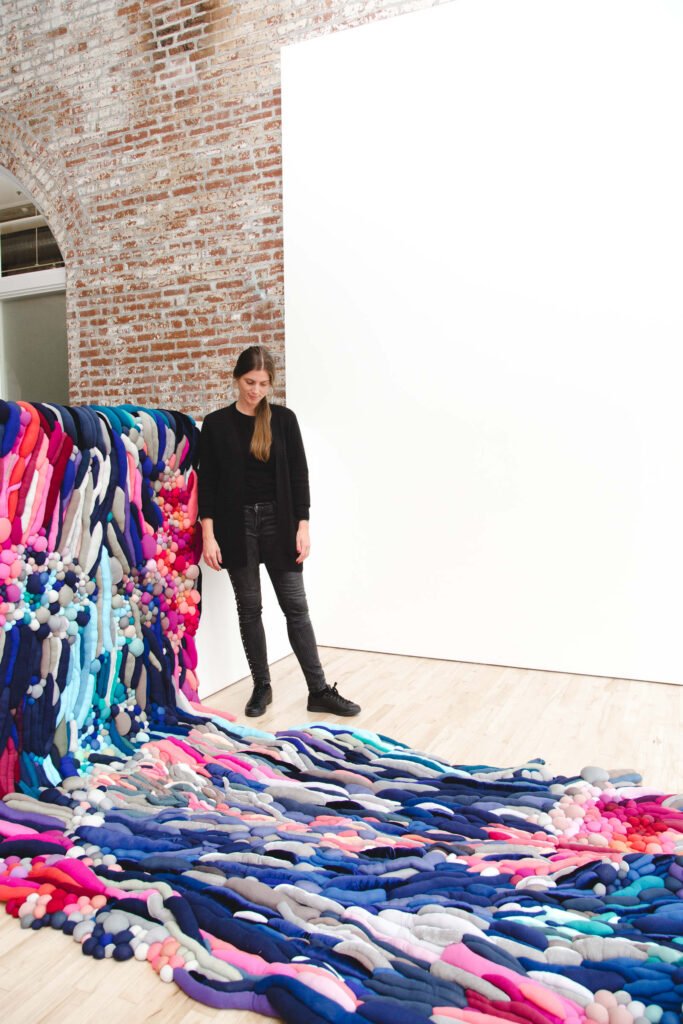
Emaho: The work 10.237 was created for Front of House Gallery and references the 10,237-kilometre distance between Santiago and Portland. How does geography – distance, travel, place – enter the emotional logic of your work?
Serena: For this piece, I wanted to work with the idea of the Pacific Ocean, which I saw as a shared element between these two places. Bringing my work to an unfamiliar and distant context felt like a challenge, so I began thinking about the sea as a vast fluid body in constant motion, filled with living organisms — a connective force linking my city to its destination.
I developed the work through these ideas, both in terms of color and form, and perhaps also as a kind of emotional anchoring.
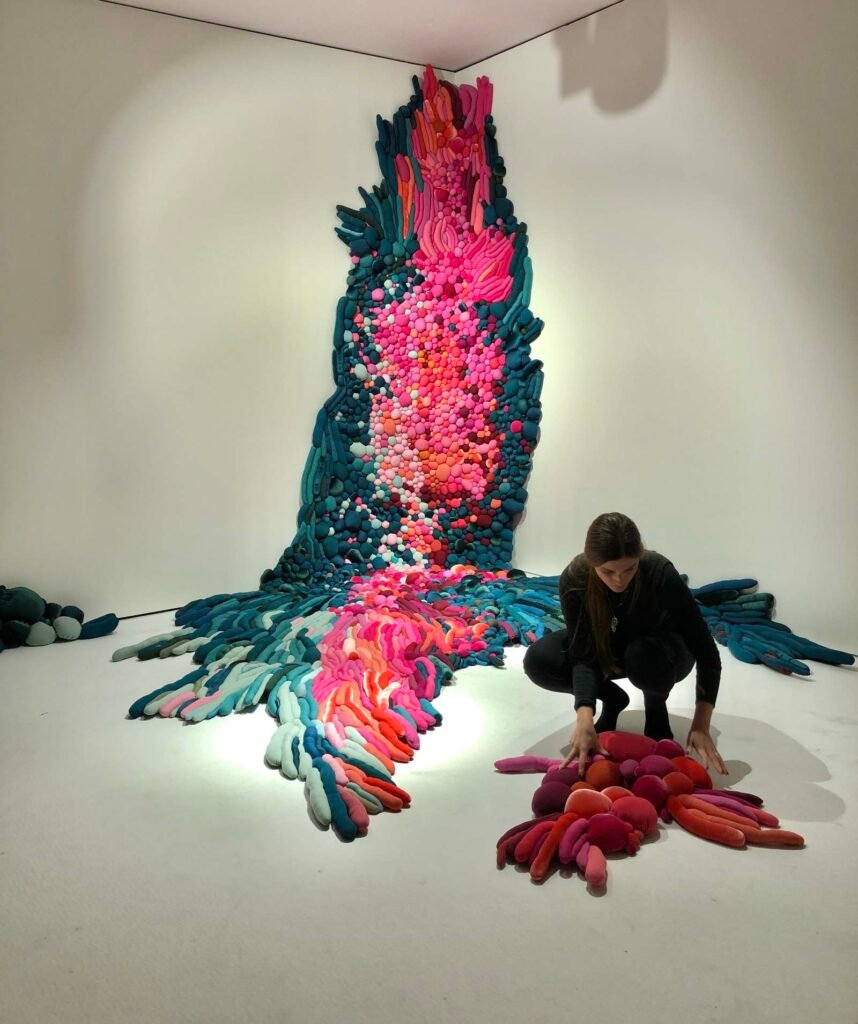
Emaho: Your pieces often read like ecosystems rather than objects. When you begin a new project, are you imagining a form, or discovering it through the process itself?
Serena: I have worked in both ways, but I am usually inclined to work instinctively — without planning, allowing the materials and colors to guide me.
I work with organic forms and concepts, and I like the work itself to grow in that same way. I establish a few rules before beginning, but I prefer for the piece to reveal itself gradually, even to surprise me.
Emaho: Fabric and thread are materials with rich cultural and historical associations. How do you think about the materiality of your work – not just its look, but its history and tactility?
Serena: I am interested in transforming simple, everyday materials — proposing something new from something deeply familiar and “approachable,” as textiles tend to be.
I am also aware that historically sewing has been women’s work. I am interested in honoring that past, in reclaiming and recontextualizing textile practice in order to elevate it.
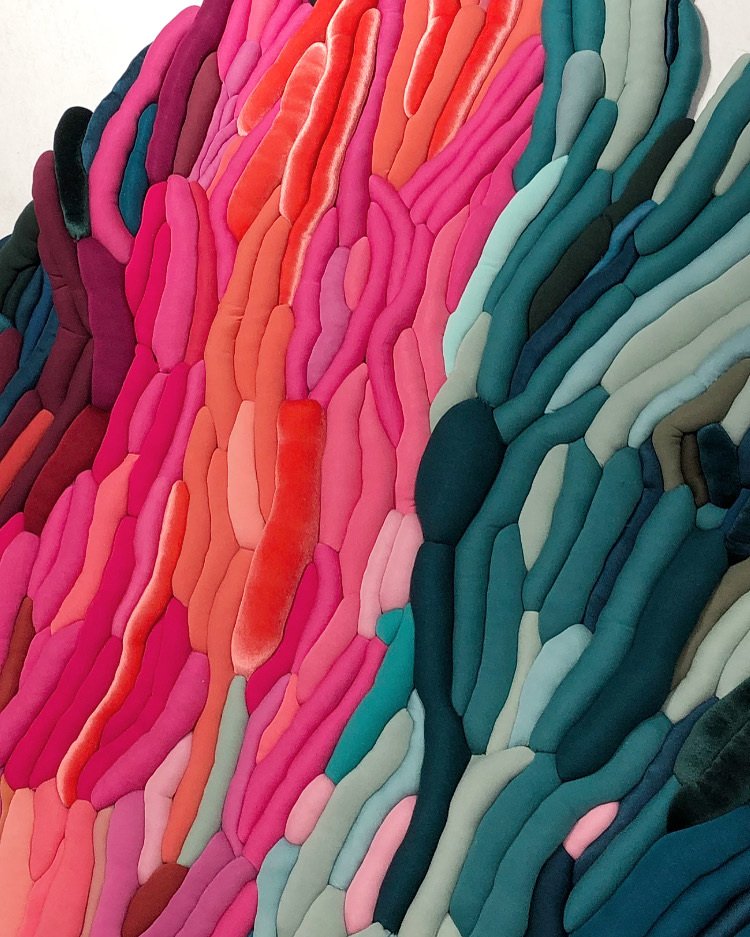
Emaho: Many artists talk about concept before medium – your work feels the opposite: medium leads to meaning. How does working from material first change the way an idea becomes an artwork?
Serena: It’s true — I begin with the material. But after working this way for so long, I feel that this technique has become a concept or language in itself.
Regardless of the medium, what interests me is starting from something simple — small individual units — and transforming them into complex systems.
Emaho: Your larger installations invite the viewer into space, not just before it. What do you hope audiences feel or discover when they encounter your work in an architectural setting?
Serena: I am drawn to the contrast between architecture — with its straight lines and minimalist spaces — and my work, which embodies abundance, color, texture, and irregularity.
I hope the viewer feels surprised, perhaps even a sense of wonder, through the sensory experience of color and in discovering that the work is entirely handmade.
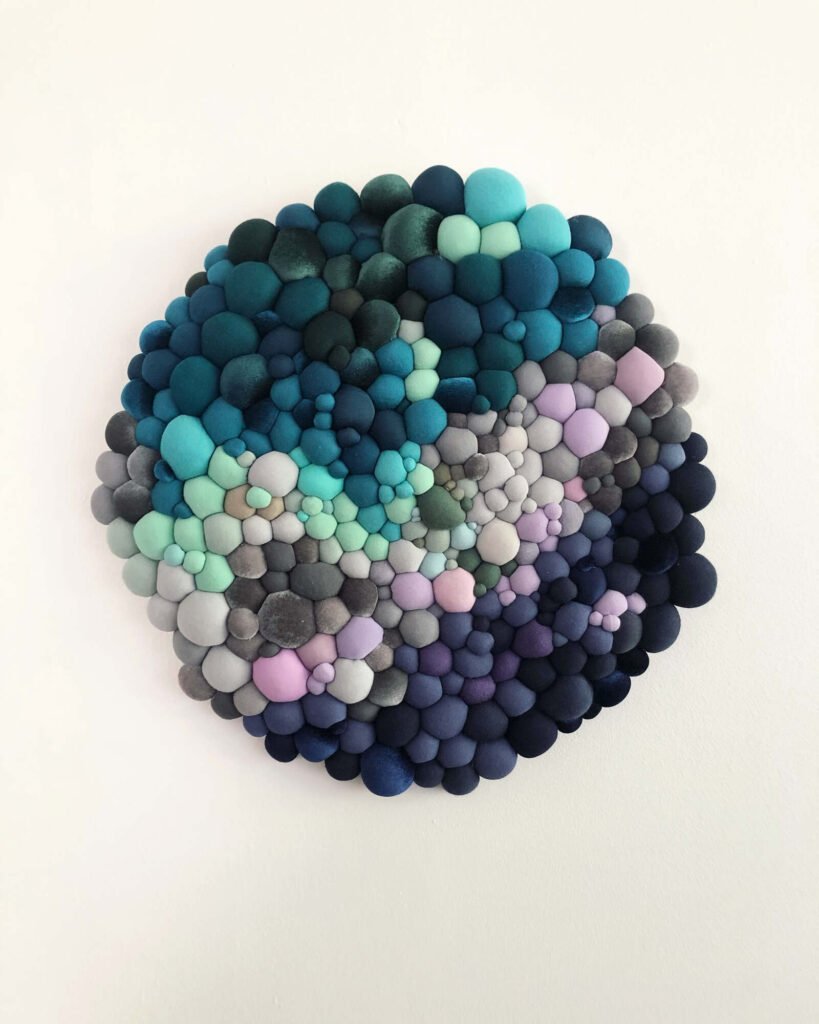
Emaho: Elements of your practice resonate with nature – growth, systems, interconnection. Do you see your work as responding to ecological logic, emotional logic, or both?
Serena: I believe it is both. The reference to nature is, in some ways, an excuse — or a strategy — to make visible emotional elements that have no fixed form.
There is also something of my inner world that I can only express in this way: sensations, colors, patterns. Things I cannot fully explain, but that I observe in nature and feel resonating within me — and that I feel compelled to recreate.
Emaho: You’ve worked across continents and contexts. As your work travels, does its meaning transform depending on the place where it is shown?
Serena: I believe it does transform. It moves me deeply to bring my work to different places; it is always a challenge. Meaning inevitably shifts — whether because of the site itself or the personal context of each viewer.
As artists, we cannot control that. We can only be honest in our proposals and then receive that feedback as something valuable. In truth, not even we fully know the meaning of what we create. For me, art does not offer definitive answers, but propositions.