Nina Pappa: Timed Gazings

Nina Pappa Born in Athens, Greece. Her work mainly refers to the tracking of time, to the human voice and to handwriting. Usually her work combines documentary features such as interviews, or recordings of people with particular codes of communication and behaviors.

Greece –

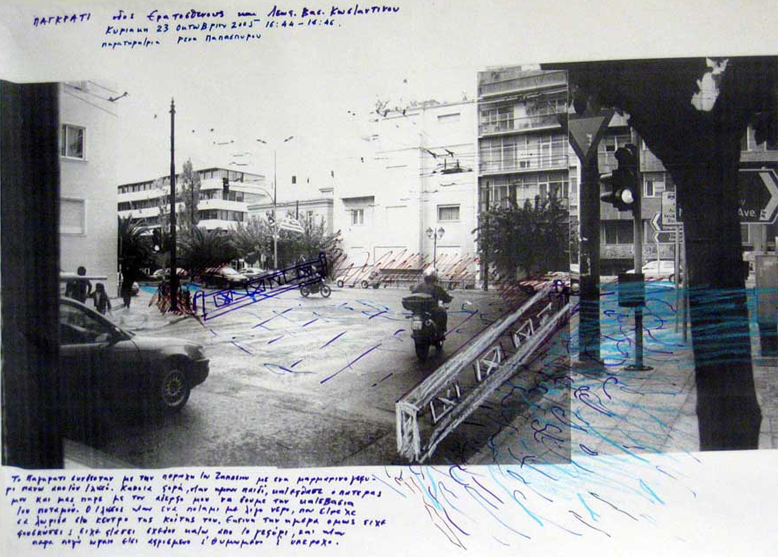
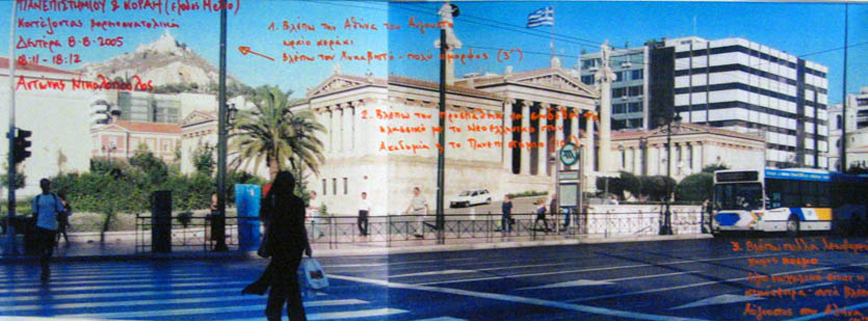
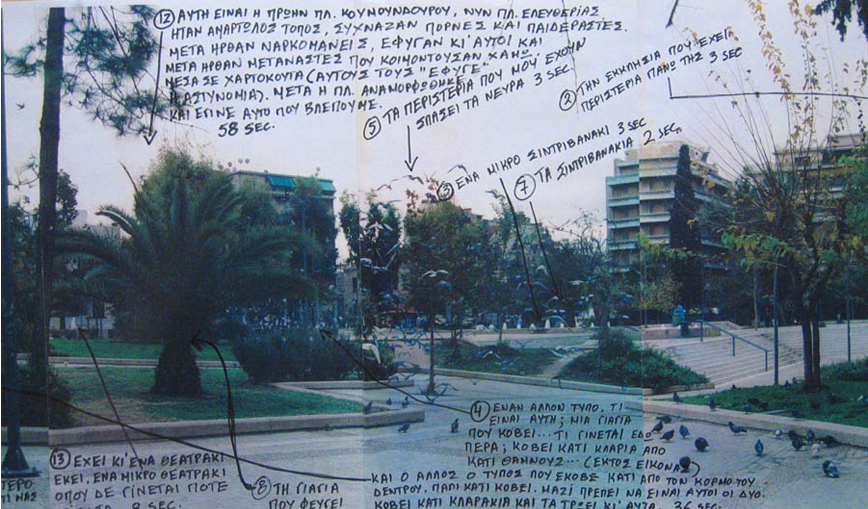
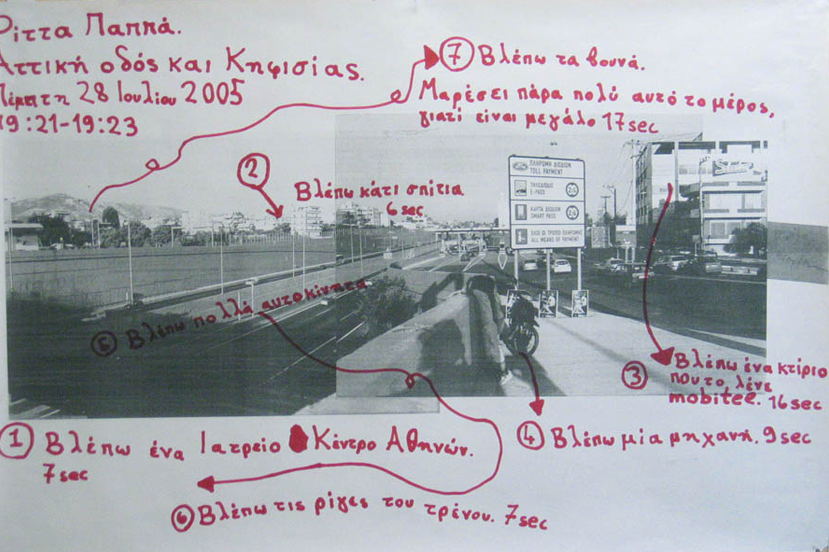
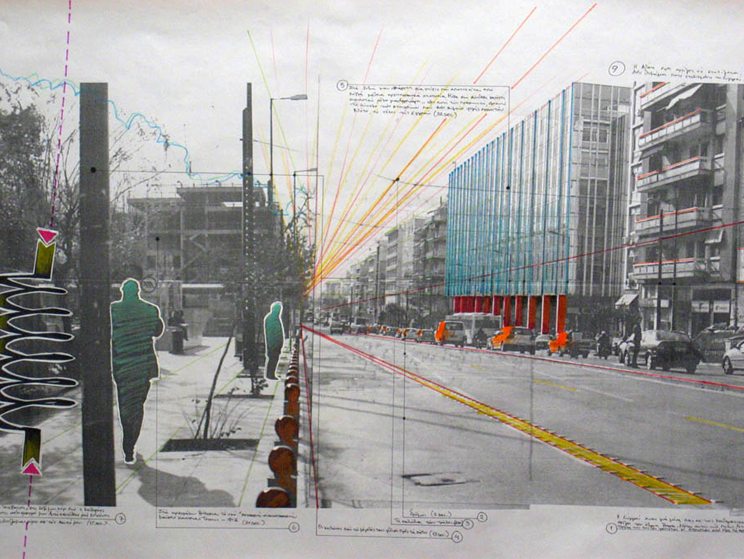
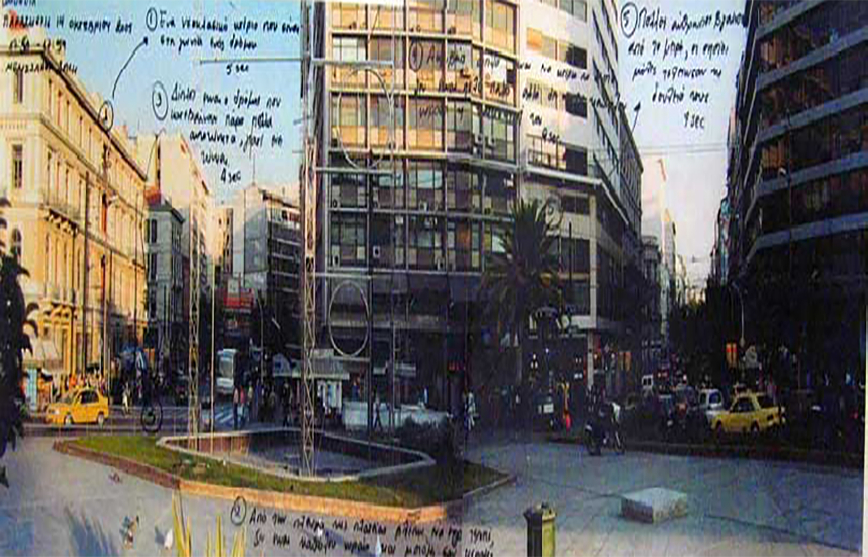
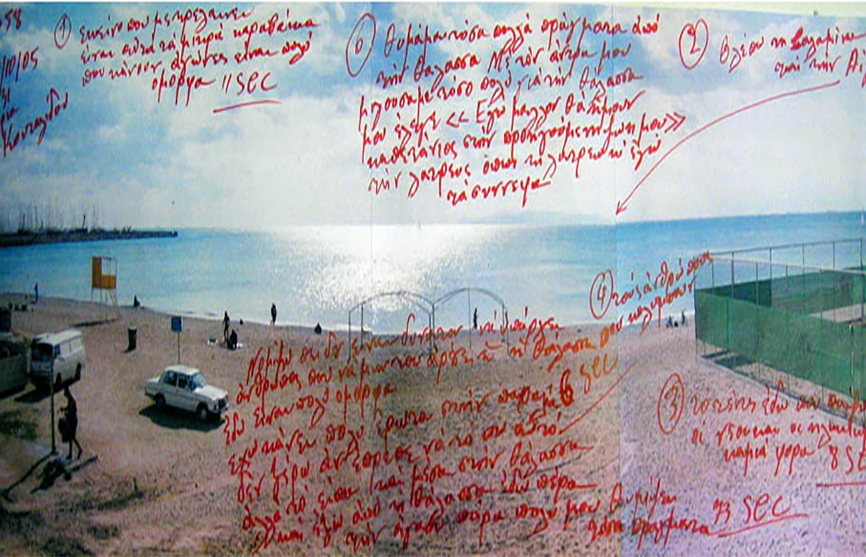
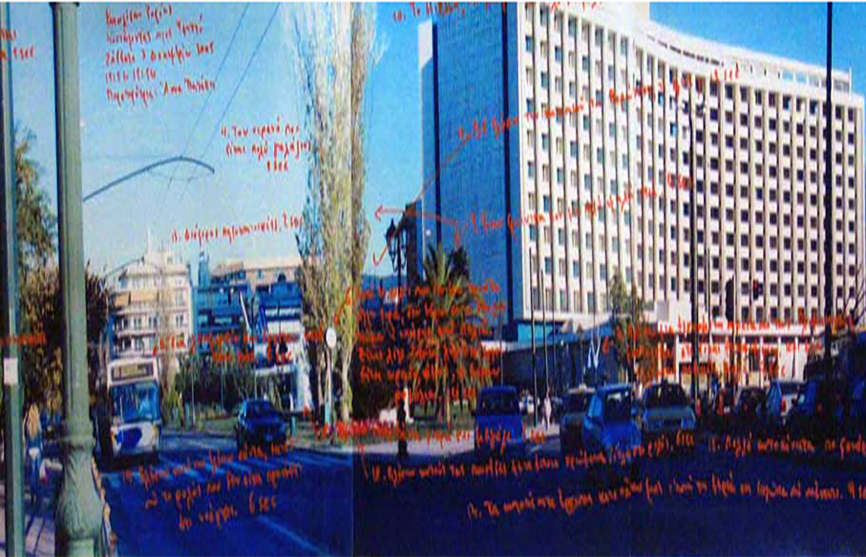
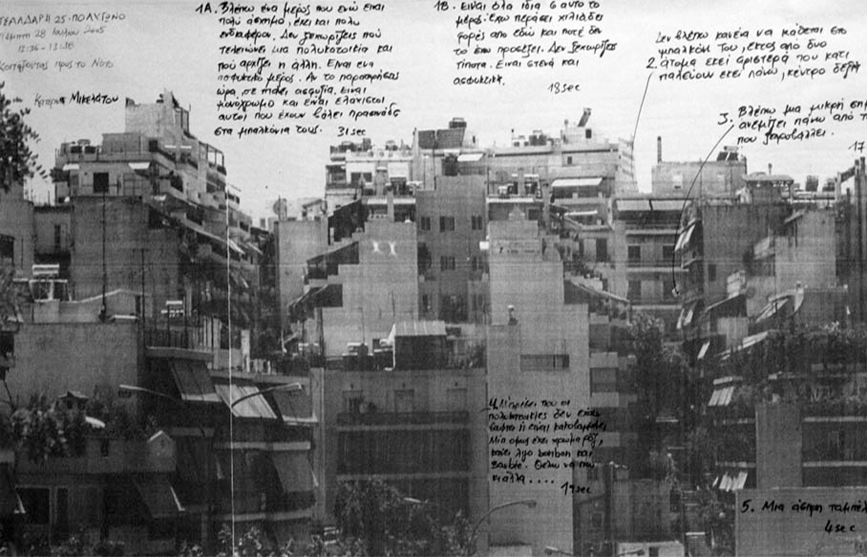
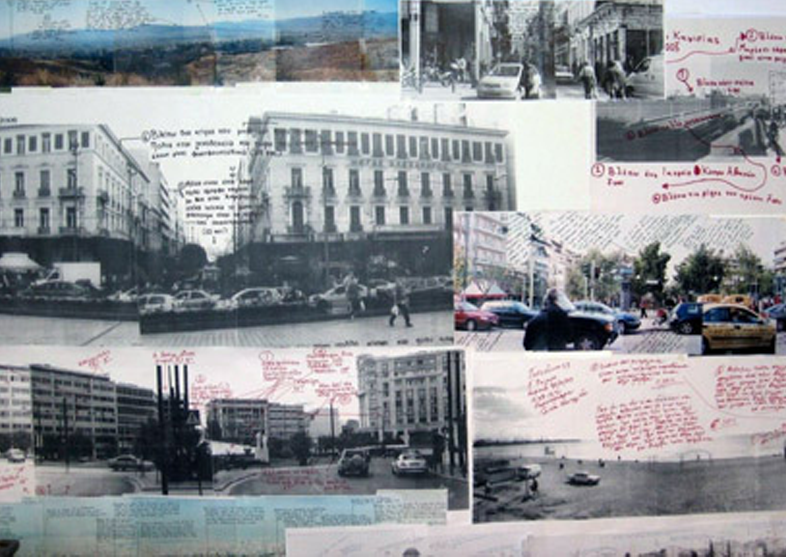
Usually, repeated passage through the places that surround our daily life deprives us of conscious contact with them. The gazings presented in this project constitute an effort to record a conscious relationship with the places within which we move, as inhabitants of Athens or just visitors.

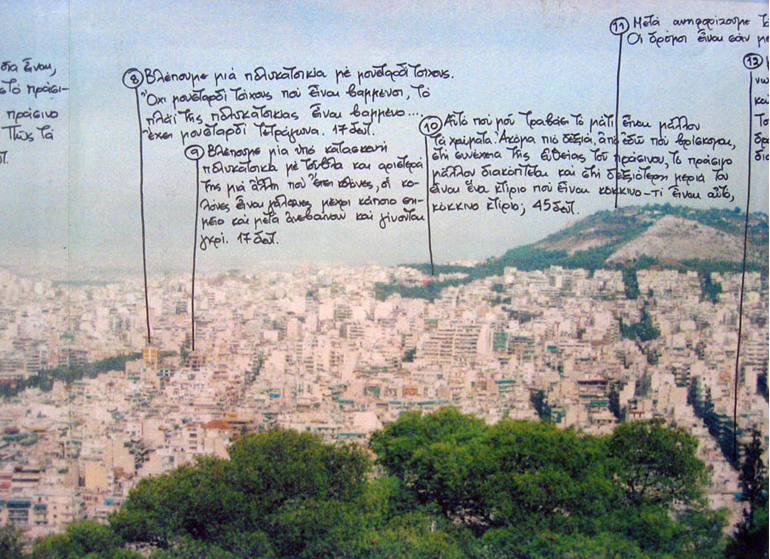
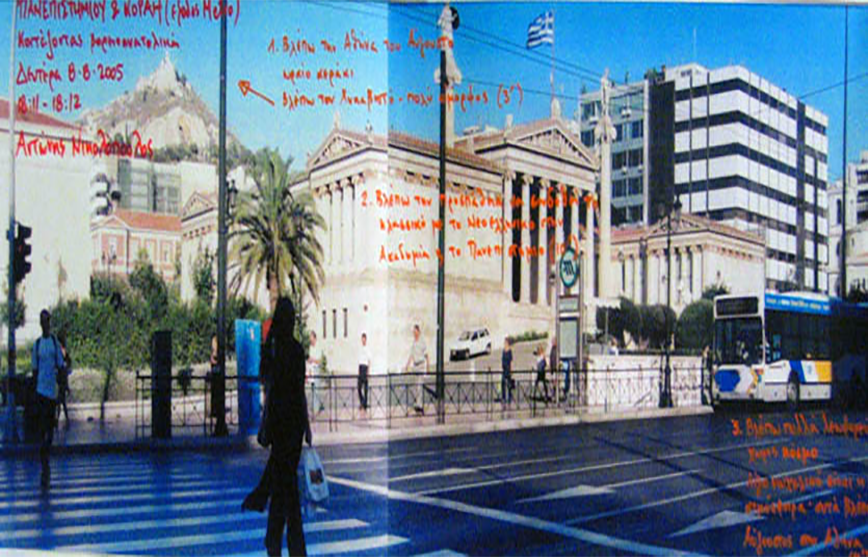
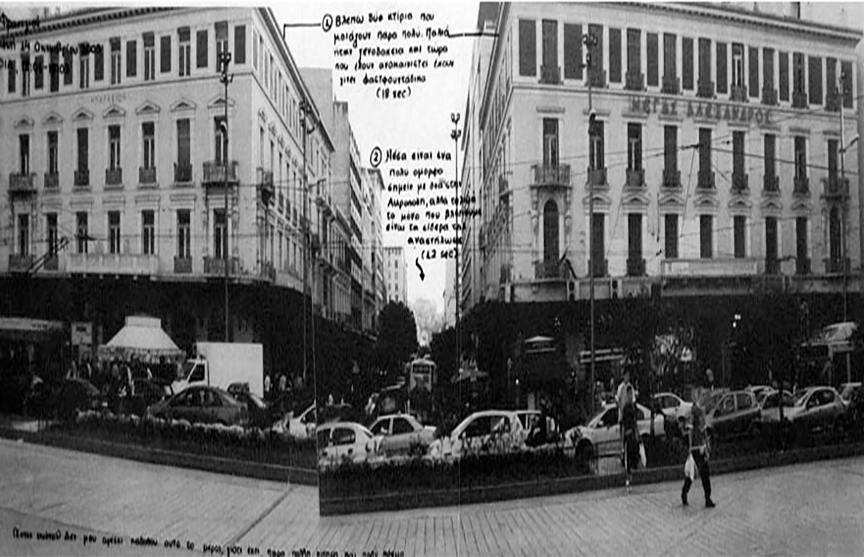
The timing of the gazings is a tool by which we can follow the observer’s thought process, since the time he/she spends focusing does not necessarily coincide with the time it takes to read what is written on the photographs. The time is noted in order to indicate the intensity of the observation, which changes according to the point the viewer is looking at and how interested he/she is in it.

The handwriting styles, the drawings and the diagrams reveal a personal way of connecting with the urban landscape. The observations may carry memories; comment on the state of the location; express aversion, affection or apathy; record habits; or be strictly descriptive. As diverse as they may be, most of them refer to central parts of Athens, which most of us have probably gone by.

The images presented do not cover the entire city; these are places that the viewers themselves have chosen, based on their daily activities. This project would not have been possible without the 55 participants who agreed to share their gaze, their thoughts and their time with me.

The process of “Timed Gazings”:

  1. We visit a public space in Athens with the observer.
  2. We take photographs of the place.
  3. With the use of a tape recorder, we record the comments of the observer, while he/she gazes at the space.
  4. Based on the recorded material, we follow the order of the observer’s gazing, noting his/her comments for every spot he/she has focused on, and measuring the time of focus for every different place of interest.
  5. We print and photocopy the photograph of the space.
  6. The observer takes the enlarged picture and the notes of his/hers gazing. With his/her own handwriting, he/she writes on the picture his/her name, the name of the place, or the street, his/her comments and the time spent on each different spot of his/her gazing. The result is a handwritten document-map of his/her gazing.

Art & Culture Written and Photographed by – Nina Pappa 
Related Posts

Takin Aghdashloo: Connecting Cultural Nodes & Reframing Iranian Art Between Rupture and Legacy

Tehran curator Takin Aghdashloo, son of Aydin Aghdashloo, discusses growing up amid classical art discipline, curating Event at Cromwell Place ...

Noushin Sadeghian: “I would describe my artistic voice as a combination of intricate details and delicate emotions”

Noushin Sadeghian is a Iranian visual artist and illustrator who won the Grand Prix at the 30th Biennial of Illustration ...

Auronda Scalera & Dr. Alfredo Cramerotti: “Beyond Gatekeeping – Curating Power, Ethics, and the Middle East’s Cultural Future”

Curator duo Auronda Scalera and Dr. Alfredo Cramerotti redefine curation beyond gatekeeping - as ethical translators navigating AI authorship, Middle ...

Who doesn’t like a cute little bunny rabbit? – Patricia Piccinini

Australia –  With our growing dependency on genetic manipulation and bioengineering we might be hesitant to ask when is it ...

Usman Riaz : Firefly in the sky

Pakistan –  A 21-year-old virtuoso at playing the percussive guitar, Usman Riaz shares his journey with Emaho. From learning the ...

Sahar Khalkhalian: “From Tehran War Sirens to Global Canvases”

Tehran-born Sahar Khalkhalian, granddaughter of painter Houshang Pezeshknia, channels Iran-Iraq War fragility and migration - from Germany to Vancouver/Dubai - ...

Mike Day: “The Island and the Whales” – Documentary on Marine Pollution in Faroe Islands

 England – Many in the Faroe Islands believe that hunting is vital to their way of life, but when a local ...

Niki Fallahfar: “Limitations pushed me to find more subtle, indirect ways of embedding desire, intimacy, and bodily sensation into the work”

Iranian artist Niki Fallahfar explains how constraints sharpened her subtle embedding of desire, intimacy and bodily sensation in works like ...

Maram Ali: “Every Story Deserves to Be Painted”

Jordanian artist Maram Ali discusses her evolution from Impressionist landscapes to powerful portraits of Gaza's martyrs. Born in Irbid, she ...

Showing Slide 1 of 10