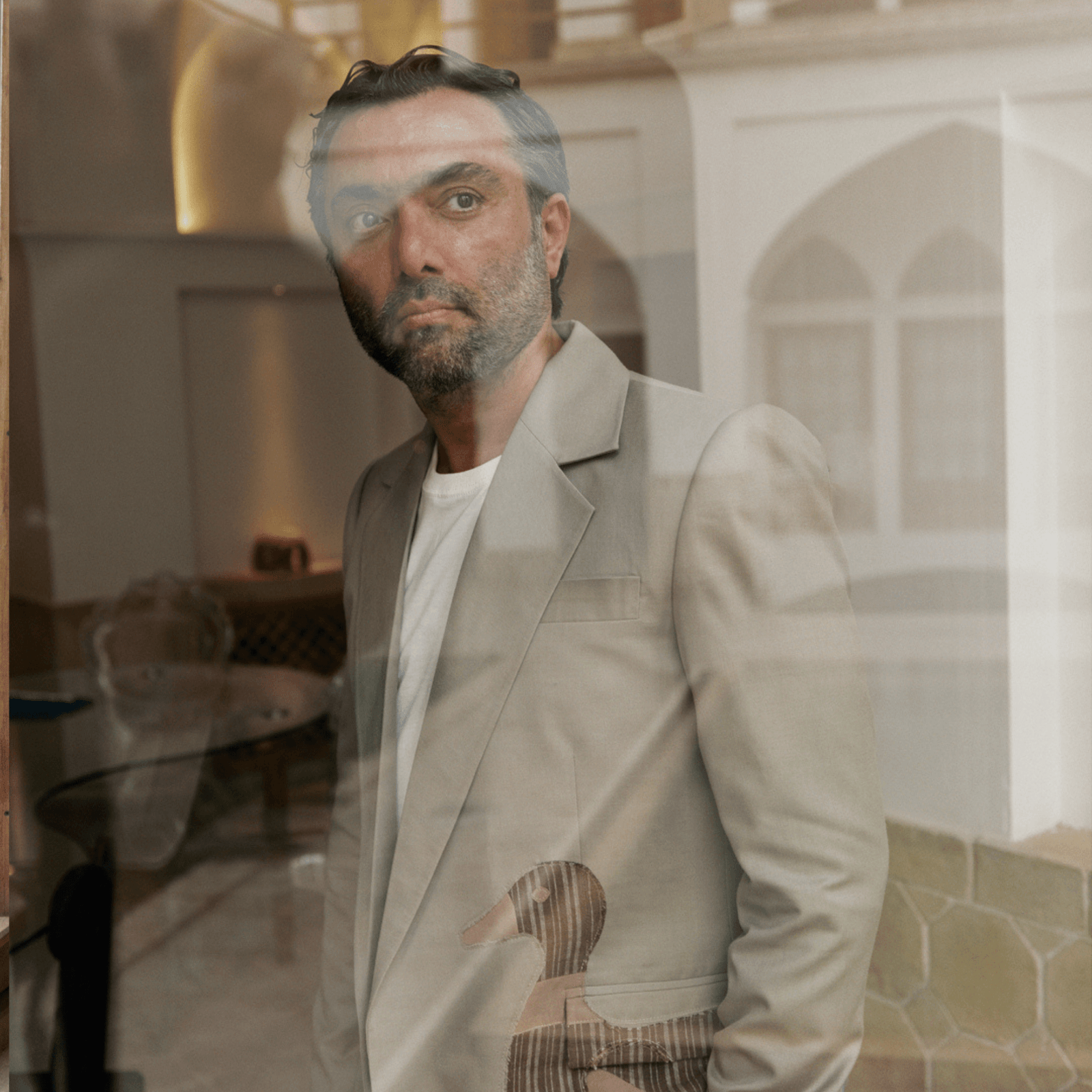
Emaho: Your studio describes itself as embodying adaptability, experimentation, and the pursuit of timeless contemporary design, and you work between Paris and Brussels with production based in Belgium. Two capitals with very different design sensibilities, French refinement versus Belgian material rigor, sit inside your practice at once. Which of those two cities do you feel actually shapes your hand more, and has a piece ever come out looking distinctly like one city rather than the other?
Diamant Versatile: I experience Brussels and Paris almost as two different rhythms, and I think I need both. Brussels has a certain calmness that gives me time to observe. It has an incredible architectural history – from Art Nouveau and Art Deco to Belgian modernism – but these references don’t feel staged. They are simply part of the city. You turn a corner and discover a facade, a staircase, a window, a material combination or a proportion that stays with you. I think that quiet architectural presence has influenced the more restrained and composed side of my work.
Paris works on me in almost the opposite way. It is extremely dynamic. So much is happening that sometimes I don’t even want to go somewhere specifically to see something. You don’t need to search for inspiration there; it finds you. It can be a tiny cafe on a corner, the way someone is dressed, a book, a piece of music, an exhibition, a conversation, or simply the movement and attitude of people in the street.
So I couldn’t really choose one. Brussels gives me space to observe; Paris gives me things to observe. One brings calm and architectural discipline, the other movement, expression and unpredictability. Diamant Versatile probably exists somewhere in that tension.
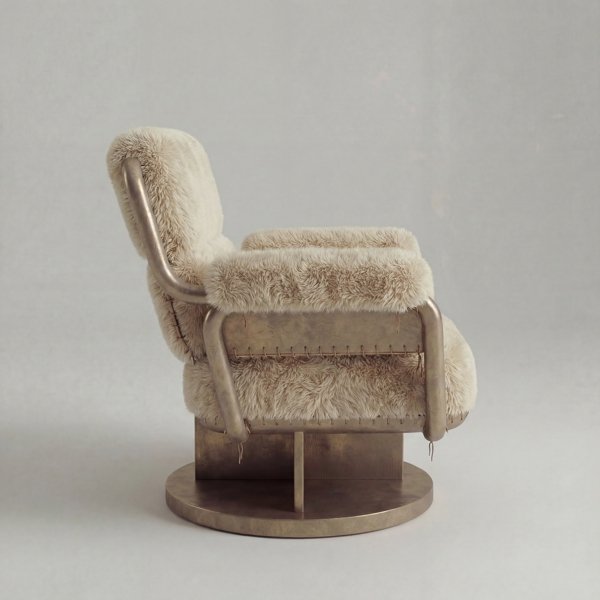
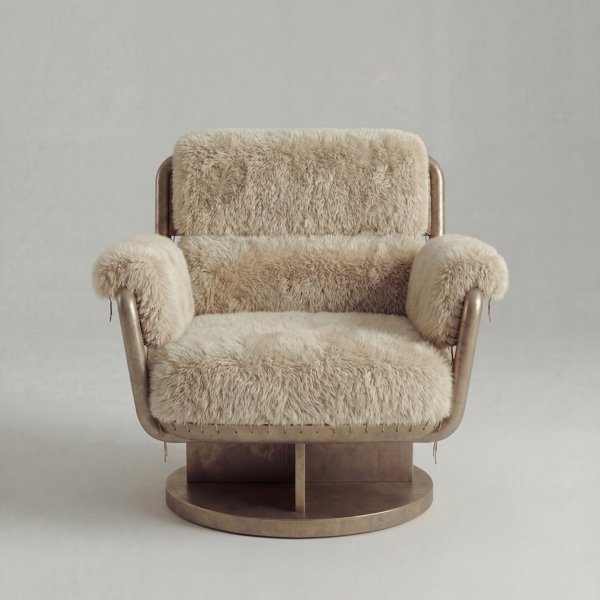
Emaho: You describe your furniture as spatial presence rather than mere function, and pieces like the Présence Armchair and Héritage Cabinet lean into that idea by name. That’s a genuinely different starting point than most furniture design, which begins with use and works backward to form. When you begin a new piece, does the spatial gesture come before you’ve even considered how someone will actually sit in or open it?
Diamant Versatile: Very often, yes. I tend to see an object in space before I think of it strictly through its function. It can begin with a silhouette, a proportion, a material encounter or simply a gesture that I find interesting. I want to understand what kind of presence it creates in a room. That is probably why some of the pieces sit somewhere between furniture, sculpture and architecture.
But I don’t believe in sacrificing function for an image. Once I find that initial gesture, there is a process of bringing the human body and use into it – sometimes working backwards, adjusting proportions and solving technical questions without losing what made the idea interesting in the first place.
With Presence, for example, I wanted the armchair to have a character even when nobody was sitting in it. The function becomes part of the object, but it doesn’t have to be its entire identity. I like furniture that continues to communicate when it isn’t being used.
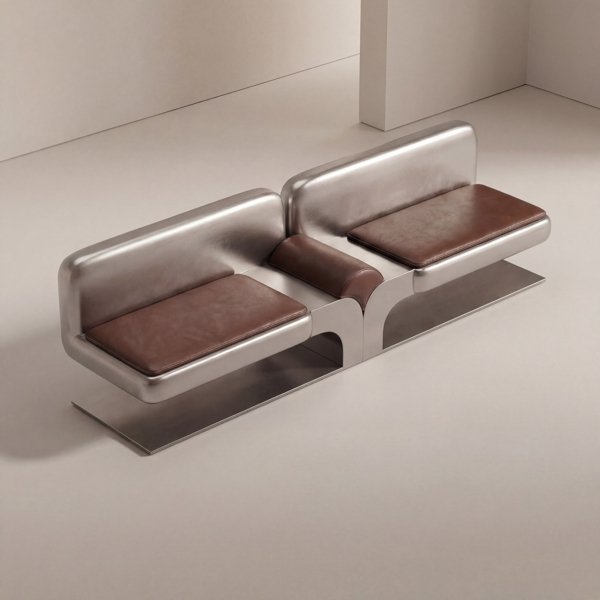
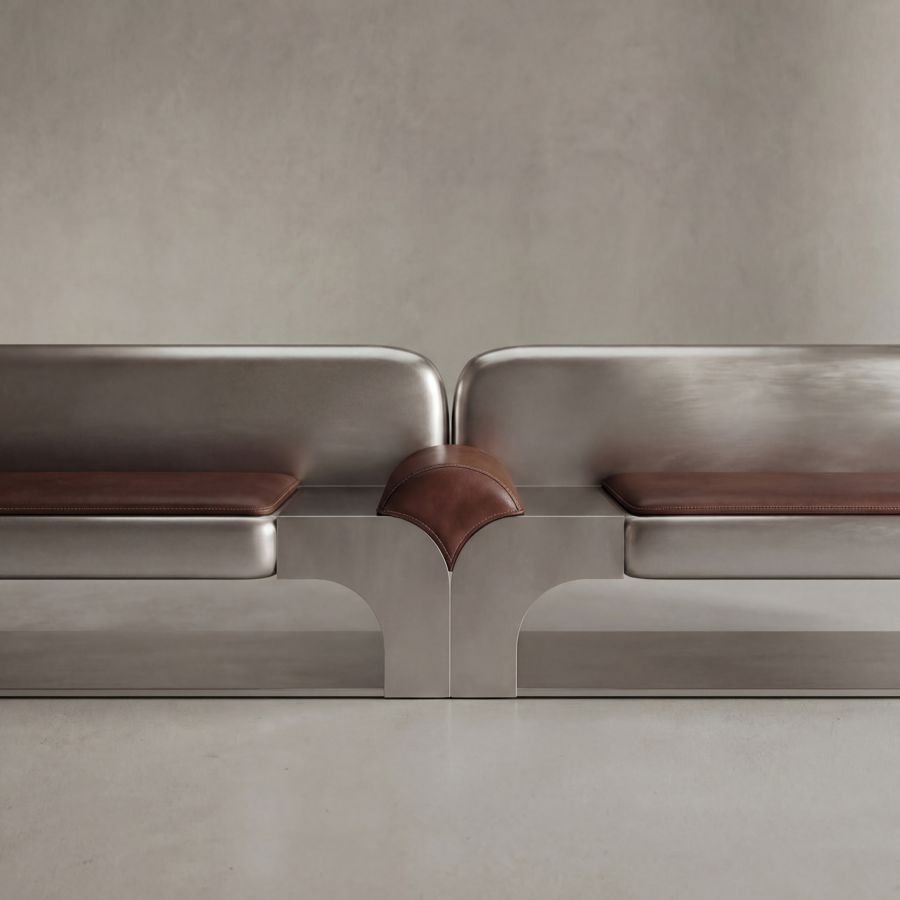
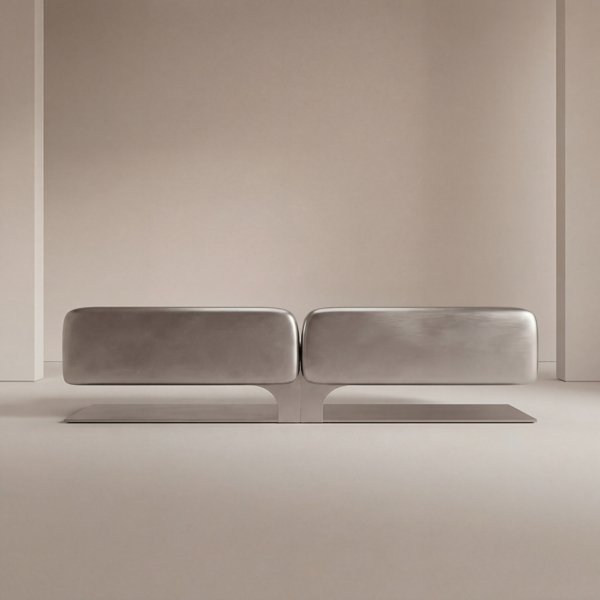
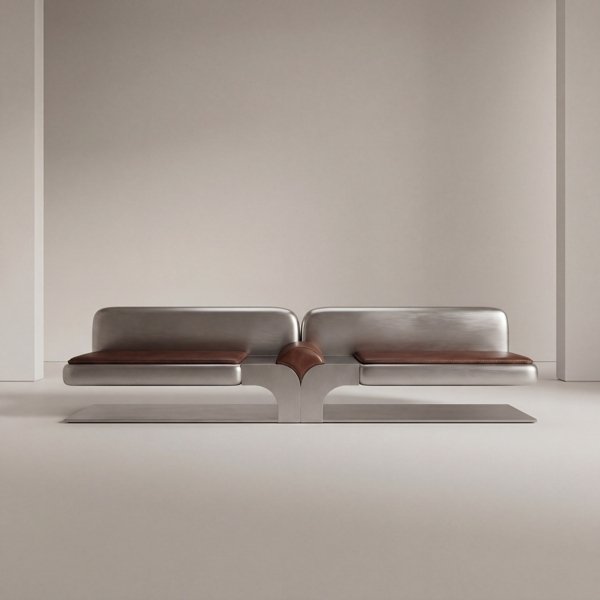
Emaho: Confluence, your sofa in brushed aluminum and leather, is described as born from the idea that balance is never static, two mirrored forms in tension joined by a central leather gesture, released as a limited edition of twelve plus two artist’s proofs. Why does a piece about instability and tension need to exist as a fixed, mirrored, symmetrical object rather than something more visibly unresolved?
Diamant Versatile: Because for me, tension becomes more interesting when it is controlled. Confluence began with the idea of two forms approaching one another – almost two independent volumes that meet through the central leather gesture. There is attraction, separation and connection happening at the same time.The symmetry gives that tension discipline. Without it, I think the piece could become too expressive, almost as though it were trying to illustrate movement. By mirroring the forms, the movement becomes contained.
I like that contradiction: something can feel unstable while being physically and visually very resolved.The limited edition follows the same thinking. It isn’t about creating scarcity simply to make the object more desirable. Some objects belong to a slower and more specific way of making. Fixing the edition gives the experiment a boundary and allows each piece to retain that particular character.
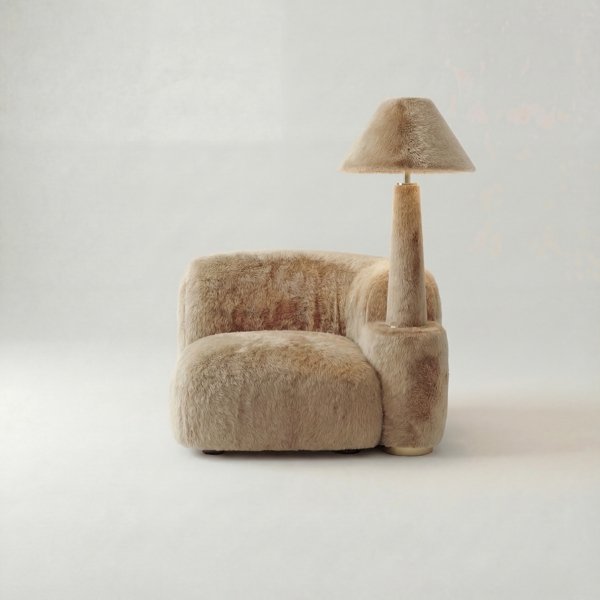
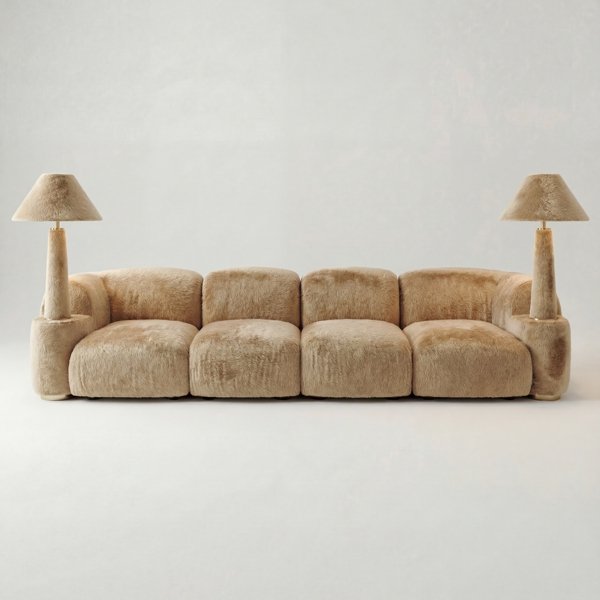
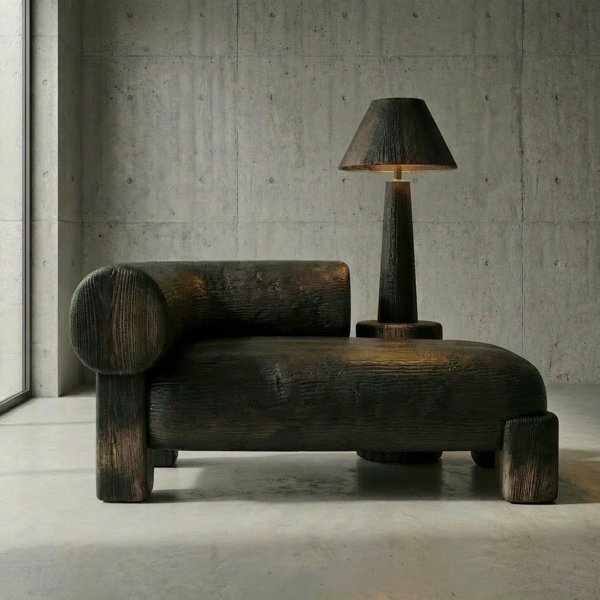
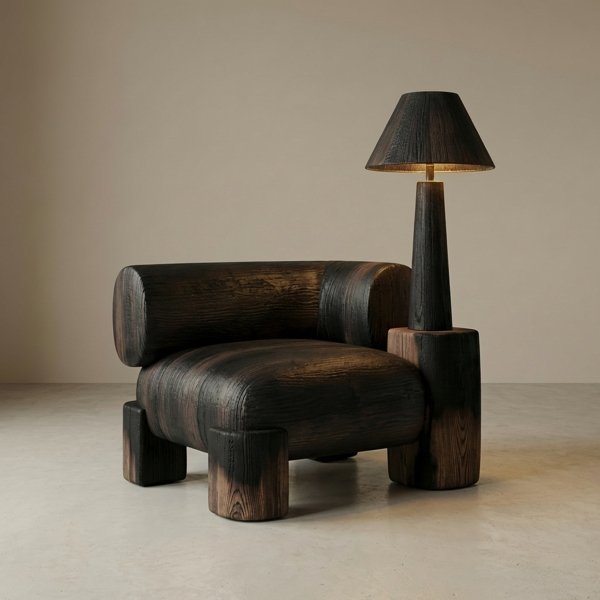
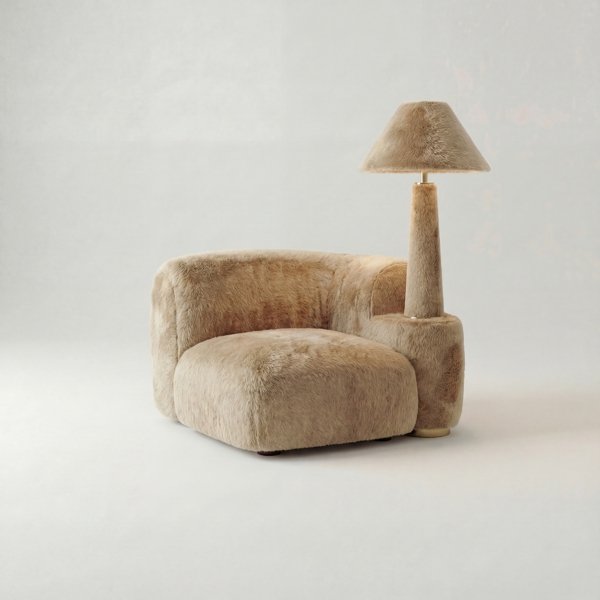
Emaho: Lamp Assise merges seating and illumination into a single sculptural object, which means solving two completely different engineering problems, structural comfort and functioning light, inside one form. What was the actual hardest technical compromise you had to make between those two functions before the piece felt resolved rather than like two ideas awkwardly fused together?
Diamant Versatile: The main challenge was actually not allowing it to feel like a compromise. With Lamp Assise, I never wanted it to look like a seat with a lamp attached to it. If you could visually separate the two functions too easily, then the idea wasn’t resolved.
Light and the human body ask for completely different things. Seating is very precise: height, position, comfort, balance. Light behaves differently; it deals with atmosphere, direction, shadow and a much larger relationship with the room.So a lot of the development was about proportion and reduction – understanding how one structure could accommodate both without one becoming decorative to the other.
The moment it worked for me was when I stopped seeing two functions. It became one object that happens to offer both light and a place for the body.
Emaho: Your work is described as drawing on classical references filtered through contemporary minimalism, a combination that could easily collapse into either pastiche or blankness if handled without precision. When you’re pulling from a classical reference, a proportion, a silhouette, a material tradition, how do you know when you’ve extracted what you need from it and when you’re at risk of simply quoting the past instead of reinterpreting it?
Diamant Versatile: I don’t think I am interested in classical references as images. I’m interested in understanding why certain things have remained visually powerful for so long.Sometimes it is symmetry. Sometimes it is proportion, rhythm, repetition, weight or the way an object establishes itself within a space.When I find something that interests me, I try to isolate that principle from its historical decoration. Then I can move it somewhere else – change the material, exaggerate a proportion, simplify it, or place it in a completely contemporary context.
That’s where materials become very important to me. The same proportion can communicate something entirely different in aluminium, leather or another unexpected material than it would in its historical form.I don’t want someone to look at a piece and immediately identify the reference. Ideally, there is only a certain familiarity that they cannot completely locate.
I’m more interested in the memory of the past than in reproducing its appearance.
Emaho: You work in a limited-edition model, where pieces like Confluence exist in tightly capped runs rather than open production. That model ties your income and reputation directly to scarcity and collector demand rather than volume. What’s the actual hardest part of building a business on objects that, by design, most people will never be able to own?
Diamant Versatile: The contradiction is that you are trying to build something that grows without necessarily making more of the same thing.
The limited-edition model gives me a certain freedom. I can work with processes, materials and details that wouldn’t necessarily make sense in mass production. An object can take more time, involve more experimentation and remain very specific.But commercially, that obviously creates another reality. Development takes time, prototypes cost money, production is demanding, and you cannot simply compensate for that through volume.
For me, though, scarcity cannot be the concept. I don’t want somebody to desire a piece only because there are twelve of them. The object has to justify its existence before the number does.So I’m interested in finding other ways for the studio to grow – through new typologies, interiors, collaborations, materials and larger spatial projects – rather than simply repeating a successful object indefinitely.
Growth doesn’t necessarily have to mean producing more. It can mean being able to explore more.
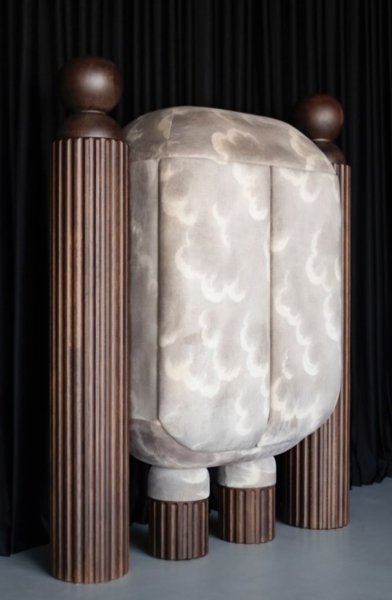
Emaho: Héritage Cabinet carries a name that directly invokes inheritance and lineage, while your broader studio language leans toward architectural restraint and material richness. Is “héritage” for you a personal reference, family, craft tradition, a specific place, or is it a more abstract idea about what furniture is supposed to carry forward across generations?
Diamant Versatile: For me, Heritage is much more about transmission than nostalgia. We inherit more than objects. We inherit proportions, techniques, materials, architectural languages and ways of making. Even when we think we are designing something completely new, we are still participating in a much longer conversation.
That interests me because furniture has a very particular relationship with time. Architecture often stays in one place, while an object can move from one interior to another, from one person to another, sometimes from one generation to another. Its context changes while the object remains.So Heritage isn’t referring to one specific family story or tradition. It is asking what an object can carry forward.I don’t want it to look old or nostalgic. In fact, I think something has to belong very clearly to its own time before it can eventually become part of another one.
Emaho: Both Lythore and The Oblist, two different collectible-design platforms, carry your work and describe you consistently as operating at the intersection of interior architecture and collectible design. Working across multiple platforms and distributors means your pieces reach collectors through different curatorial lenses each time. How much control do you actually retain over how a piece is presented and contextualized once it leaves your studio and enters someone else’s platform?
Diamant Versatile: I think there are things I need to control very precisely and things I have to allow to leave my control. The object itself – its proportions, materials, execution and fundamental identity – has to remain uncompromised. How we initially communicate and photograph the work is also important because that establishes a certain context around it.
But once the piece enters another platform, another exhibition or eventually somebody’s home, I think it should be allowed to create new relationships. Lythore and The Oblist have their own curatorial perspectives and their own audiences. The same object can feel completely different depending on what is placed beside it, the architecture around it or the person looking at it. I find that interesting.
At some point you have to let the object live without you. I want to protect its integrity, but not dictate every interpretation of it. Otherwise I’m not really releasing an object into the world; I’m simply extending the studio around it.
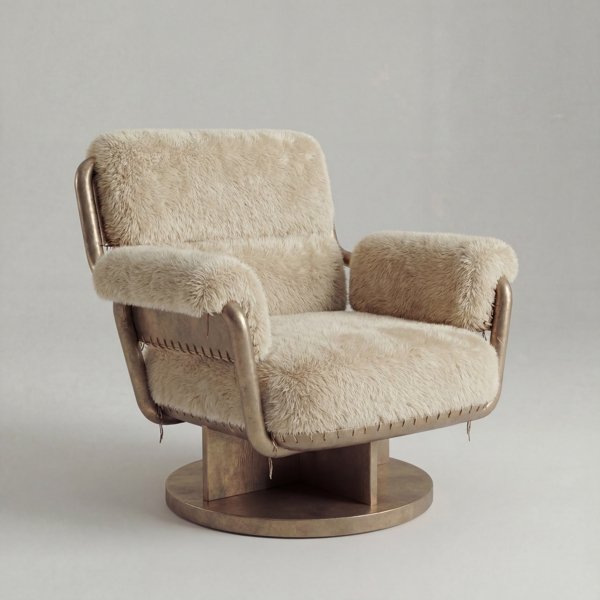
Emaho: Every piece in your collection so far, Confluence, Présence, Éloquence, Héritage, carries a French name that does real conceptual work rather than serving as a decorative label. Does the name usually arrive before the object is finished, shaping how you develop it, or does it only crystallize once the piece is essentially complete and you finally understand what you’ve actually made?
Diamant Versatile: Usually somewhere in between. I rarely want to name something too early because a name can become a direction, and then there is a danger that you start designing an object to illustrate a word.
Normally the object begins first. Through drawings, materials, prototypes and changes, it gradually develops a personality. At a certain point I understand what it is trying to become, and that’s often when the name appears. Confluence, Presence, Eloquence, Heritage – they aren’t intended simply as French decorative labels. Each one describes something I already recognized in the piece.
I also like that the names don’t describe function. Presence doesn’t tell you that you’re looking at an armchair. Heritage doesn’t tell you it’s a cabinet. It gives you another entrance into the object. So I would say the form comes first, and the name arrives when I begin to understand its character.
Emaho: You’ve built a practice defined by adaptability and experimentation as a founding principle, which by definition resists settling into one fixed identity or repeating a signature move. As the studio grows and gains more collector recognition, is there a risk that success eventually pressures you toward a repeatable “Diamant Versatile look,” and if that pressure arrived tomorrow, is there a piece or material direction you’d deliberately pursue specifically to resist it?
Diamant Versatile: Absolutely, because I think the moment a visual language becomes a formula, experimentation starts disappearing. Of course I understand why it happens. As a studio becomes more visible, people begin associating it with certain silhouettes, materials or gestures. And there will naturally be recurring elements in my work because they come from the same person.
I’m interested in proportion, architectural presence, material tension and a certain restraint. Those things will probably continue to appear because they’re part of the way I see rather than a style I’ve chosen. What I don’t want is to reach a point where I think: this worked before, so let’s make another version of it. If I ever felt that happening, I would probably deliberately remove something familiar from my process – change material, scale or typology, collaborate with someone from another discipline, or enter a context where I don’t immediately know how to solve the problem.
The word Versatile is important for exactly that reason. It gives the studio permission to move. I would much rather have someone recognize a Diamant Versatile piece because of the way it thinks than because of a repeated silhouette. For me, Diamant Versatile should become recognizable through an attitude, not through a formula.