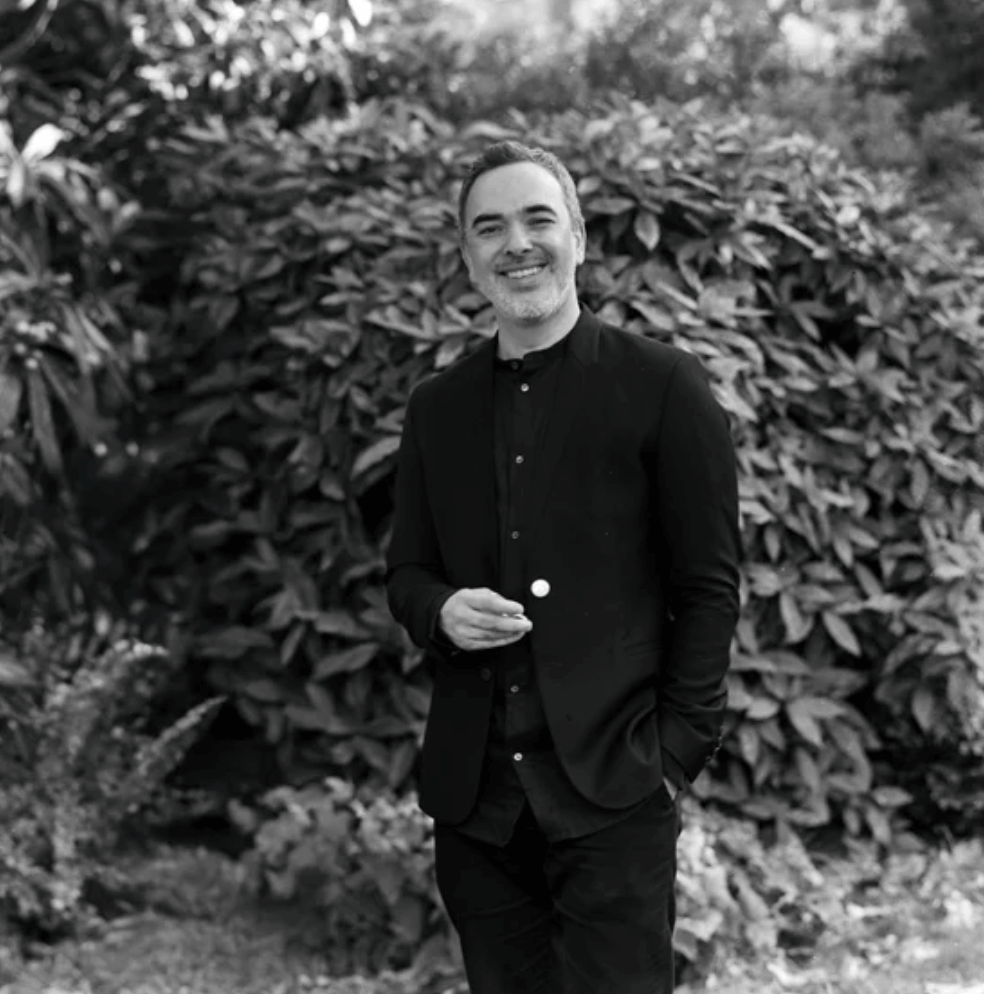
Emaho: You grew up in a small rural village in the province of Antwerp, literally between the cows and the fields, with a Congolese father whose stories felt cloaked in mystery, and a Belgian grandfather in whose attic you would spend hours with old furniture, photographs and vinyl. Most designers can point to a school or a city that shaped them. Your formative material was much quieter and stranger than that. What did that particular kind of childhood solitude give you that a more culturally saturated upbringing might not have?
Kim Mupangilaï: A huge part of it was my grandfather’s shop. I spent most of my time there growing up. He was incredibly handy, one of those people who could basically do everything. He worked on metal parts, repaired machinery, built things, knew how to turn wood, understood mechanics, carpentry… it was very instinctive knowledge.
And his shop reflected that mind completely. It was overflowing with everything he had collected throughout his life and everything he was interested in. Old tools, bolts, wood fragments, furniture parts, machines, photographs, books about completely random subjects, including metaphysics. Nothing felt separated. Everything coexisted in the same space. I think being around that from such a young age made me very curious about objects and materials, not only aesthetically, but physically. How things are made, why they are shaped the way they are, why people keep certain things for decades.
At the same time, my father’s side and my Congolese heritage always felt present, but also distant in certain ways. There were stories, objects, books, fragments of information, but never a full picture. So I think I became comfortable very early on with piecing things together myself. Observing, researching, sensing connections before fully understanding them intellectually.
And honestly, I think that kind of upbringing gave me the freedom to develop a visual language that feels very personal and instinctive. I wasn’t surrounded by design culture in an obvious way, so a lot of my references came from lived experience, memory, materials, objects, and curiosity rather than from what was considered current or relevant at the time.I think that distance allowed me to arrive at design in my own way.
Emaho: You took a Bachelor’s in Graphic Design and a Master’s in Interior Architecture at LUCA School of Arts in Belgium, then moved to New York in 2018, backpacked, worked for an established firm on high-end residential projects, solo-designed Ponyboy, the restaurant and nightlife venue in Greenpoint, ran a vintage shop called ENLAMÉSÁ, and only then began ideating your own furniture. That is an unusually long runway before a first collection. What were you accumulating during all of that time that you did not yet know you would need?
Kim Mupangilaï: Looking back, it wasn’t just about accumulating skills, it was also about timing. I’ve always been fascinated by furniture, by the idea that something can take on unexpected, almost unconventional forms and still remain functional. Even during my studies, I knew I was drawn to a more spatial practice, which is why I chose interior architecture. That world is still very much part of me, and something I would love to return to more actively at some point. But alongside that, there was this deeper pull that had been there for a long time. A curiosity, but also a kind of tension around my identity and cultural landscape that I didn’t quite know how to articulate in words.
So at a certain point, I made space for that. I leaned into a medium I had always been drawn to but hadn’t yet explored seriously, which was sculpture and furniture. The pandemic gave me time to explore that further. But being in New York, I was also aware that these things require stability, patience, and the right moment. So it wasn’t a sudden decision. It was the right moment meeting something that had been there all along.
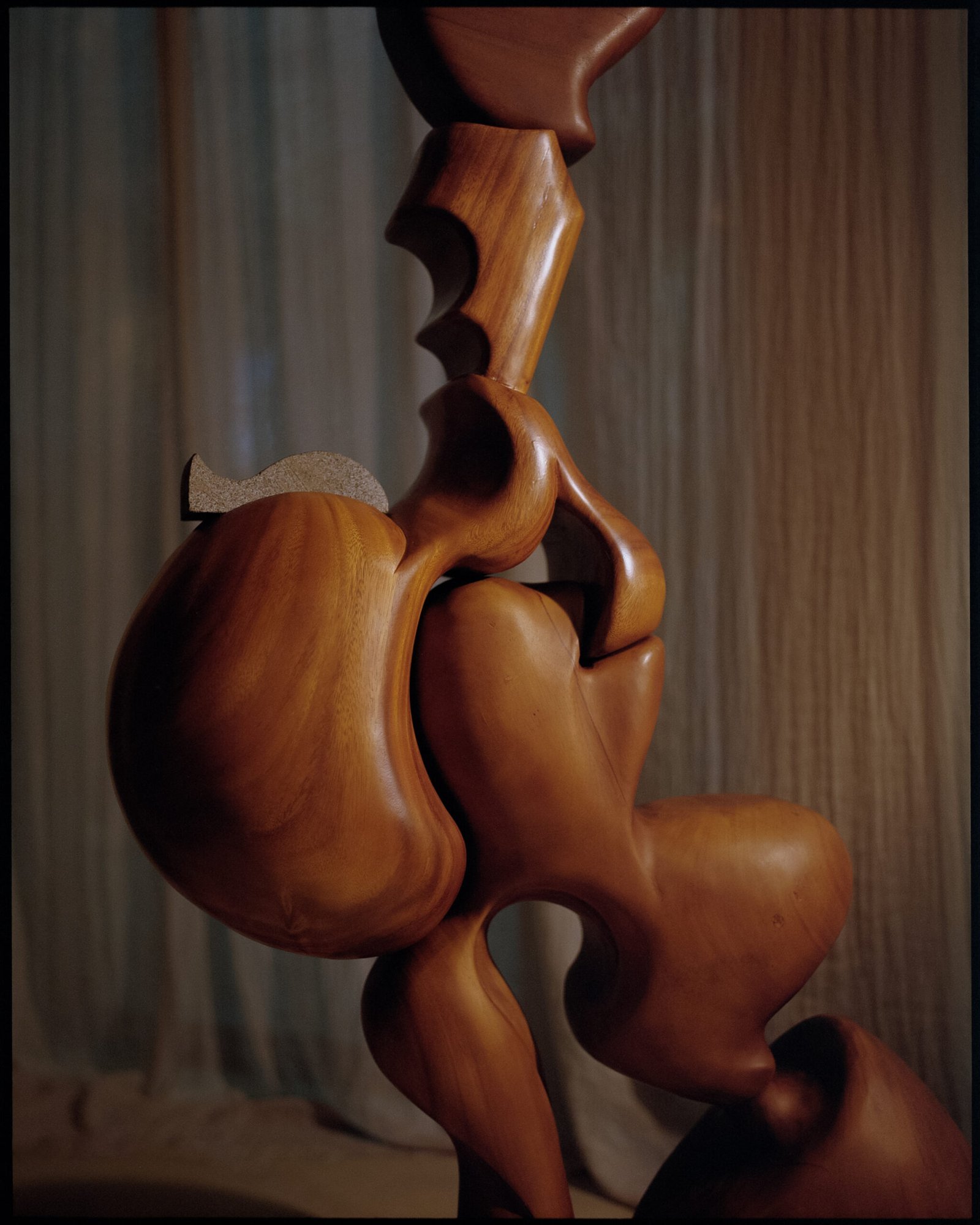
Emaho: The Kasaï collection is built from teak, volcanic stone, rattan and banana fiber, materials that are natural resources of the Democratic Republic of Congo. The research involved long phone calls with your father and the old books he sent you inscribed with his name. What did those conversations with your father unlock that no archive or library could have given you, and how did that information translate into physical form?
Kim Mupangilaï: The conversations with my father weren’t about extracting information, they were about proximity. About getting closer to something that had always been part of me, but never fully accessible.
What they gave me wasn’t clarity, but a deeper understanding of that in-between space. The ambiguity of holding two worlds at once, without needing to resolve them into one. So when this began translating into my work, it was never about representing one place or the other. It was more about allowing both to coexist within a piece. I wasn’t necessarily trying to define identity, but rather allowing it to remain layered, complex, and present at the same time.
Emaho: The Bina Chair takes its name from the Congolese Tshiluba word for dance, and its weight appears to rest on a single volcanic river stone in a way that plays deliberately with the appearance of balance. Hypebeast named it one of the 100 Most Collectible Designs of the 21st Century, and it is now in the permanent collection of the Vitra Design Museum in Weil am Rhein, while the Denver Art Museum acquired the Brazza Screen from the same collection. What does it feel like when pieces you made as a personal act of identity research become objects that institutions want to preserve for the future?
Kim Mupangilaï: It feels very surreal, because those pieces started from such a personal place. They were not made with the intention of entering institutions or becoming part of a permanent collection. They came from questions I had around identity, materiality, and how to translate something I couldn’t fully verbalize into form. So when a piece like the Bina Chair enters the Vitra Design Museum, or the Brazza Screen is acquired by the Denver Art Museum, it feels like a very strange and beautiful shift. Something that began as an intimate investigation becomes part of a larger design history.
At the same time, I’m very aware of the responsibility that comes with that. When work enters an institution, it also enters a system of preservation, language, and interpretation. So for me, it matters that the narrative around the work remains layered and honest, and doesn’t become simplified into just aesthetics or collectibility.
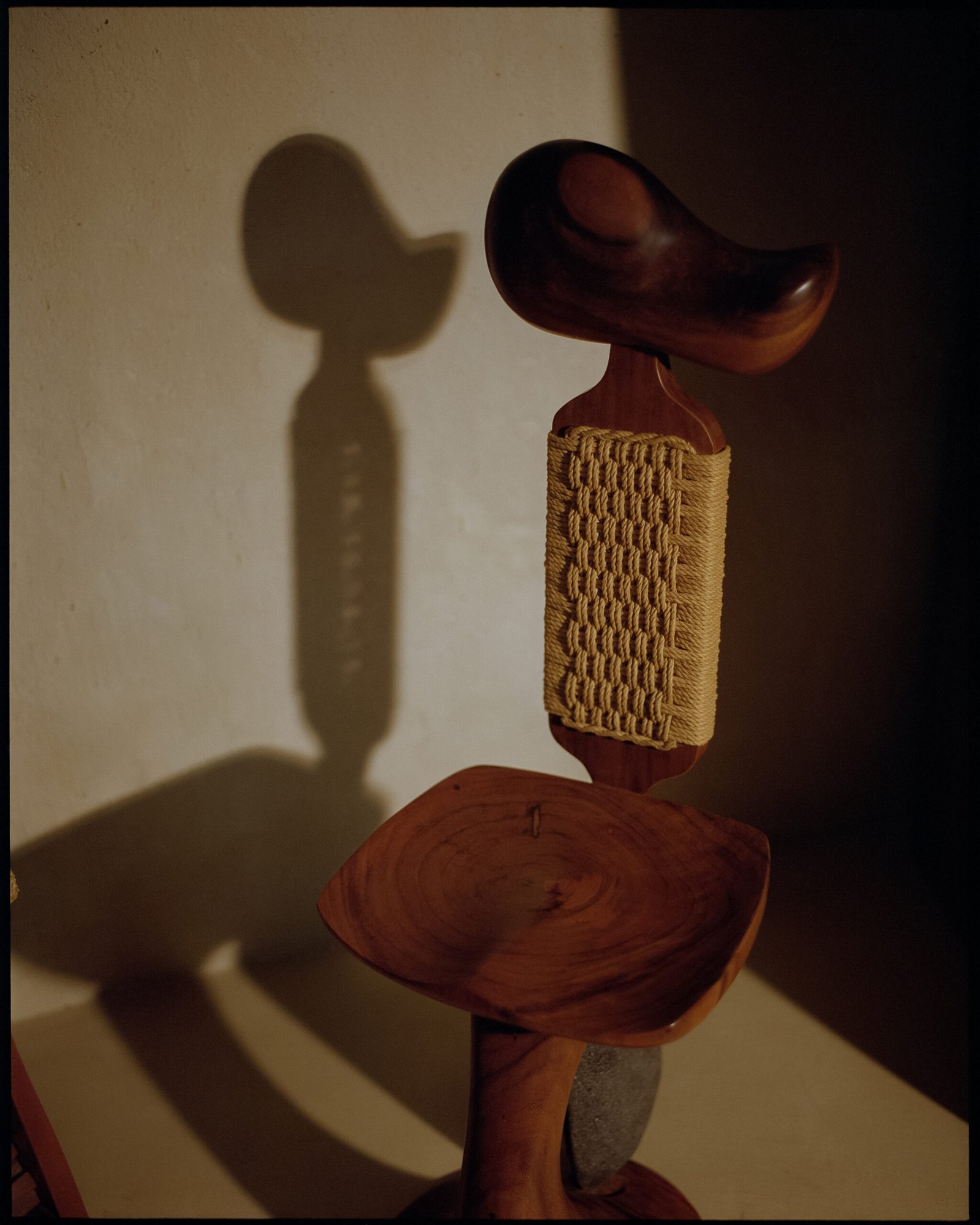
Emaho: The Mwasi Armoire draws its door from the form of an African shield and its limb-like supports from femininity and movement. Your research into Art Nouveau and Congolese colonial history is central to that piece, specifically the argument that Congo’s influence on the Art Nouveau movement has gone largely unacknowledged. What did that research reveal, and why does that particular historical erasure matter to you as a designer working now?
Kim Mupangilaï: This is still very much ongoing research, and I think that’s important to say. Over time, I noticed people describing my work as having Art Nouveau influences, which I wasn’t consciously referencing. I was simply working from my own visual language shaped by Congolese references and personal research. At a certain point, it made me question where those overlaps come from and why certain histories are more visible than others.
The Mwasi Armoire itself is not directly tied to that research, that sits separately. But I do think this conversation matters now more than ever. As designers, we have the tools to communicate in ways that don’t rely solely on words.There is a responsibility in that, especially working between Belgian and Congolese contexts and within education.
Emaho: In 2024 your Liso Stool was installed in the Brooklyn Museum’s new café alongside work by nine other designers, and your work featured in the Cooper Hewitt’s Making Home triennial. A museum café is encountered by accident by people who came for something else entirely. Does the accidental encounter with design matter to you differently than the deliberate one inside an exhibition space?
Kim Mupangilaï: Yes, I think the accidental encounter matters a lot. In an exhibition space, people arrive with a certain intention. They are there to look, to read, to understand, or at least to engage. But in a café, the encounter is much more casual. Someone might be getting a coffee, meeting a friend, passing through, and suddenly they are sitting beside or interacting with a piece of design without that formal distance. I like that kind of encounter because it brings the work closer to daily life. It removes some of the pressure around needing to understand something immediately.
For me, furniture has always lived between sculpture and use. So a museum café is actually a very interesting place for that tension to exist. The piece is still part of an institutional context, but it is also in a space of conversation, movement, and routine.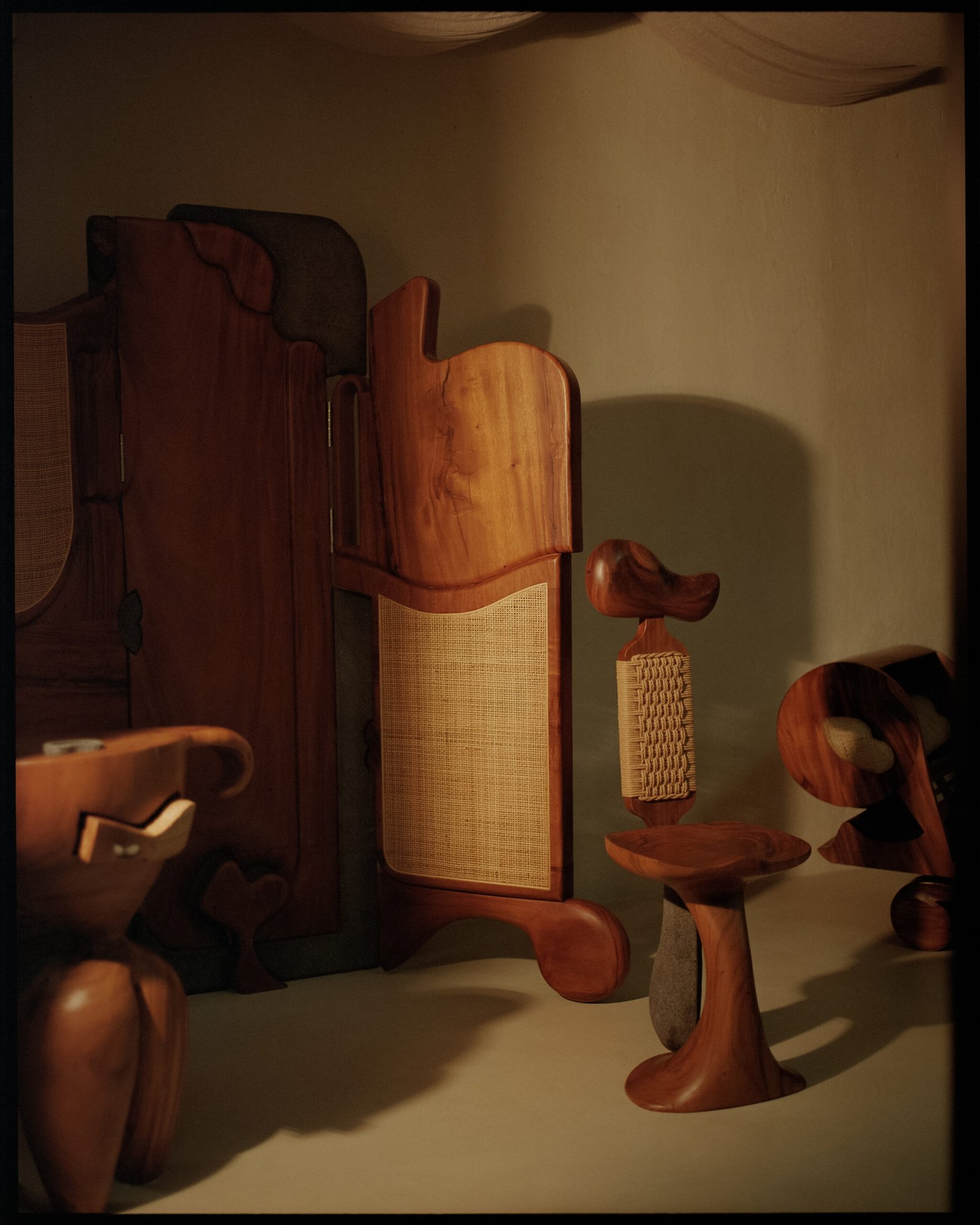
Emaho: You collaborated with Omexco on an exclusive wallcovering collection, a significant shift in register from sculptural furniture to surface and architectural skin. What does working at the scale of a room rather than a single object ask of you that furniture does not, and what carried over from one discipline to the other in ways you did not expect?
Kim Mupangilaï: It really taught me how different these disciplines actually are.
I naturally think in 3D, so moving into 2D was a real shift. That was the biggest challenge, but also what made it interesting. I tried to carry over my own language into a surface rather than an object. It made me realize that design moves across mediums, across scales, and beyond the tangible.
Emaho: You teach at Parsons School of Design and describe naming as a literal tool in your design process, part of the alphabet of how you work. When you are in the room with students who are trying to find their own design language, what is the question you find yourself asking them most often, and what does it tell you about where design education is right now?
Kim Mupangilaï: I often ask my students to go beyond what something looks like and question where it’s coming from. We’re in a fast-paced moment where there’s pressure to define yourself quickly. But identity and language take time. I encourage them to go deeper, to understand their context and not just follow trends. That’s where meaningful work begins.
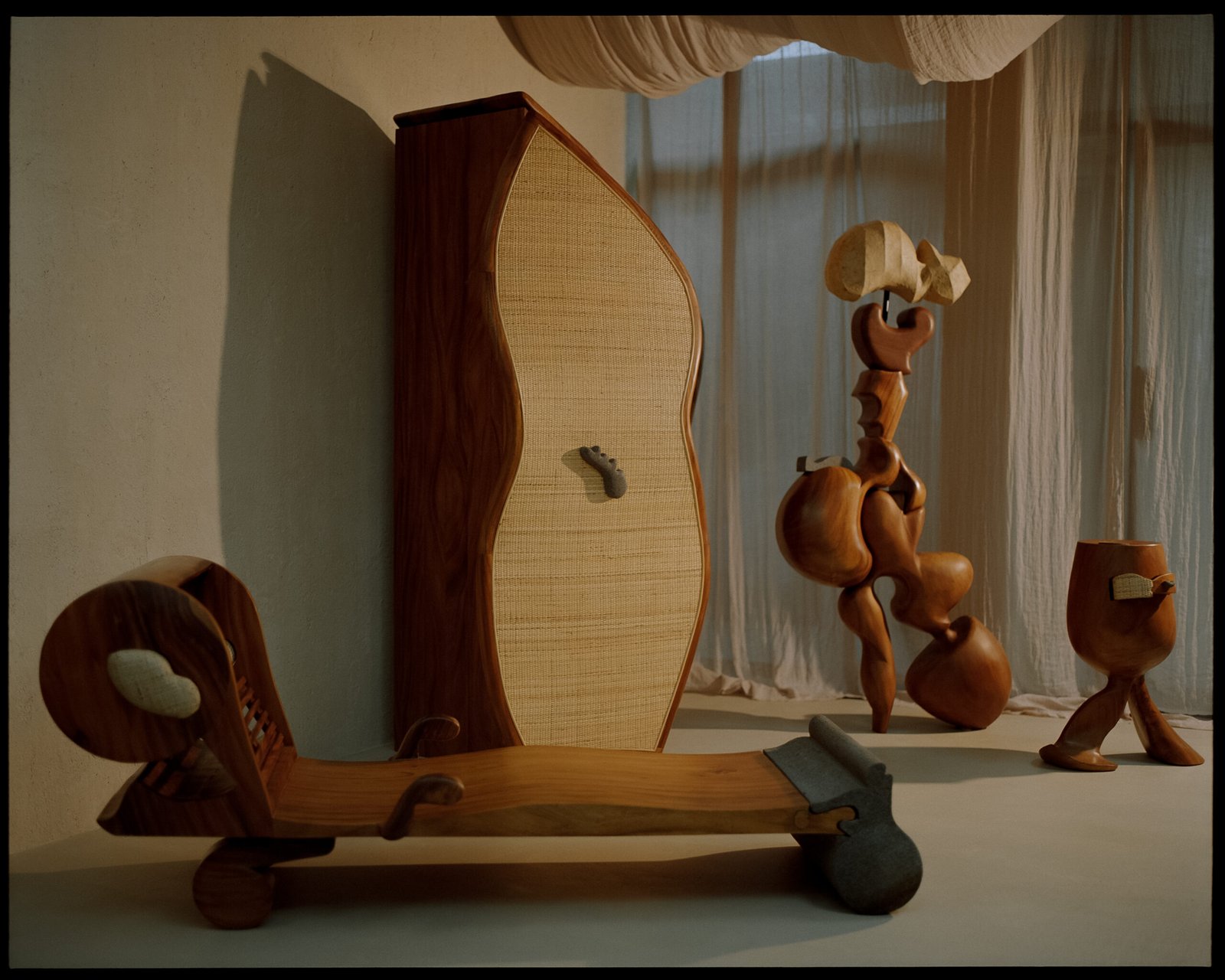
Emaho: Your work has been acquired by major institutions, covered on the covers of international magazines, and you debuted new pieces at the FOG Design+Art Fair in San Francisco in 2025. You have described being courted by A-list celebrities for major projects and remaining deliberately skeptical. At a moment when your visibility is at its highest, what are you protecting, and what does the next body of work need to do that the Kasaï collection could not?
Kim Mupangilaï: What I’m protecting most right now is time. Time to think, research, and develop work without pressure. I’ve always worked slowly and intentionally, and I want to maintain that. The next body of work is about exploring different mediums and allowing that to unfold naturally. The challenge is staying open while protecting the integrity of the process.