Emaho: You grew up without an artistic background, and it was a chance visit to the Fondation Maeght in Saint-Paul-de-Vence that changed everything for you: the encounter between art, architecture and landscape was, in your own words, capital. A single visit to a single place reorienting an entire life is a very particular kind of experience. What was it specifically about the Fondation Maeght that struck you so completely, and do you think the fact that you came to art from outside it, without having grown up inside its language, has permanently shaped the kind of curator you became?
Fanny Robin: I didn’t grow up in an environment where culture was part of my daily life. My relationship with art developed gradually, almost by chance, through a series of pivotal encounters. Among them, discovering the Maeght Foundation was a true turning point. I walked into that space without any prior knowledge or expectations, and that lack of preconceptions undoubtedly made the experience all the more formative. Having grown up in the countryside, I had long been attuned to the landscape. Yet there, I suddenly discovered another way of inhabiting the world : a subtle dialogue between architecture, nature, and the artworks, where no single element takes precedence over another, but where each reveals and amplifies the presence of the whole. Looking back, I think what left a deep impression on me was that this place wasn’t merely an exhibition space.
I saw it as a creative territory, a place shaped by exchanges, friendships, intellectual affinities, and artistic collaborations. I love these spaces that carry the memory of ideas, conversations, and creative impulses — places where you can sense that the works were born from a living ecosystem rather than a mere juxtaposition of objects. All of this has had a lasting impact on my perspective. It has fueled a curiosity that has never left me and has profoundly influenced the way I approach curating exhibitions. What interests me is that delicate alchemy that occurs when a work of art, a space, and a viewer come together, opening up a realm of interpretation, emotion, and thought.
Emaho: You studied Art History, then joined the EAC before completing a Masters in General Management and Business Administration at IAE Lyon, a combination of art historical training and business education that is quite specific. Most curators choose one or the other. What made you pursue both, and where has the management training proven most unexpectedly useful inside a practice that is fundamentally about aesthetics and ideas?
Fanny Robin: My decision to study art history was driven first and foremost by curiosity and a desire to learn, and as for my other educational paths — particularly at the IAE in Lyon — I was fortunate to receive good guidance. Very early on, the President of the Bullukian Foundation, Jean-Pierre Claveranne, taught me that intuition and ideas alone aren’t enough to bring a project to life : you also have to know how to build it, support it, and create the conditions for its implementation. That’s why I turned to business management. What interested me was not just administration in the strict sense, but understanding the entire production chain of a project. From legal matters to strategy, from financial management to governance issues, these aspects seemed to me inseparable from any curatorial ambition. I have always enjoyed moving from an idea to its concrete realization, while understanding the mechanisms that make this transformation possible. This cross-disciplinary approach allows me to understand institutions from the inside, to identify their strengths, their inertia, and the areas where action is possible.
Curating, in my view, is not solely about producing exhibitions : it also involves thinking about institutional frameworks, modes of collaboration, and the conditions that enable projects to exist sustainably. At the same time, I have never stopped developing my theoretical thinking, and my perspective has been shaped not only by art history, of course, but also — on an ongoing basis — by readings in poetry, criticism, and philosophy; I am also passionate about sociology. These references are essential, but they only truly take on meaning when brought into contact with reality. This is undoubtedly what most characterizes my practice : fieldwork. Encounters with artists, studio visits, exchanges with teams, production contexts, and lived experiences are, for me, forms of research in their own right. I view curating as a situated practice, shaped as much by experience as by concepts. It is in this constant back-and-forth between thought and the field that my critical perspective takes shape.
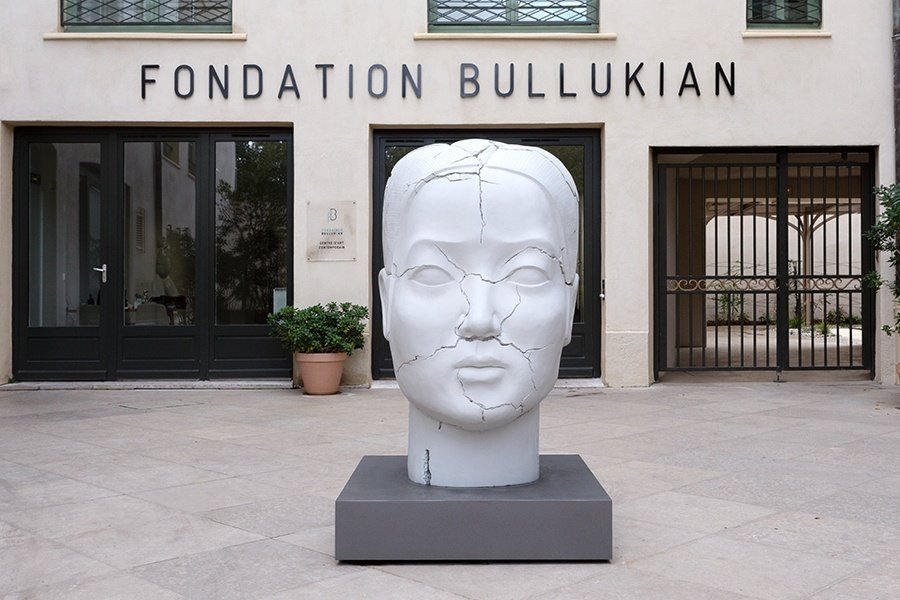
Emaho: You have been Artistic Director of the Fondation Bullukian in Lyon since 2008, now more than fifteen years, at an institution founded in 1985 by Napoléon Bullukian with a three-part mission spanning contemporary creation, medical research and the promotion of Armenian culture. That is an unusual institutional mandate: most art centres have a single identity. How do you programme for an institution whose DNA is already three things simultaneously, and has the Armenian cultural dimension of the Fondation’s mission shaped your curatorial choices in ways that a purely contemporary art centre would not have?
Fanny Robin: Navigating these different projects was a real learning experience. I had to gradually familiarize myself with fields that were initially unfamiliar to me, and that is precisely what fascinated me. The Foundation’s projects are diverse (culture, health, cooperation with Armenia), and I quickly felt the need to view them not as separate fields, but as spaces for dialogue. Nothing required me to do so, but it has always seemed to me that the most enriching projects arise precisely from these intersections. The trips I was fortunate enough to take to Armenia deeply nourished this reflection, as I discovered there a culture of great richness, a particularly stimulating contemporary art scene, and a relationship with the land that left a lasting impression on me. There, memory seems to be inscribed in the landscapes as much as in the architecture, crafts, traditional skills, and stories. This almost primal experience reinforced my interest in issues of heritage, transmission, resilience, and geography.
Twenty years later, these themes continue to flow naturally through my curatorial research. At the same time, my work on health issues has led me to reflect more broadly on the concept of care. I am now convinced that access to culture is essential to our individual and collective well-being, because art creates spaces for attention, sharing, reflection, and empowerment that play a vital role in maintaining our sense of balance. All of this has therefore shaped my approach to curating, which I view not only as a practice of building relationships but also as a space for engagement. It involves creating dialogues between works, disciplines, regions, and audiences, while taking on the responsibility of bringing forth narratives that examine our times. For me, designing an exhibition is not merely about creating a space for presentation : it is also a space for transmission and sometimes even transformation. The curator’s role is to make these exchanges possible, while remaining attentive to the contexts, histories, and people who navigate them.
Emaho: Your most recent exhibition at Fondation Bullukian, Le Mur Invisible by Sarah Jérôme, opened in January 2026 and runs until June 2026 (finished), taking its inspiration from Marlen Haushofer’s novel and presenting painting on transparent layers, ceramic and porcelain where colour is scraped, smoothed and reworked over weeks. Before that, you curated Empreintes by Prune Nourry in autumn 2025, and before that Alluvion by Eva Nielsen in early 2025. Your programming moves between artists working with materiality, the body and memory. Is there a unifying curatorial question running through those three very different practices, and how do you construct a season at Bullukian so that the exhibitions speak to each other rather than simply following each other?
Fanny Robin: I rarely build a program around a predefined theme or a seasonal breakdown. Unless the context calls for it, I prefer to let projects emerge organically and leave room for the unexpected, even if a deep coherence has emerged over time. My curatorial work relies less on applying a concept than on a process of research in which ideas respond to one another, shift, and sometimes mature over the course of several years. I always find it difficult to explain this process precisely, because it is deeply personal. Every curator develops their own way of approaching exhibitions. For me, they arise from my personal mythologies, nourished by my experiences, my reading, studio visits, and conversations. I try to remain open and sensitive to my surroundings, attentive to contexts, events, and both personal and collective transformations. Images and intuitions gradually accumulate before finding their proper expression.
Then, this intuitive and emotional dimension takes shape and becomes structured through more scientific and theoretical research, because nothing is ever improvised. Looking back, I see that a clear thread has run through all my projects over the years. Certain questions keep coming back, shifting, finding answers, and deepening, as in a cyclical narrative. I love works that are not unambiguous, that maintain a sensitive relationship with the landscape and living things, and that evoke the question of matter and memory. These are less themes than fundamental concerns that continually fuel my research, because I work with artists who do not view the past with nostalgia, but who re-engage with it to shed light on profoundly contemporary issues—whether social, ecological, political, or emotional.
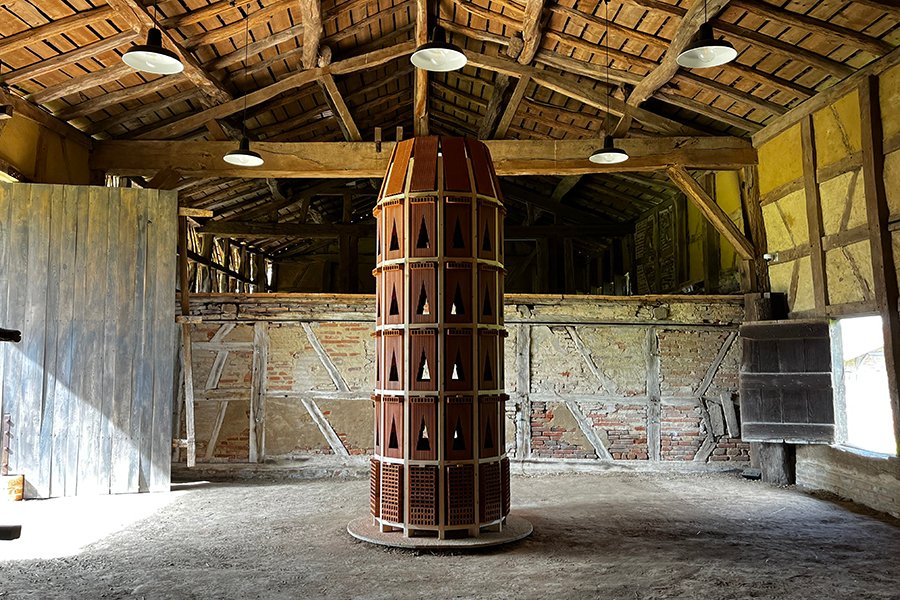
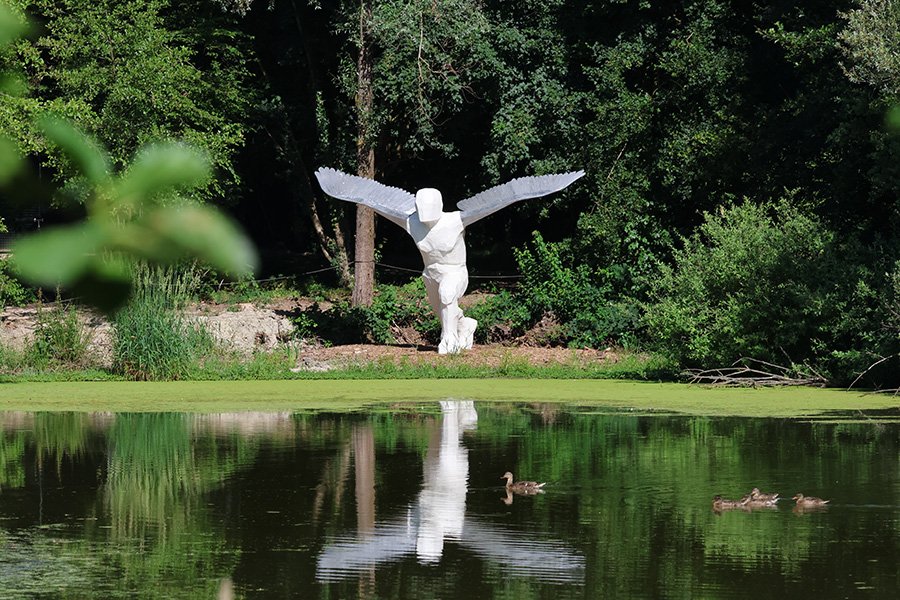
Emaho: In 2018 you founded Campagne Première, a festival that brings contemporary art and heritage to rural areas, most recently with Monts et Merveilles at Festival Campagne Première in Revonnas in June 2026 and Les Étincelantes at the Parc des Oiseaux in Villars-les-Dombes running from May to November 2026. Taking contemporary art out of the institution and into rural landscapes is a programme built on a very specific conviction about who art is for. What resistance did you encounter when you first proposed that idea, and what has the rural context given the artists who have participated in ways the gallery or museum could not have offered?
Fanny Robin: When I founded the Campagne Première association in 2018, this initiative emerged at a time when the issue of rural areas was not yet as prominent in institutional and cultural discourse as it is today. At the time, the idea of shifting perspectives, stepping outside the usual frameworks for presenting art, and fostering a dialogue between contemporary creation, the local area, and its residents could still provoke some misunderstanding. I am, of course, delighted that these issues are now more widely recognized, but I remain mindful that this momentum must be grounded in genuine sincerity. When a subject gains visibility, there is always a risk that certain initiatives may respond more to prevailing trends than to a sincere, long-term commitment. For me, a relationship with a region cannot be merely a geographical shift: it involves time, active listening, and a sensitive understanding of the places and the people who live there. That is precisely what interests me about these non-institutional contexts. Stepping outside established frameworks opens up stimulating spaces for experimentation—not only for artists but also for local residents.
These areas become interstitial zones where new forms can emerge because the usual constraints shift and new ones take their place. Interactions with people who aren’t necessarily familiar with the art world inevitably lead to reciprocal shifts in perspective : they transform not only how artworks are perceived, but also how artists view their own practice. In some cases, these encounters have even given rise to entirely new artistic forms. I believe in the ability of community-based projects to foster synergistic collaborations and unexpected situations. We are moving away from a more vertical and rigid approach to cultural dissemination to build spaces for dialogue, where everyone can become an active participant in a shared experience. This also allows people who feel disconnected from cultural institutions to find a place within the artistic experience. The challenge is not merely to bring art to new audiences, but to create the conditions for an encounter where everyone feels empowered to develop their own perspective and critical thinking. It is this relational and experimental dimension that continues to guide my commitment to this type of project.
Emaho: You and artist Raphaëlle Peria were selected as laureates of the BMW ART MAKERS 2025 programme dedicated to the visual arts and contemporary image, presenting your collaborative exhibition Traversée du fragment manquant first at the Rencontres d’Arles from July to October 2025 and then at Paris Photo at the Grand Palais in November 2025. The BMW ART MAKERS programme pairs curators and artists specifically to produce new collaborative work rather than simply to exhibit existing work. What did that curatorial and creative collaboration with Raphaëlle Peria produce that either of you could not have reached independently, and what does making a work together ask of the curator that programming an existing body of work does not?
Fanny Robin: This experience was incredible, both personally and professionally, because of its unique intensity. What stands out most to me is the power of collective work when everyone agrees to fully commit to bringing something into being that didn’t yet exist. It also strengthened my desire to support artists over the long term, through ambitious projects. You have to strike a delicate balance : listening, advising, and supporting, while also being able to drive the process forward and take risks. The curator’s role lies precisely in this space of dialogue : supporting an artist without trying to overly direct their creative process, creating the conditions for exploration while helping to open up new possibilities. In this case, the challenge was to conceive a novel concept, produce new works, and support the artist in renewing her visual practice, all while finding concrete solutions — technical, personnel-related, and organizational — that would allow the project to come to fruition within a very tight time frame. This tension between intuition and execution, between artistic ambition and the realities of production, is an integral part of the curatorial journey. It was a very demanding experience, at times trying, but deeply stimulating. It reminded me how often the most powerful projects arise from a form of shared trust. This ability to create together, to take risks, and to develop a shared language will remain a defining milestone in my journey.
Emaho: Traversée du fragment manquant translates as Crossing the Missing Fragment, a title that carries its own curatorial intelligence. The missing fragment as a structural and poetic concept has a particular resonance in Raphaëlle Peria’s practice, which involves scratching and erasing the photographic surface to reveal something underneath. How did you develop that title and that conceptual frame, and does a strong title for a curator function as a thesis to be proven or as a question to be kept open?
Fanny Robin: Writing a title and a curatorial text is an essential step in the curatorial process. It is the moment when research crystallizes and intuitions take shape. When the title is just right and the text manages to convey the intention without locking it into place, I feel as though the exhibition already exists, even before it is installed in the space. I never view a title as a mere description : it must open up a field of interpretation rather than close it off. I like it to evoke a sense of tension, a mental image, or a question, without ever exhausting the meaning of the works. Similarly, the curatorial text does not seek to explain the exhibition : it guides the viewer’s gaze, offers interpretive avenues, and invites the visitor to construct their own journey through the exhibition. For Traversée du fragment manquant, the title emerged from a conversation with the artist Raphaëlle Peria. We explored several possibilities before settling on this phrasing, which took shape through our joint effort, drawing on our respective imaginations. What interested me was precisely this idea of the “missing fragment,” which resonates with her artistic practice but also transcends it, since the missing fragment evokes what eludes us, what remains invisible — what each viewer is invited to complete through their own gaze and memory.
The term “journey,” meanwhile, introduces a dimension of travel and experience : it suggests a shift, a transformation, rather than a simple tour of the exhibition. I believe that a powerful title is not meant to prove a thesis. It opens up a horizon of thought. It creates a sense of openness, an anticipation, and sometimes even a slight enigma that accompanies the visitor throughout their exploration. This focus on language is a common thread throughout all my projects. For Monts et merveilles, conceived as part of the Campagne Première festival, the title already played on a dual level of meaning, echoing both the landscape of the Revermont and the idea of wonder. In other exhibitions, such as the upcoming group show opening at the Bullukian Foundation in September 2026, I prefer to cultivate a certain ambiguity. Thus, Facts as Challenges raises the question of engagement without ever explicitly naming it, leaving visitors free to set their own curiosity and thoughts in motion.
Emaho: You are a member of CEA, the French association of exhibition curators, of Trampoline which promotes the international influence of the French art scene, and of Les Filles de la Photo. You teach at ICART, serve as Ambassador of Paris Gallery Weekend, sat as President of the jury for Paréidolie 2025 and 2026 in Marseille, and describe yourself as particularly interested in artists who draw on the past, historical context, popular traditions, gestures and know-how, tangible and intangible heritage, to question the present. How did you arrive at that as the throughline of your practice, and is there an artist you have worked with whose relationship to the past changed your own understanding of what contemporary art can do with it?
Fanny Robin: Every artist with whom I’ve had the chance to collaborate has, in their own way, enriched my understanding of art. That’s also what I seek in an encounter: to feel an emotion and discover new avenues of thought, so that these moments become true spaces for exploration. This process continues today, whether during a studio visit or when viewing a work from the past. But if I had to name one particularly memorable collaboration, it would be the one with Andrea Mastrovito for the exhibition The World Is an Invention Without a Future, presented at the Bullukian Foundation in 2019. This project was especially significant because it embodied a conviction that runs through my practice : the most powerful works are often those that draw on history to better question the present.
By revisiting the Lumière brothers’ early films through a monumental marquetry installation, Andrea Mastrovito created a dialogue between the memory of images, the history of cinema, ecological collapse, contemporary conflicts, and post-humanist imaginaries. I was deeply moved by this ability to draw upon a collective heritage to produce a critical reading of our era, without ever sacrificing the power of poetry. This collaboration also reaffirmed my interest in artists who draw on archives, narratives, or inherited traditions—not to celebrate them, but to revitalize them and place them in tension with the challenges of the contemporary world. It is within these intersections that a significant part of my curatorial research is currently situated.
Emaho: You are simultaneously Artistic Director of a major Lyon institution, founder of a rural art festival, independent curator, art critic, jury member, teacher and BMW ART MAKERS laureate. Those are not just multiple roles but multiple institutional cultures and multiple relationships to how decisions get made and how art gets presented. How do you maintain a consistent curatorial identity across all of those contexts, and is there a version of yourself in one of those roles that the others would not fully recognise?
Fanny Robin: I have never felt as though I were juggling multiple roles : on the contrary, I believe I am pursuing the same quest, regardless of the contexts in which I find myself. What remains constant are my convictions, my values, and my approach to curating — as a practice of relationship-building, reconciliation, and transmission. On the other hand, each context calls for a different approach. The challenges faced by a foundation, an association, or an independent project are obviously not the same. You have to know how to listen to the institution and its staff, and understand its history, constraints, and audiences. I strongly believe in this ability to adapt — not to change one’s identity, but to find the most appropriate form. Being demanding also means knowing how to serve a given context without ever losing sight of one’s convictions. This requirement also involves collective work : I am convinced that the most ambitious projects arise from the synergy of diverse areas of expertise.
I like to surround myself with people whose skills complement my own, to accept that dialogue challenges our certainties, and that decisions are made collaboratively. Curating is often perceived as an individual practice ; I experience it first and foremost as a collective adventure. It is also this movement between different spheres that fuels my commitment. I believe it is essential that the resources, visibility, and credibility gained within an institution can feed into more experimental, community-based, or locally-rooted projects. In my view, these worlds are not opposed to one another ; they reinforce each other. Facilitating dialogue between these different worlds is undoubtedly one of the most important aspects of my practice.
Emaho: You have described being interested in the culture of doing things together, and your practice across Bullukian, Campagne Première and BMW ART MAKERS consistently involves deep collaboration rather than solo curatorial authorship. In a contemporary art world that still tends to elevate the individual curator as the primary creative voice, what do you think gets lost in that model, and what has working so consistently through collaboration taught you about what shared authorship actually produces that individual expertise cannot?
Fanny Robin: This vision of the dominant curator does not align with my understanding of this profession. Of course, a curator brings a unique perspective, a sense of responsibility, and a curatorial voice, but an exhibition is always the result of collective intelligence, as I mentioned earlier. It is built through dialogue with artists, and thanks to the work and dedication of the production and outreach teams, always in connection with an ecosystem of institutions, partners, regions, and audiences. It is precisely this interplay that interests me. Working at the intersection of different contexts allows me to build bridges between worlds that still interact far too little. I am convinced that these points of connection enrich both the projects and the people behind them.
Furthermore, I believe it is essential that the visibility and credibility gained within an institution like the Bullukian Foundation can now feed into more experimental projects or those rooted in local communities — as I am doing with Campagne Première — and vice versa : that the forms of innovation developed on the ground can in turn nourish the institutions. These exchanges generate much more fruitful dynamics than spaces that operate in isolation. Co-creation does not dilute responsibilities ; it broadens the range of possibilities. It is precisely in this ability to embrace the unexpected that, in my view, the richness of curatorial work lies. My role is not to impose a vision, but to create the conditions for a rigorous dialogue in which everyone contributes to the emergence of a shared vision, without losing sight of individual perspectives.