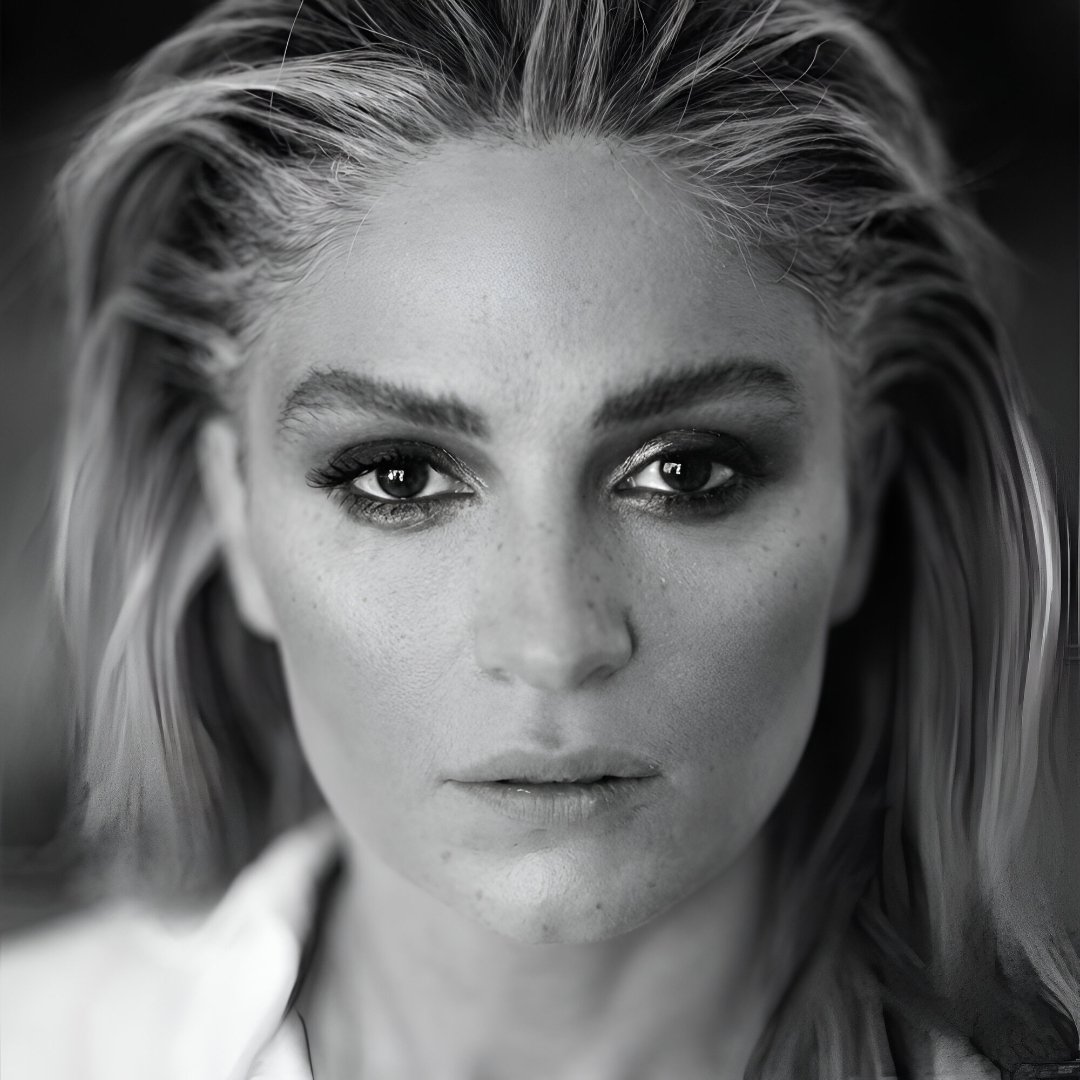
Emaho: You were born on January 8, 1986 in Almaty, Kazakhstan, raised in Munich in a working class family, and have said that one of your earliest creative memories is sitting on the floor with a stack of magazines, scissors and coloured pencils, cutting out buildings, animals and patterns and collaging them into your own drawings to create imaginary worlds. Most artists can point to a single object, a book or a film or a painting, that cracked something open. For you it sounds like the medium arrived before the vocabulary. When did you first understand that what you were doing on that floor was not just play but the beginning of a practice?
Constantin: I think I understood it much later, but the instinct was already there. As a child, I did not have the vocabulary for collage, surrealism, or visual storytelling. I was simply creating worlds that felt more exciting than reality. Sitting with magazines, scissors, coloured pencils, and images was a way of escaping, but also a way of understanding the world. I was not just cutting things out. I was giving them a second life, placing them into new relationships, and building a universe where everything could coexist. Looking back, that was the beginning of my practice.
Emaho: You studied fashion and communication design in Munich, began your career working with Condé Nast in Paris, moved to Berlin where you worked for a famous fashion designer, then relocated to Italy where you found it hard to find work and began making collages in your free time. It was not a training programme or a gallery or a mentor that launched your practice but that specific period of difficulty in Italy, of having time and no brief. What did having nothing to do for a client actually unlock in you that working for others had prevented?
Constantin: At that time, I was still based in Berlin, but my first real opportunities as an artist came from Italy. Italian luxury brands gave me creative freedom when my visual language was still developing. They trusted my imagination, gave me space to experiment, and helped me begin to be discovered internationally. It gave me confidence. I realized that collage could move beyond a personal practice and become a professional language for creating entire worlds.
Your first collages were stills, and the shift into animation happened when a communication agency client in Paris asked you for animation, you reached out to former university companions who specialised in multimedia, they sent you a result they were themselves not excited about, and you said: it is right, I want it, because nobody had done it like that before. That instinct, to choose something your own collaborators doubted, is a very particular kind of creative confidence. Where does that certainty come from in a room full of people who disagree with you?
It comes from recognizing a feeling before it becomes logical. Sometimes, when something is new, people around you cannot immediately understand it because they have no reference for it yet. When I first saw animation entering my collage world, I felt that something had opened. It was imperfect, but it had life. I trusted that feeling. I think creative certainty is not about being sure that you are right. It is about knowing when something has energy, when it contains the beginning of a language.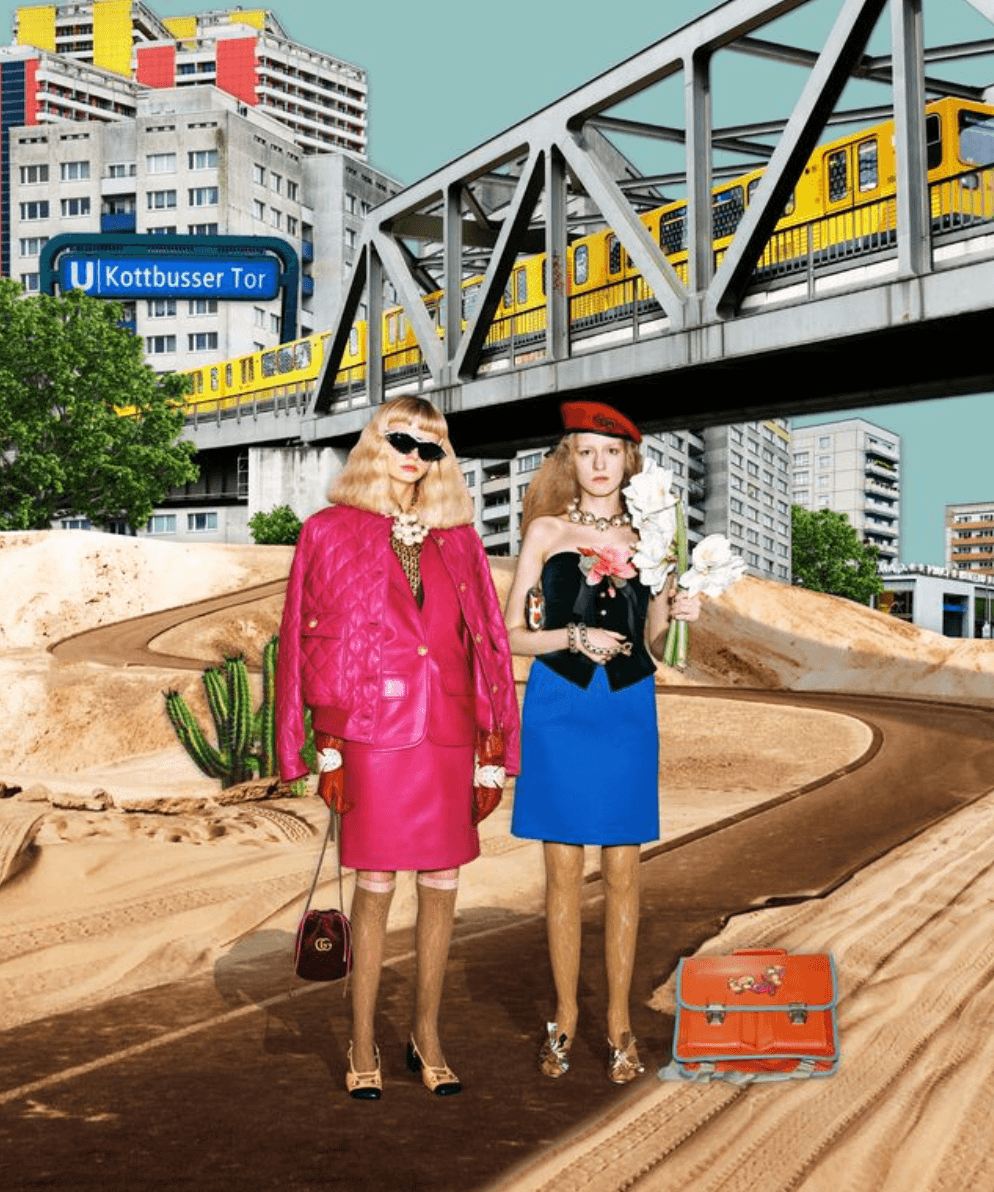
Emaho: Each of your collages is composed of hundreds of layers of superimposed images and requires nearly two months of work. You take on only one brand project per year by choice, and you have said you cannot call your output content because it takes too long. In a creative economy that rewards speed, quantity and algorithmic consistency, what has the discipline of slowness actually protected in your work, and has any client ever tried to change that and been refused?
Constantin: Slowness protects the soul of the work. My collages are made from hundreds of layers, and each detail needs time to find its place. I cannot treat them as content because content is often designed to disappear quickly. My work needs to stay alive longer than the moment in which it appears. Slowness allows me to build atmosphere, emotion, and meaning. It protects the work from becoming disposable. Of course, we live in a world that rewards speed, but I believe people still feel when something has been made with care.
Emaho: You have described your work not as advertising but as artistic collaboration, and said you do not accept commissions from brands but choose who you work with based on values and inspirations. You have worked with Moncler alongside Richard Quinn for the 2019 Genius collection, Gucci under Alessandro Michele, Louis Vuitton for the Louis200 campaign in 2021, MINI for MINIVERSUM in 2023, Universal Genève for its 2024 relaunch, and AMI Paris for the L’Échappée Belle collection. That is an unusually selective roster built entirely on your own terms. What does a brand have to have for you to say yes, and what has made you say no?
Constantin: A brand needs to have a story, a soul, and a sense of imagination. I am not interested in simply placing a product inside a beautiful image. I need to feel that there is a universe to explore. With Moncler, there was the freedom to dream through the Genius collection. With Louis Vuitton, there was the extraordinary heritage of travel, the trunk, and the celebration of 200 years. With De Beers London, there was a deep cultural history, craftsmanship, and the challenge of translating memory into a physical installation. I say yes when I feel that my visual language can open a new dimension inside the brand’s story.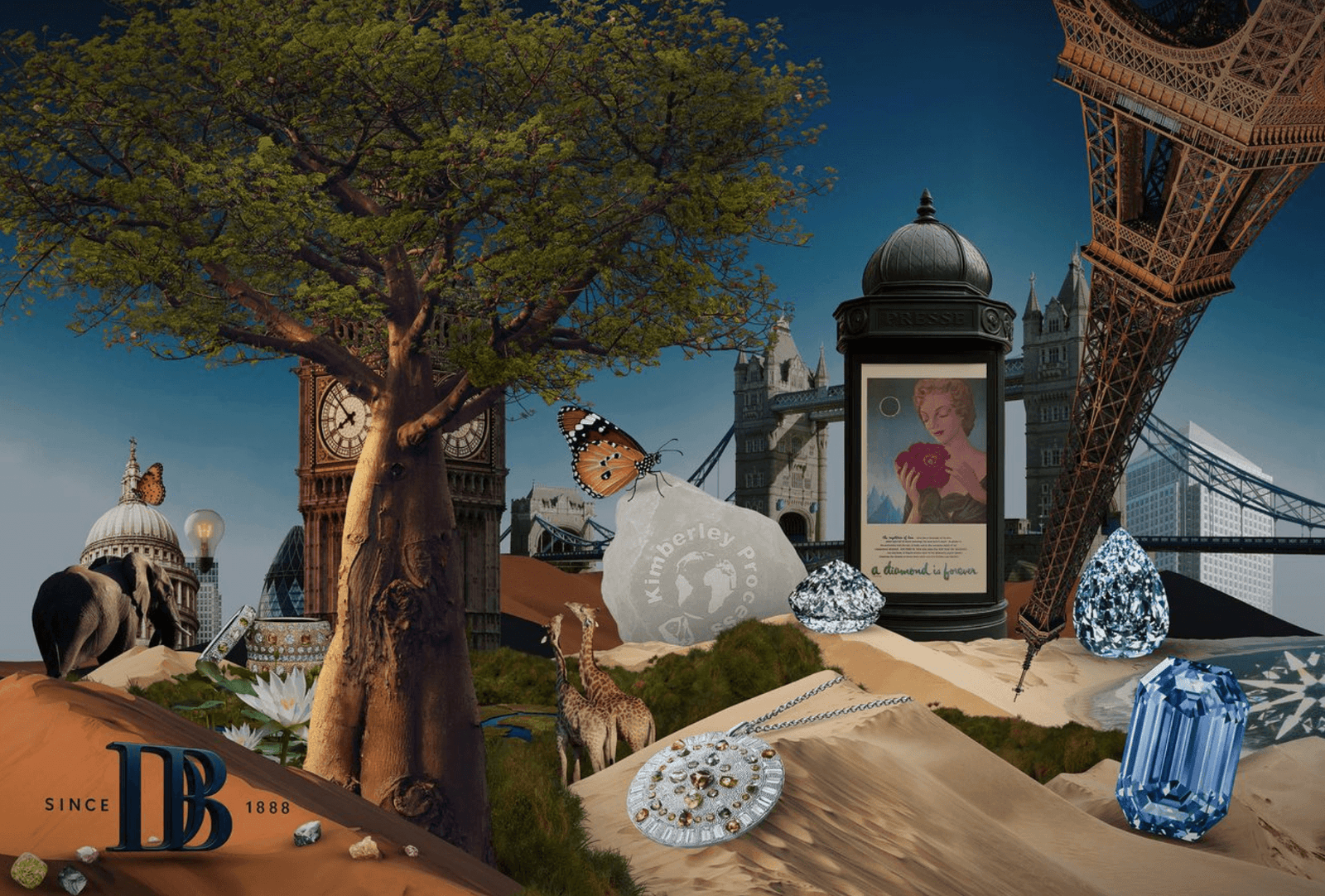
Emaho: The De Beers Story, unveiled in January 2026 at De Beers London’s new Paris flagship on Rue de la Paix, is your first permanent three dimensional physical installation, translating your digital collage language into a sculptural heritage wall that guides visitors through the house’s key moments from the creation of A Diamond Is Forever and the Four Cs to conservation work in the Okavango Delta and the establishment of the Kimberley Process. Moving from a screen based practice into permanent physical matter is a significant shift. What did making something that cannot be updated, deleted or animated ask of you that the digital work has never had to answer?
Constantin: “The De Beers Story“ was a turning point because it asked my work to leave the screen and enter the physical world. A digital collage lives through movement and light, but a permanent installation has to speak through material, scale, and presence.
For De Beers London, I wanted to create a sculptural journey through heritage, culture, and imagination. Translating the House’s history into a three dimensional Heritage Wall allowed me to bring together craftsmanship, storytelling, and surrealism in a new way. It showed me that collage can become more than an image. It can become a space, a memory, and an experience.
Your stated influences span Hieronymus Bosch’s nightmare visions, Salvador Dalí’s dreamscapes, Andy Warhol’s pop sensibility, Jeff Koons’ playful scale, the Mexican surrealists Frida Kahlo and Remedios Varo, the Dadaists, photographers Tim Walker, David LaChapelle, Peter Lindbergh and Herb Ritts, and filmmakers Wes Anderson and Tim Burton. That is one of the most eclectic visual libraries in contemporary art. How do you stop a visual library that large from becoming noise, and when you sit down to begin a new work, which of those voices speaks first?
I always begin with emotion. References are important, but they cannot lead the work alone. If I begin only with images, the collage becomes decorative. If I begin with emotion, the images find their place. I admire many artists and filmmakers, from women surrealists such as Frida Kahlo, Remedios Varo, and Leonora Carrington to Wes Anderson and Tim Burton. But when I create, I am not trying to quote them. I am trying to enter a mood. Once the atmosphere is clear, the visual world becomes more precise.
Emaho: You have described your emotional register as happiness, nostalgia and melancholy operating simultaneously inside a single image, joy and loss held together rather than resolved, and this runs through everything from your childhood floor collages to your luxury brand campaigns. What is the personal source of that specific combination, and do you think it can be taught or is it only something that can be lived into?
Constantin: I think it comes from memory. Childhood, dreams, places we leave behind, people we meet, and things we lose all create emotional layers inside us. I am interested in images that feel beautiful but also slightly fragile. Happiness alone can become flat. Melancholy gives it depth. Nostalgia gives it time. In my work, I try to hold these emotions together because that is how life feels to me. Beauty is often strongest when it carries a gentle melancholy.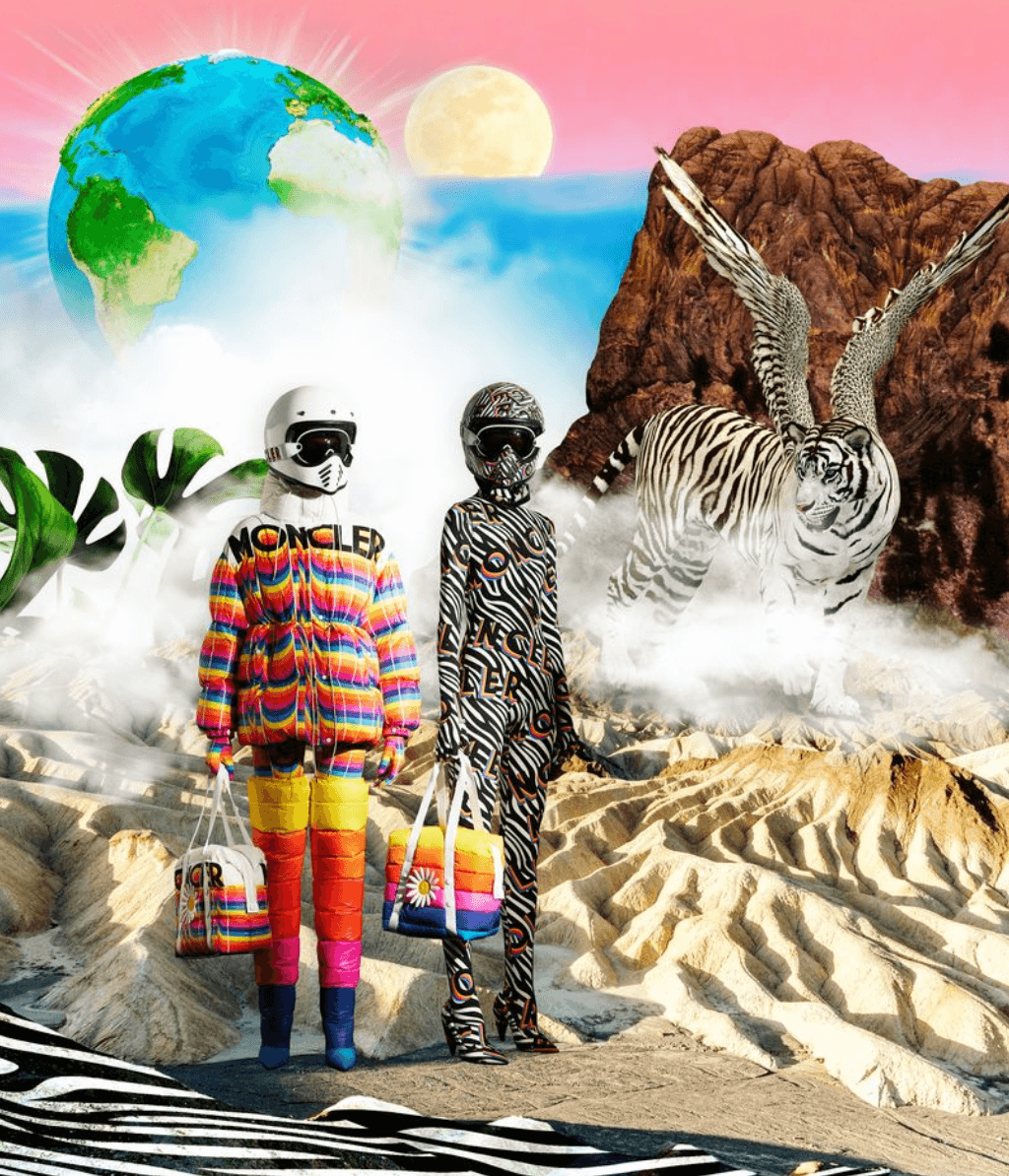
Emaho: You are now writing your first book, a coming of age story set in California in 1984, and you have said your next step is to become a director, that you want to go to Los Angeles and take your first steps into filmmaking. You described collage as your chosen medium partly because of its immediacy, yet each piece requires two months and hundreds of layers. Film has its own version of that paradox. What specifically does the moving image allow you to say that even animated collage cannot, and what are you afraid of losing in the translation from a medium you have mastered to one you are beginning?
Constantin: Film is not about leaving collage behind. For me, collage and cinema are two separate artistic languages. Collage allows me to tell animated stories in a few seconds, to open a door into a world very quickly. Film allows me to stay inside that world for much longer.
What excites me about feature film is the possibility of going beyond the short visual moment and building a complete story. It gives the viewer time to live inside the atmosphere, to follow the emotion, and to experience the universe in a deeper way. I do not want to lose collage. I want to let each medium do what it does best, while carrying the same imagination into a longer form of storytelling.
You live and work in Paris, were born in Kazakhstan, raised in Germany, built your career moving between Paris, Berlin and Italy, and are now moving toward Los Angeles. You have said you see the world as flooded with images and that your goal is not to add to them but to recycle some, to bring a new perspective. For an artist whose entire practice is built on images taken from elsewhere and reassembled into something new, how do you think about originality, and at what point does an image stop being a source and become yours?
For me, originality is not about creating something from nothing. It is about transformation. We all live inside a world of images, memories, histories, and references. What matters is how you see them, how you connect them, and what emotional truth you bring to them. In collage, an image stops being only a source when it enters a new world and begins to serve a new meaning.
That is what happened for me with Louis Vuitton. The trunk is one of the most recognizable objects in luxury history, but in my work for the Maison’s 200 year anniversary, I imagined it as a vessel travelling through past, present, and future. It became part of a surreal journey of discovery. With Moncler, the collection reminded me of space suits, so I wanted to send them into outer space to discover dreamlike worlds. With De Beers London, historical moments became a sculptural visual narrative. In each case, the source remains present, but it is transformed through imagination. That is where originality begins.