Japan –
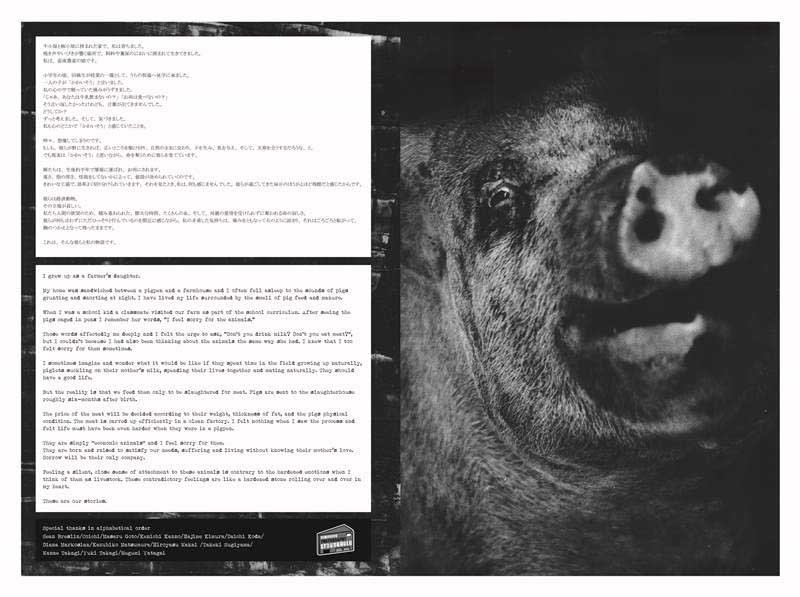
I grew up as a farmer’s daughter.
My home was sandwiched between a pigpen and a farmhouse and I often fell asleep to the sounds of pigs grunting and snorting at night. I have lived my life surrounded by the smell of pig feed and manure.
When I was a school kid a classmate visited our farm as part of the school curriculum. After seeing the pigs caged in pens I remember her words, “I feel sorry for the animals.”

Those words affectedly me deeply and I felt the urge to ask, “Don’t you drink milk? Don’t you eat meat?”, but I couldn’t because I had also been thinking about the animals the same way she had. I knew that I too felt sorry for them sometimes.
I sometimes imagine and wonder what it would be like if they spent time in the field growing up naturally, piglets suckling on their mother’s milk, spending their lives together and mating naturally. They should have a good life.
But the reality is that we feed them only to be slaughtered for meat. Pigs are sent to the slaughterhouse roughly six-months after birth.
The price of the meat will be decided according to their weight, thickness of fat, and the pigs physical condition. The meat is carved up efficiently in a clean factory. I felt nothing when I saw the process and felt life must have been even harder when they were in a pigpen.

They are simply “economic animals” and I feel sorry for them.
They are born and raised to satisfy our needs, suffering and living without knowing their mother’s love. Sorrow will be their only company.
Feeling a silent, close sense of attachment to these animals is contrary to the hardened emotions when I think of them as livestock. These contradictory feelings are like a hardened stone rolling over and over in my heart.
These are our stories.
Written and Photographed by – Nozomi Iijima
Newsprint can be purchased at the Reminders Stronghold Gallery
Book Review : Scoffing Pig by Palash Krishna Mehrotra
The Japanese photographer, Nozomi Iijima, spent her growing up years on her parents’ farm. This experience affected her deeply as is evident from her book of photographs: Scoffing Pig.

Being the daughter of farmer parents she knew that the relationship with animals was a two-pronged one. They primarily served an economic need, which required taking hard decisions like separating them from their mothers at an early age, and putting them in small cages according to size. They were also not given pet names. Cruelty was something she observed close-hand. On the flipside, she had the opportunity to observe cattle and pigs from very close-quarters, something that she puts to use in these black and white photographs.
Iijima has no specific ethical agenda. She continues to remain a meat-eater herself. Yet, in these disturbing photos, she brings a passionate eye to the plight of caged animals. In image after image, we see the morose, helpless eyes of these pigs, waiting to be sent to slaughter. In some, their snouts press against or through the bars of the cage, desperate for a whiff of freedom.
While other photographs in the book bring us news of life up-close on a farm—including one very striking image of a cow giving birth, the most arresting ones remain those of the imprisoned pigs. Their sadness and loneliness remind us of the moral ambivalence on which our own existence is based on.

Palash is the author of the book, The Butterfly Generation. He writes a fortnightly column for Mail Today Sunday, and is a Contributing Editor at Rolling Stone.