Emaho: Your practice moves fluidly between painting, drawing, textiles, video, and sculpture. Do you choose the medium first, or does each idea demand its own physical form?
Jedda: For the past few years, my practice has been focused primarily on painting, so reflecting on my earlier, more multidisciplinary work feels somewhat distant. However, when I think back to that time, I see how my choice of medium was always driven by concept. One memorable piece was a video work where I painted myself green and blended into the landscape using a green screen. It was a physical act of erasing myself, creating a hole in my belly/womb space through which the landscape poured in. This act was a way to dissolve into the environment, to become part of it rather than simply depict it.
Although painting has become my primary medium, the material experiments and embodied practices from this earlier work continue to influence my approach today. The idea of erasure, transformation, and embodiment remains central to how I approach the painted field. I still view the canvas as a space where the figure can disappear or transcend its physicality. In my more recent work, I blur the lines between figure and landscape, with figures often merging into the environment or the environment taking on a human-like quality. This reflects my ongoing exploration of the interconnectedness between body and land, and how these elements can bleed into one another.
Emaho: Series such as WIMON, FEEEEELINGS, and more recently Unbodied confront womanhood through intensity rather than softness. What does exaggeration allow you to say that realism cannot?
Jedda: I like playing with the idea of realism as subjective — something fluid, personal, and shaped by what is unseen. In my work, I’ve developed the concept of Angelic Dissociation, which navigates the tension between the physical world and the ethereal, where being in the body but not entirely of it feels essential to how I experience the world. While my work deviates from traditional realism, each piece reflects a deeply embodied vision or feeling.
The figures I paint attempt to capture a larger-than-life, out-of-body experience, where boundaries between body and spirit blur. I’ve long been drawn to the darker side of femininity, exploring the idea of women as “monsters” rather than soft, passive archetypes. This isn’t about vilifying women but embracing their power and complexity – seeing strength as pure love and raw intimacy. I’ve often focused on women who embody both chaos and healing — their monstrous qualities as sources of vitality.
The scale, gesture, and vibrant colour in my work may seem exaggerated, but they’re simply reflections of the energy. Choosing intensity over softness in my paintings allows me to communicate power and presence. Softness can feel passive, but intensity invites engagement, even discomfort — a deeper, more honest interaction with the figure. It gives room for confrontation and transformation, enabling the viewer to feel something more visceral, something less easily ignored.
The tension between embodiment and disembodiment is central to my practice. I blur the line between figuration and abstraction, transforming figures into emotional terrains. These figures are not fixed but are dynamic fields. I paint women as expansive beings, reclaiming the monstrous as an essential part of the human experience — especially the feminine.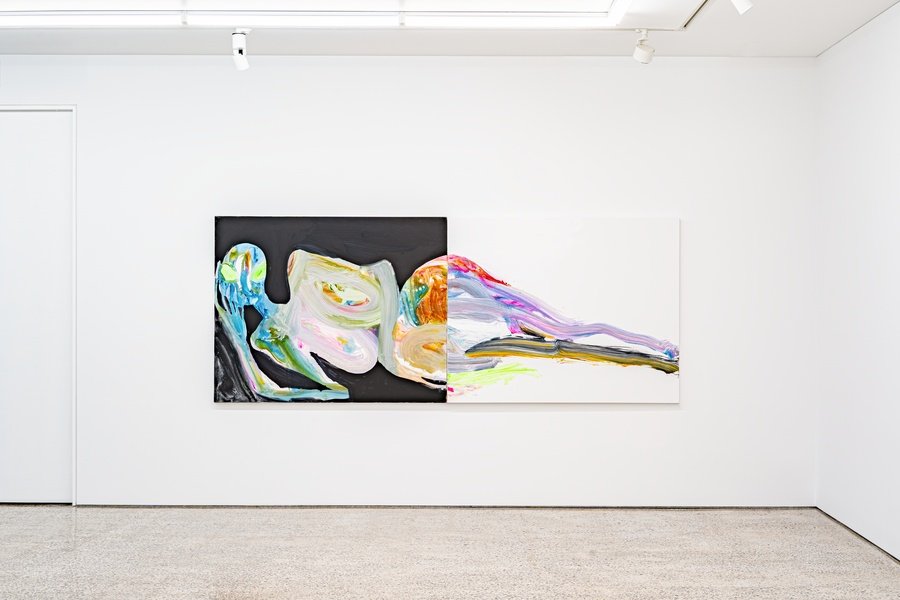
Emaho: Your figures often feel psychologically charged, sometimes monstrous, sometimes tender. You have spoken about fear, motherhood, and near-death experiences informing your work. How do you translate lived experience without illustrating it directly?
Jedda: The feeling of leaving my body — of stepping outside myself — has been a central obsession for the past five or six years. This fragmented, chaotic state has become an integral part of my practice. I actively access this sensation through meditation, hypnosis, and other altered states of consciousness, sometimes daily or weekly. It’s as though I’m learning to unmake myself.
This exploration is deeply personal, informed by lived experiences that have shaken my sense of identity. In those moments of profound disconnection, I felt the fragility of the body and the boundlessness of spirit. For me, painting becomes a means of visualizing something intangible — a body that is not fixed or anatomical.
More recently, I’ve been studying the 1983 CIA report Analysis and Assessment of Gateway Processes, which examines whether certain techniques, such as “Hemi-Sync” soundwaves, can alter human consciousness to achieve out-of-body experiences and access realms usually invisible to our physical senses. I find it fascinating to align my personal experiences with the research of others working in completely different contexts.
Alongside this exploration of altered states, my practice also draws on the power of motherhood. In becoming a mother, I’ve tapped into a primal, almost monstrous energy that is both creative and destructive. This energy is immense, something that exists far beyond traditional concepts of femininity or motherhood. It’s a raw, untamed force that is out of this world — a source of power and transformation. The belief that we are more than what we appear on the surface is fundamental to my work. My paintings visualize this expanded sense of self.
Emaho: Titles play an unusually active role in your practice. They read almost like parallel texts. Do you see language as a collaborator in your work, or as a form of resistance to being misread?
Jedda: Language plays a crucial role in my practice. Sometimes, when I’m deep in the flow of painting, a sentence or idea arrives — as if the painting itself is speaking to me. I quickly scribble it down, knowing I’ll return to it later when I’m working on titles or written material for the work.
For me writing is intuitive; it can’t be forced. I’m fascinated by how words can carry such power. A beautifully or harshly crafted sentence can move you, shift your perception, or even make you cry. Writing is a private form of expression — I like how written pieces can be small enough to tuck away in a drawer— secrets even —, but when shared, it can transfer energy from one person to another in a profound way.
I love this duality of writing. I guess I’m also fascinated by how neat and tidy the process can be in comparison to my painting practice. I work on large-scale canvasses in my studio, the gestures I make use my whole body. It’s important to me that each mark expresses the length and urgency of my entire physicality — this is how I transmit my energy onto the canvas. So, it’s fascinating for me that a similar resonance of power can be crafted in little tidy notes and very easily cleaned up as if it was never done. Because of this, writing often runs parallel to my visual practice rather than serving it secondarily.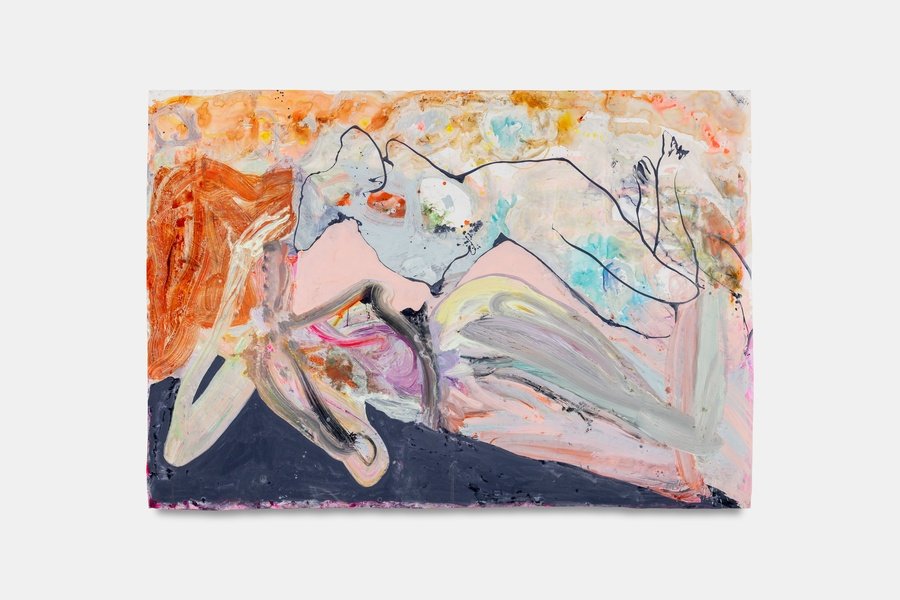
Emaho: In Download Hats, the body becomes fragmented, stretched, and digitally inflected. How has the contemporary condition, particularly screens and mediated identities, reshaped the way you think about the figure?
Jedda: Downloads Hats was a playful title referencing the idea of downloading information through technology. But for me, it was more about receiving a “download” from another realm and at the time coined almost jokingly — an idea or feeling arriving from somewhere intangible. The phrase came from conversations with close friends, where we’d ask, “Did you get that download?” — meaning a sudden moment of knowing that felt more like a transmission than a logical thought.
While the title nods to technology, I intentionally created a life with little engagement with it. For me, the word “download” is more metaphorical, closer to psychic reception than anything digital. I chose this title to introduce metaphysical and pseudoscience ideas into my practice without making them too heavy.
The paintings in this series began to explore psychoactive portraiture — images that alter the viewer’s perception, not just visually but emotionally. This marked a shift in how I understood perception: it is never fixed, and each person’s experience of an image is shaped by their internal state. This understanding became foundational for my later work, where paintings invite viewers into a shared but unstable psychological space.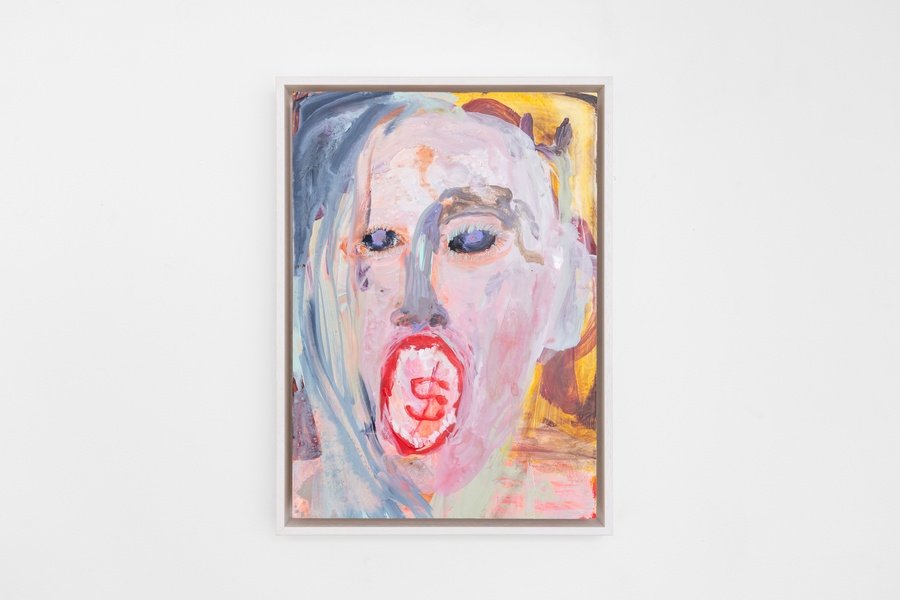
Emaho: Color in your work feels visceral rather than decorative. How do you use color as an emotional or physical force, especially when addressing themes like birth, rage, and vulnerability?
Jedda: Growing up around artists with a deep love of colour, I’ve always experienced the world as inherently vibrant. Colour is not just an added layer; it’s the foundation of how I perceive everything. As a child, I would press hard on my closed eyes to see shifting rainbow spots, and even now, in moments of meditation or altered awareness, colour is often the first thing to emerge.
In the studio, colour acts almost as a force. I sometimes try to restrict my palette, thinking it might bring clarity, but that rarely lasts. Eventually, the colours open up, and the painting begins to organise itself through chaos. For me, colour functions as a language that communicates directly to the body, bypassing the intellect. It’s less about cultural or historical symbolism and more about how colour feels — its temperature, weight, and vibration.
Colour becomes a carrier of internal states outward. My practice celebrates this sensory intensity, allowing colour to lead the work and act as a bridge between inner experience and shared perception.
Emaho: Feminist thought has long informed your work, but never didactically. How do you negotiate making work that is politically charged without becoming illustrative or instructional?
Jedda: Feminist thought informs my work, but I don’t want it to be overtly didactic or instructional. I used to think my feminism was gentle, domestic based, curtain blows in the breeze – stitching kind – but more recently I’m interested in exploring the complexities of female existence — the contradictions, the chaos, and the fluidity of being a woman.
For me, feminism is less about a moral lesson and more about creating space for the viewer to feel the emotional and embodied experience — whether it’s the rawness of motherhood, the power of rage, or the ethereal. The figures I paint blur the lines between body and environment, challenging fixed ideas of identity and power.
Writing is just as central to my practice. My titles often carry even more poetic weight and intensity than the paintings themselves. They are not explanations but rather amplifications of the feelings and energies I explore in the visual. I do and I don’t believe feminist work needs to be loud or overtly political. Sometimes the louder the better but there’s power in subtleties, in letting the work speak for itself. I wouldn’t say my work is subtle, but I would say that I am working with feminist themes that are not obvious.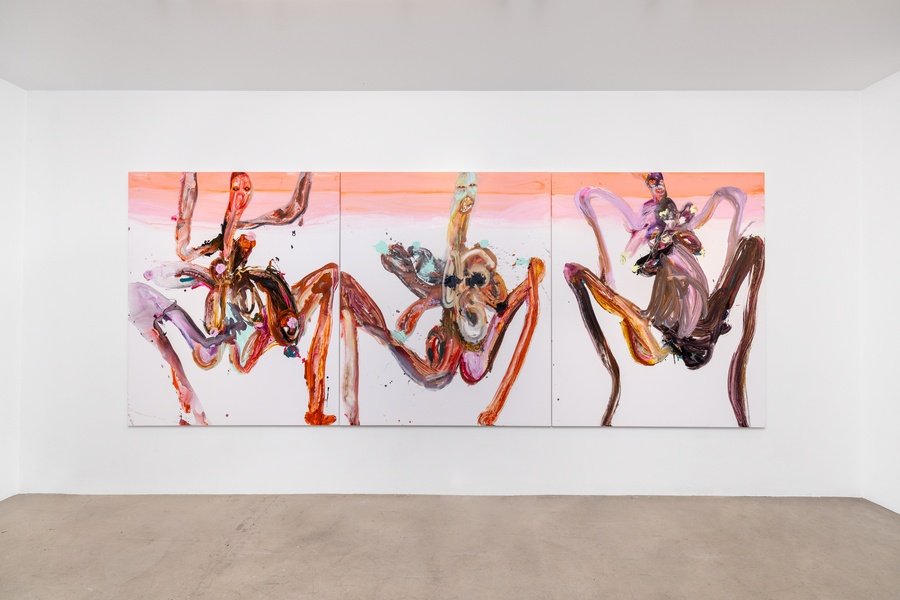
Emaho: You have moved from landscapes toward bodies that feel like terrain. When did the body become your primary site of inquiry, and what questions does it still hold for you?
Jedda: I’ve always seen bodies and landscapes as interconnected. Even in my earlier landscape paintings, the forms were often soft, figurative, or suggestively bodily. There’s always been a direct and intuitive relationship between the two for me.
Because of this, I don’t think of myself as painting figures in the traditional sense. They aren’t recognizable human forms; they feel closer to landscapes — topographies, emotional terrains. These forms exist in a metaphysical sense, where inner and outer worlds collapse into each other. There’s no clear distinction between figure and ground, body and environment.
The body becomes a site that absorbs, reflects, and dissolves into its surroundings. This collapse of boundaries mirrors how I experience the self: not as a contained entity, but as something porous and in constant dialogue with the world around it. My recent work continues this exploration, with figures that feel less like individuals and more like states of being — expanded, unstable, and in flux.