Emaho: You were born on Spain’s Mediterranean coast with French a Norwegian mother and grandmother. and You grew up between two very different visual cultures. Before you ever picked up a brush, how did those two worlds shape the way you see things, and which one do you think lives more naturally in your paintings?
Irene Noren: Growing up between two cultures shaped the way I see before I even knew I would become a painter. My paintings live in the tension between the two. I don’t try to resolve it. One side is more embodied, open, almost exposed. The other is quieter, more internal, more contained. I move between those two ways of seeing constantly, so it feels natural that the work does the same. I’m not interested in choosing one over the other, because that tension is not something I step out of. It’s who I am.
Emaho: You came to painting not through art school but through a deeply personal impulse, moving to New York and wanting to make something for the person you loved. Most painters spend years training before they make their first real piece. What was it like discovering the medium completely on your own terms, without anyone telling you what it was supposed to look like?
Irene Noren: Starting to paint without any formal training allowed me to approach it without fear or expectation. I wasn’t trying to make “good paintings,” I was trying to make something that felt true. There was a kind of freedom in not knowing what painting was supposed to be. I followed intuition more than knowledge. Looking back, that period was important because it established a relationship to painting that is still very direct and personal. Later, training helped me refine it, but the core of it comes from that first impulse.
Emaho: You completed a residency at Michael Werner Gallery shortly after you started painting, which by any measure is an extraordinarily fast arrival. You have said you had no expectations going in. What did the experience demand of you that your own studio practice had not yet?
Irene Noren: The residency forced me to take the work seriously very quickly. In my own studio I was still exploring, but there I had to stand behind what I was making. I had to think differently about why I was painting. What it demanded was clarity. Not necessarily answers, but a sense of direction. It made me realise that painting is not only about making images, but about building a position over time.
Emaho: Your paintings are described as shaped by early Renaissance symbolism and late Impressionist atmosphere, making the domestic quietly mythic. The Renaissance and Impressionism are centuries apart in philosophy and technique. Where exactly do they meet in your work, and was that a conscious decision or something you only recognised in the paintings after you made them?
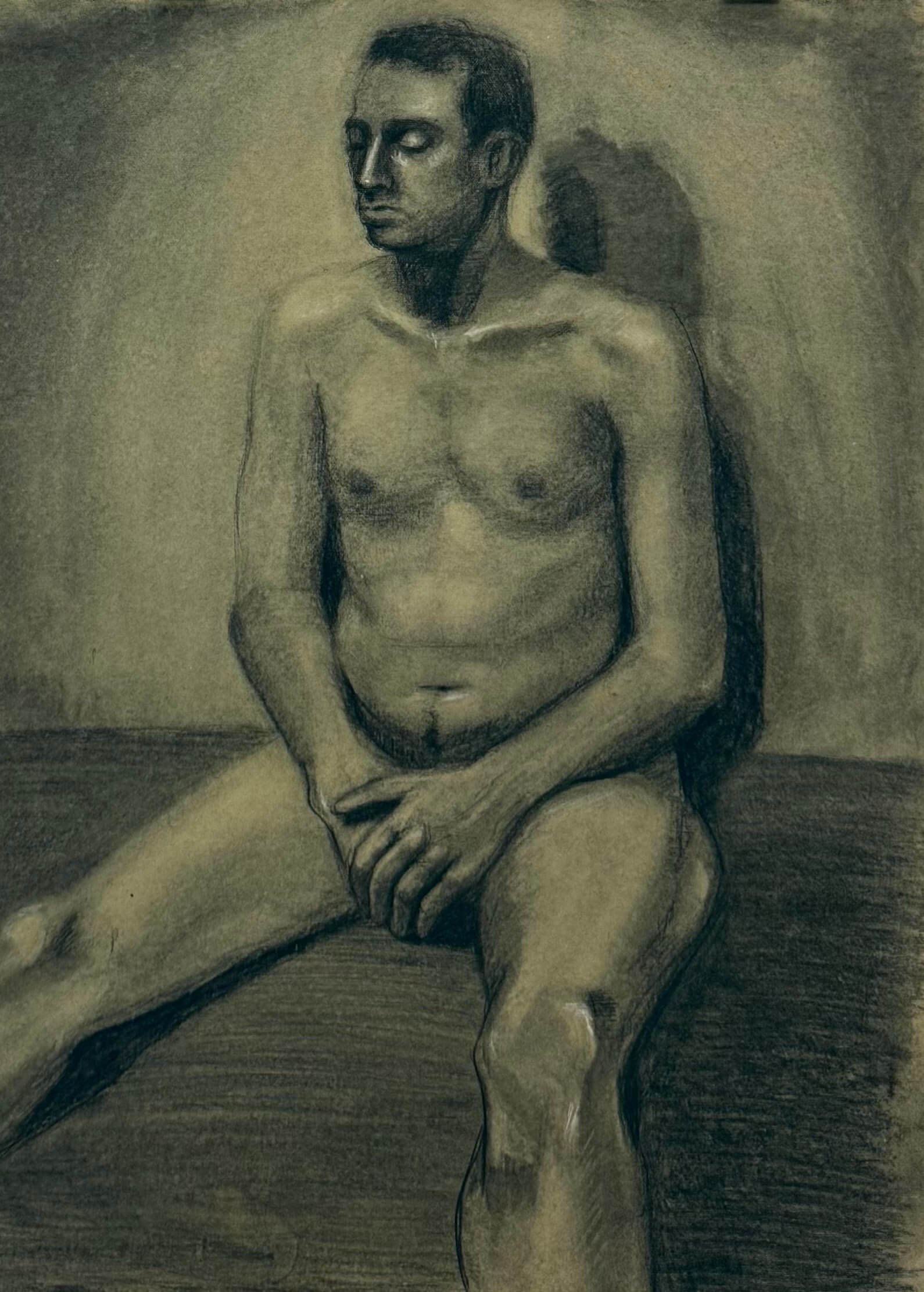
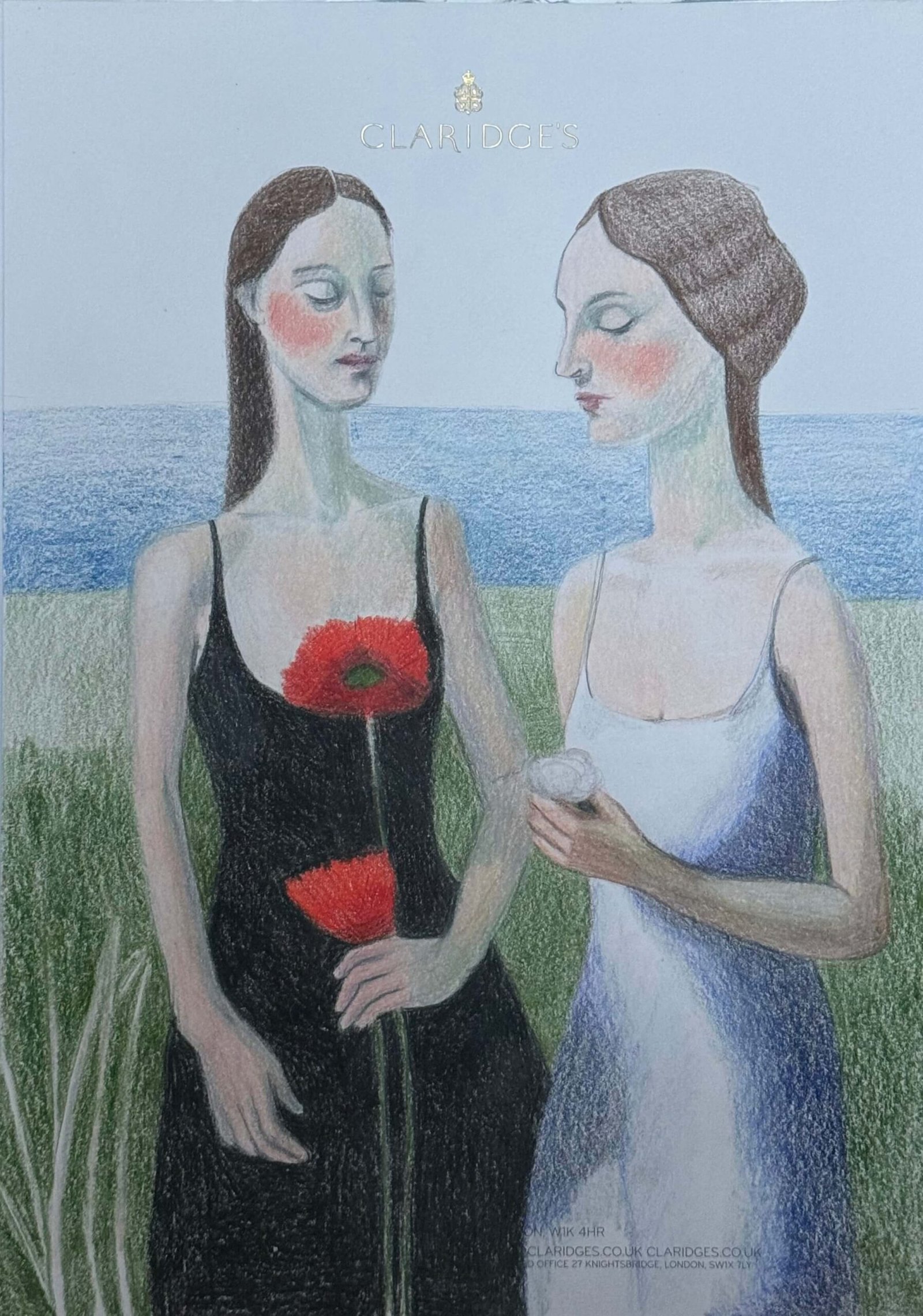
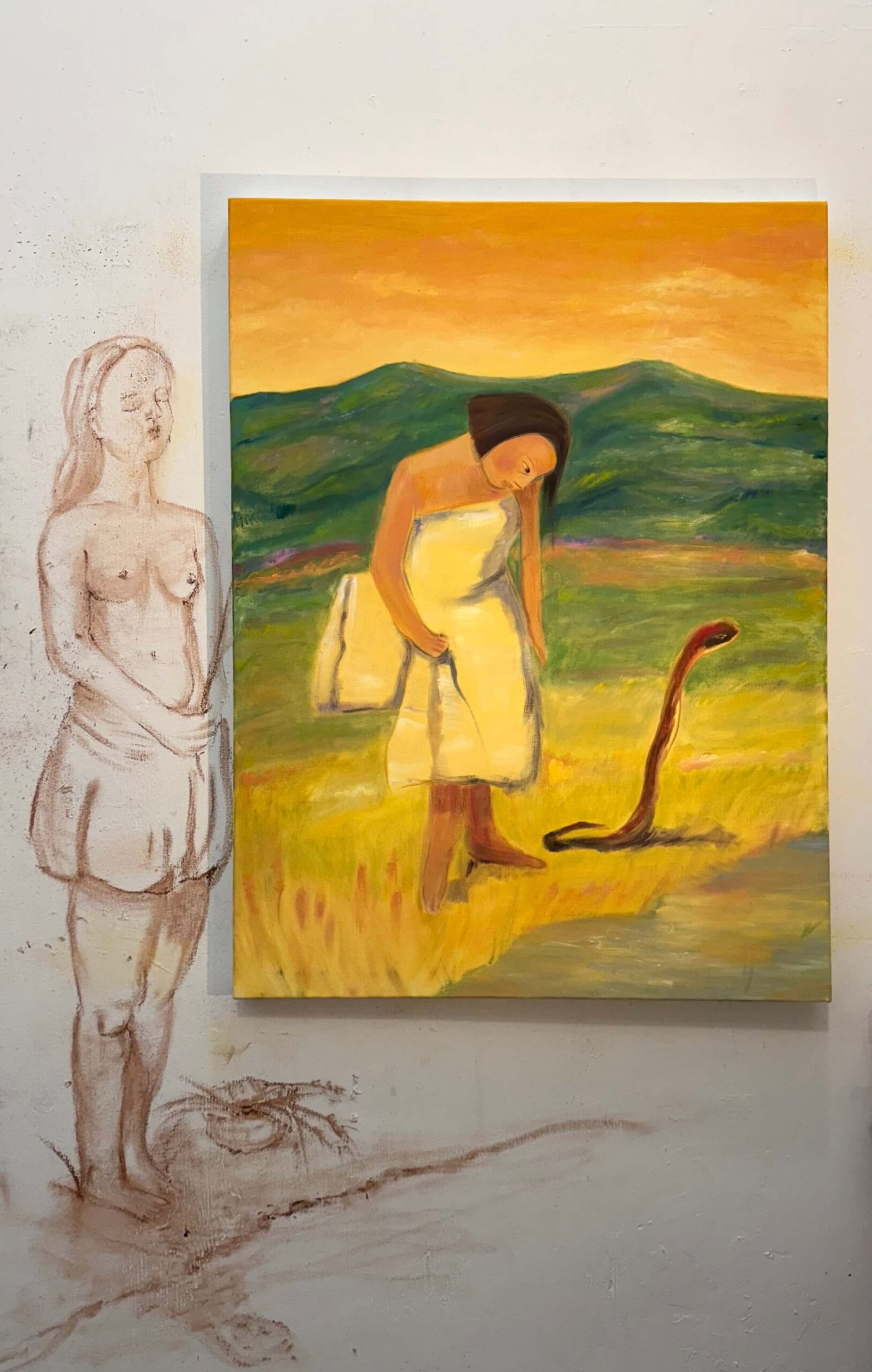
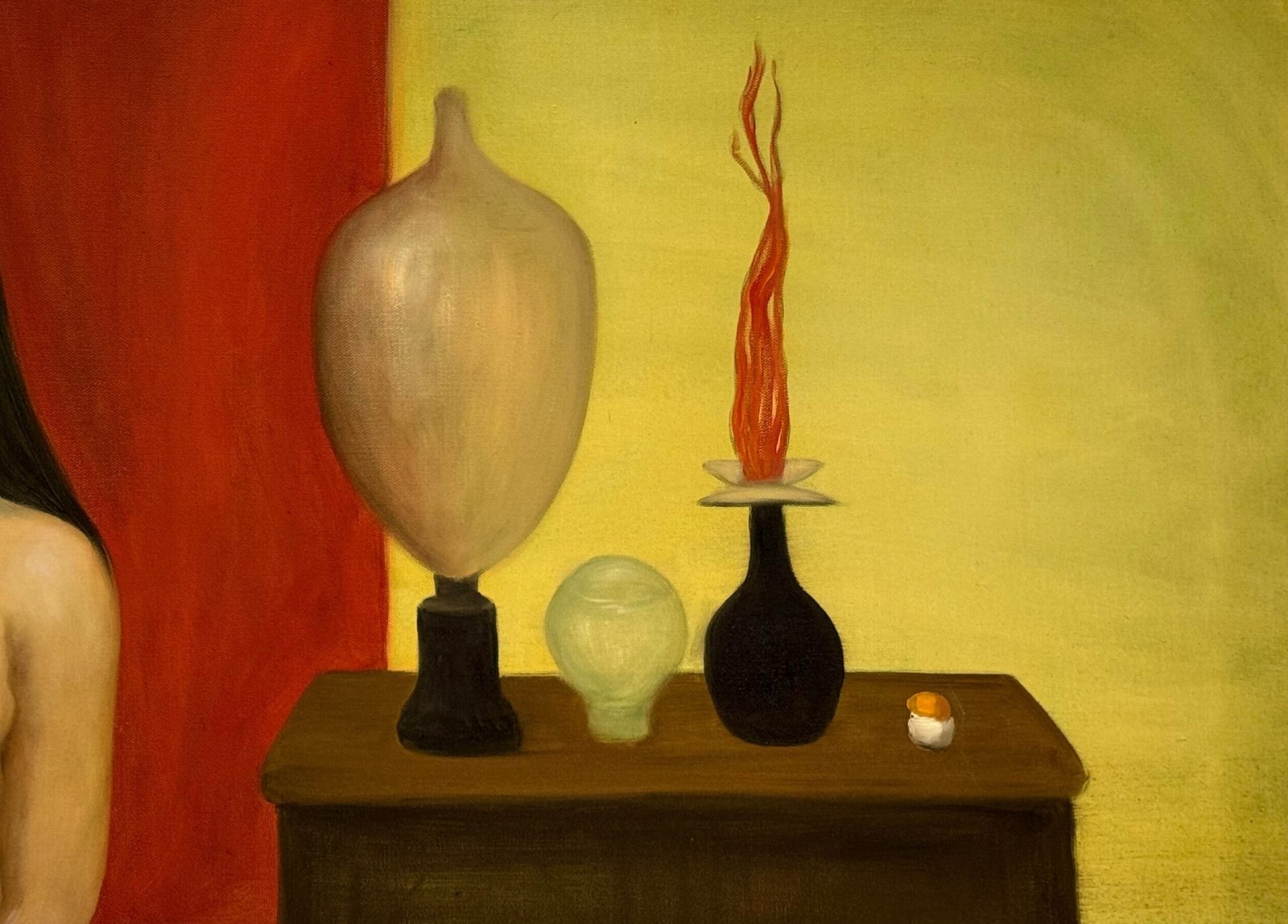
Irene Noren: I did not think about those references in a conscious way at the beginning. It was something I recognised later. The Renaissance gives me a structure. It is rooted in symbolism, stillness, and the idea that an image can hold meaning beyond what is immediately visible. It creates a kind of order, almost a devotional space. Impressionism, particularly the Nabis, carries something more internal. It works through atmosphere, colour, and sensation rather than narrative. It feels more psychological and symbolic, less fixed. What interests me is where those two meet. A controlled, almost devotional structure that holds something more unstable and psychological within it. The structure gives a sense of order, but inside it things are shifting. Emotions, perception, identity. I think that tension is where the work becomes alive.
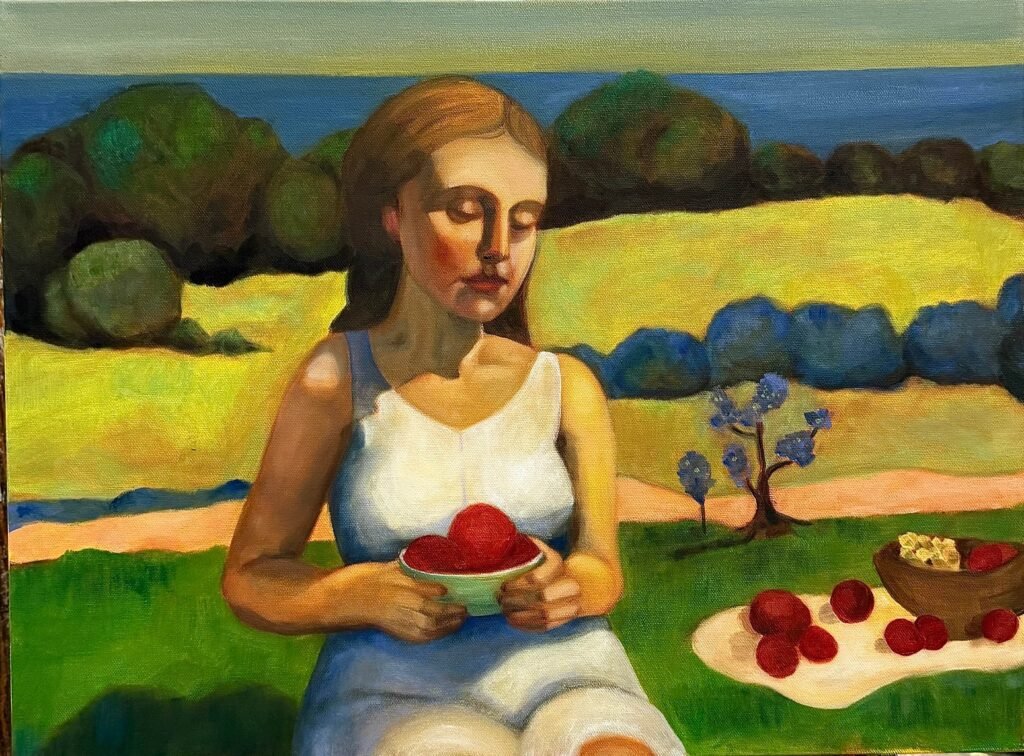
Emaho: Your work uses layered symbolism. In The Flower of Life, three monks levitating on a platform are simultaneously three roses, and their missing ears represent the wisdom of listening inward rather than to external noise. How do you decide which meanings to bury in an image and which to leave visible on the surface?
Irene Noren: I don’t usually decide everything beforehand. Some meanings emerge while I’m working.There are elements that are more direct, that guide the viewer into the painting, and others that are more hidden and reveal themselves over time. I think it’s important that not everything is immediately readable. A painting should unfold. The symbols are not there to be decoded like a puzzle, but to create a resonance that is felt before it is understood.
Emaho: You have described your spiritual journey as the deepest source of your inspiration, and painting as the way you transformed personal trauma into beauty. That is a significant amount of weight to ask a canvas to carry. How do you stop a painting from becoming therapy and keep it becoming art?
Irene Noren: For me the difference is distance. The starting point can be very personal, but if it stays too close, it becomes limited. I’m not interested in describing the experience, but in transforming it into something that can exist beyond me. When it moves far enough away from the original emotion, it stops being only mine. It becomes something more constructed, something that can hold different meanings without needing explanation. At the same time, it’s important for me that the work remains relatable, especially to other women. The experiences I draw from are personal, but they are not only mine. I think there is a shared emotional language around the body, how it’s seen, how it changes, the things that we inherit but are unspoken, and I want the paintings to exist in that space, where someone can recognise something of themselves in them.
Emaho: You completed your Certificate of Fine Arts at the New York Academy of Art in 2025 and are now pursuing your MFA there. You came to formal training after already having a practice, gallery representation and an audience. What can a programme actually give someone in that position that experience alone cannot?
Irene Noren: Training gives structure to something that was initially very intuitive. It allows me to understand what I’m doing more clearly, technically and conceptually. It also places the work in a broader context, historically and critically. Experience teaches you through doing, but a programme can accelerate awareness. It gives you confidence, references, and a certain discipline that is harder to build alone.
Emaho: Harper’s Gallery included your work in their 36 Paintings group show in 2024. You have also been featured in Harper’s Bazaar and had your studio photographed for Tory Burch. That is a notably wide range of contexts for a painter still in her MFA. How do you stay grounded in the work when the world around it keeps accelerating?
Irene Noren: I try to keep the focus on the work itself and not on everything around it. Those opportunities are important, but they are external to the practice. The only thing that really sustains the work is the time spent in the studio. I feel a strong sense of gratitude for everything that has happened, but also a kind of pressure. Not external, but internal. I think part of that comes from still questioning, at times, whether I deserve certain things. The only way I know how to stay grounded is by returning to the studio and working, even when I feel unsure. If that remains consistent, everything else becomes secondary.
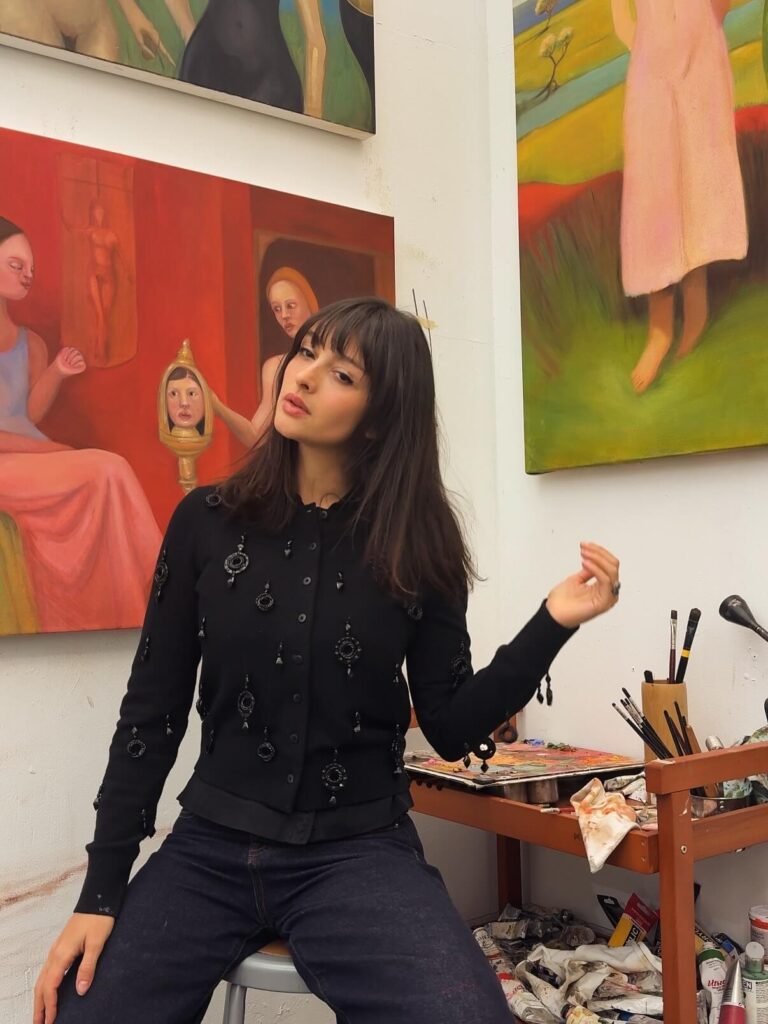
Emaho: You are completing your MFA in 2027. Most painters come out of graduate school with a clear next direction. Given where you are right now in the work, in the practice, in your own thinking, what do you want the paintings you make after the programme to be able to do that the ones before it could not?
Irene Noren: I want the paintings to become more authentic in the way they are made. More confident in my brushwork, less concerned with proving something or demonstrating skill. More raw, and closer to a more intuitive way of working. At the same time, I also want to push the ideas further. To not stay fixed in certain concepts, but to allow them to change, to question them, and to move beyond what I already understand. In a way, it feels like a process of unlearning what I am currently learning. Not rejecting structure, but not relying on it either, allowing something more instinctive to exist within it.