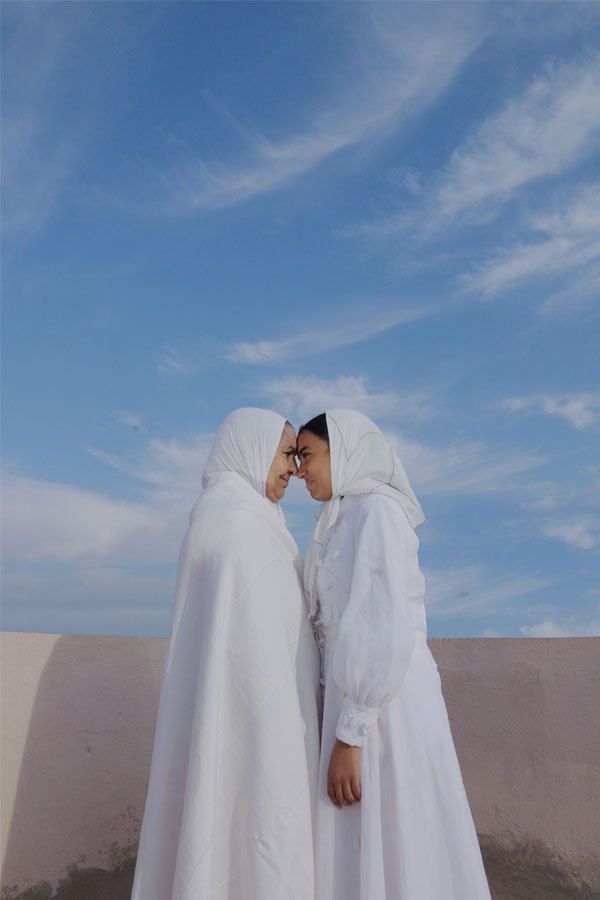
Emaho: Your mother used to take photographs, and you’ve said something was always bursting inside you to continue that path. Growing up in a modest neighbourhood in Marrakech, watching the women on your street in their haiks and djellabas, did you feel you were already composing images in your mind before you ever picked up a phone?
Ismail Zaidy: Yes, I think I was already making images in my mind long before I ever touched a phone. Growing up in Marrakech, in a modest neighbourhood, I was surrounded by strong visual memories without realizing it at first—the women in haiks and djellabas, the textures of fabric, the light on the street, the quiet dignity of everyday life. My mother also had a connection to photography, so maybe that image-making energy was already somewhere around me, waiting. Even before I started taking pictures, I think I was already sensitive to composition, atmosphere, and emotion. I did not have the language for it yet, but I could feel that something inside me wanted to express itself visually.
Emaho: You started in 2017 with a Samsung S5 and a rooftop, because you had no camera and no studio. Rather than waiting for the right equipment, you worked with what you had: mirrors, cardboard, fabric, sky and family. Most photographers treat constraints as a problem to solve. You turned them into a style. At what point did you stop seeing the limitations and start seeing the language?
Ismail Zaidy: At the beginning, I did not really have the luxury to think too much about limitations. I had a phone, a rooftop, my family, and whatever objects I could find around me. That was enough to begin. With time, I understood that what looked like a limitation from the outside was actually becoming my visual language. The rooftop was not just a substitute for a studio; it became part of the work. The fabric, mirrors, cardboard, and open sky were not temporary solutions—they became tools that shaped the identity of the images. I think the shift happened when I stopped comparing what I had to what others had, and started trusting that my own environment already contained a world.
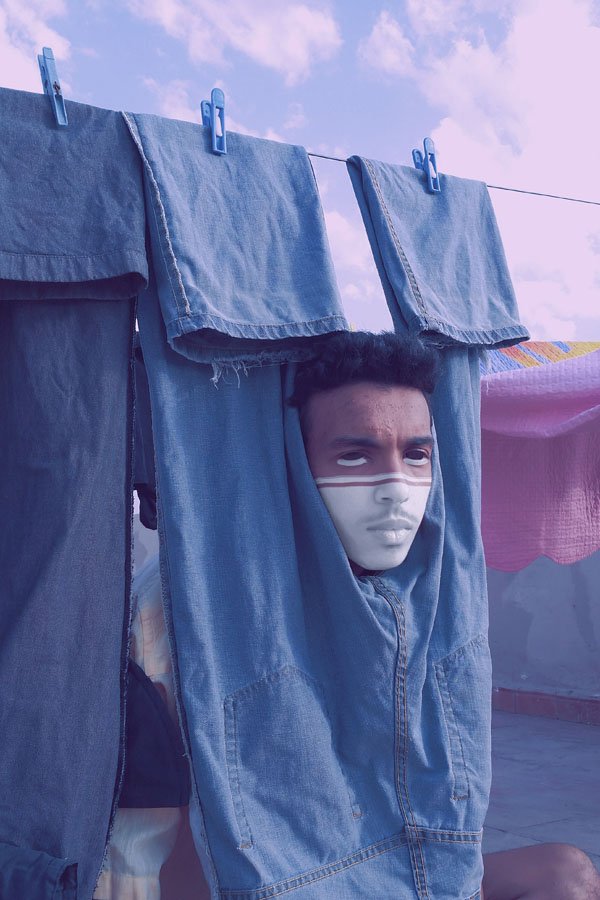
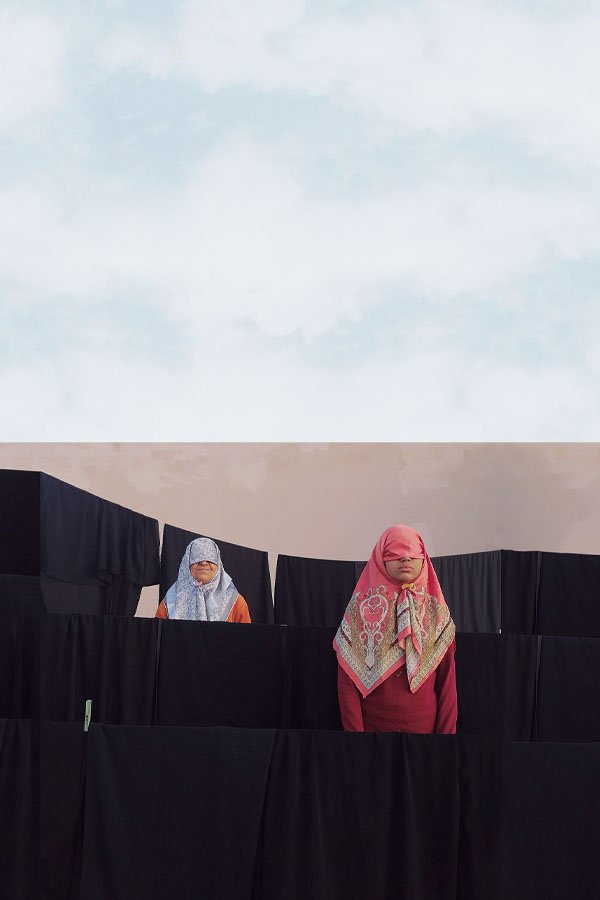
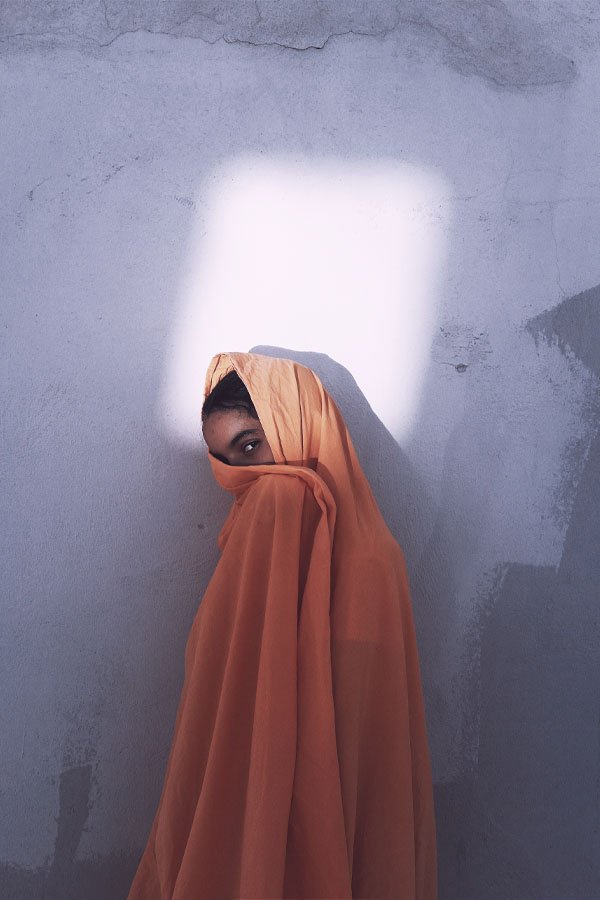
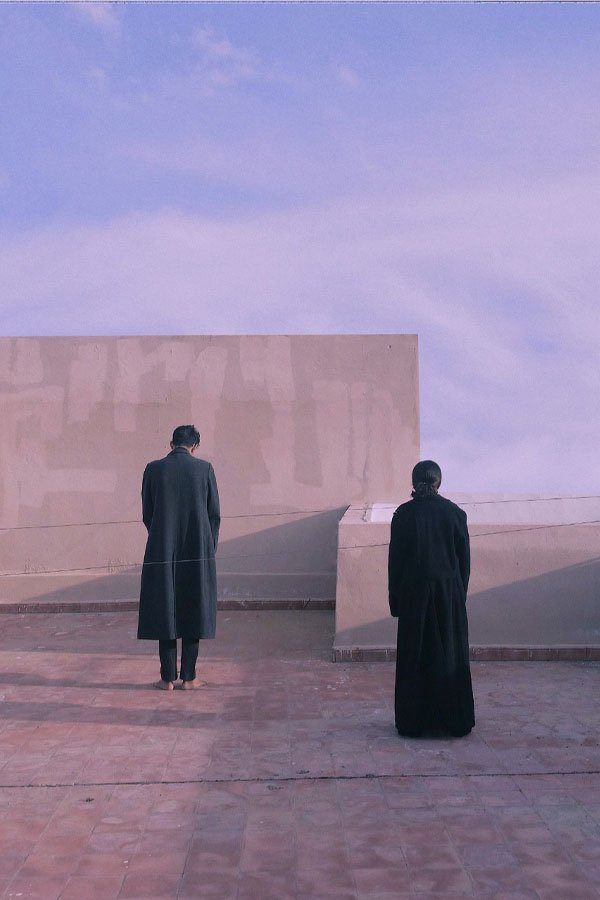
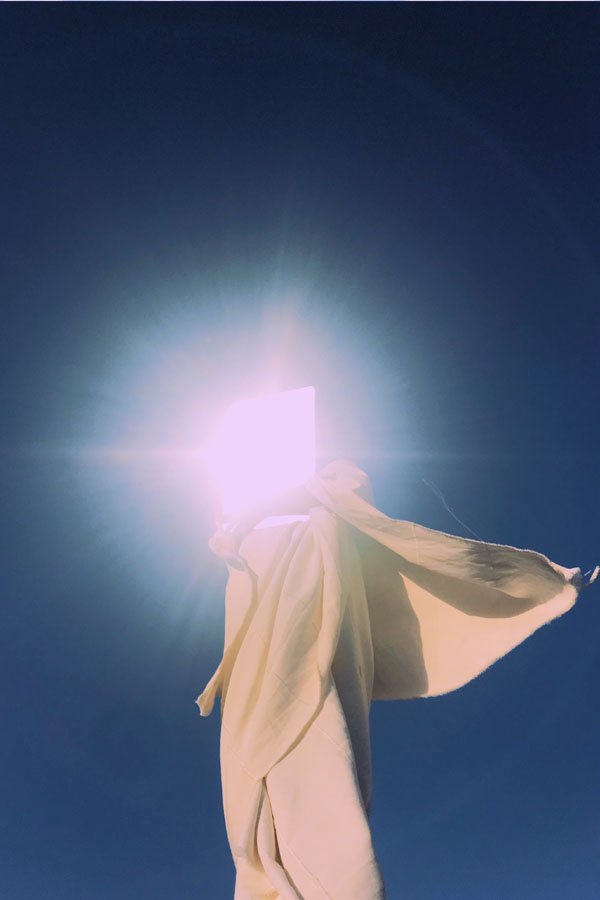
Emaho: Your characters are often photographed with their faces covered or turned away, and you’ve said you can create the same emotional effect without showing a face at all, because the image itself becomes the emotion. That challenges one of photography’s basic assumptions—that connection requires visibility. How did you arrive at that, and has anyone pushed back?
Ismail Zaidy: I arrived at that quite naturally. I was never interested in photography only as a way to show a person’s face. For me, emotion can live in posture, in fabric, in colour, in silence, in absence. Sometimes hiding the face says more than revealing it, because it leaves space for projection, memory, and feeling. The image becomes less about one specific person and more about something universal. Of course, some people have pushed back on that, because portraiture is often expected to deliver identity through the face. But I never felt limited by that expectation. I felt freer without it. I wanted the viewer to feel something first, before identifying someone.
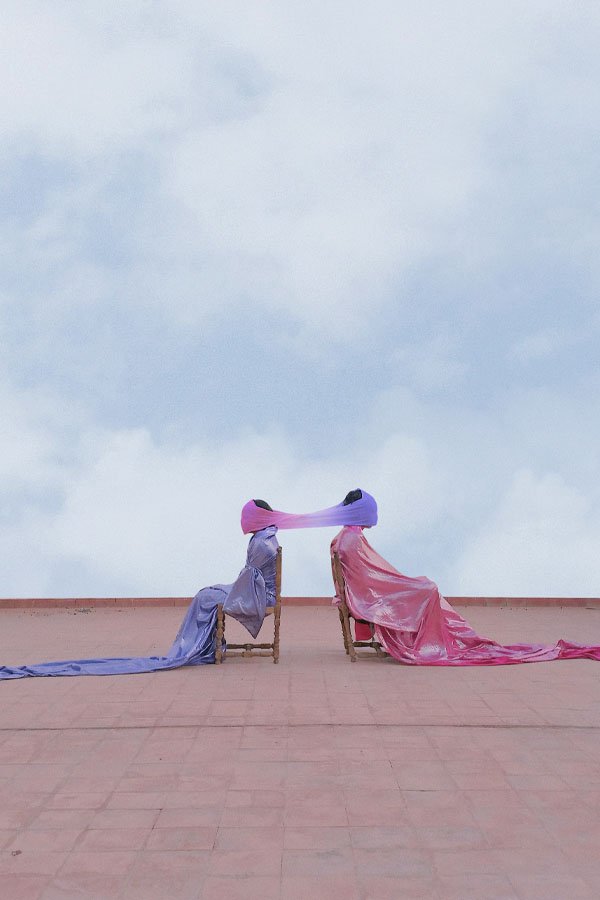
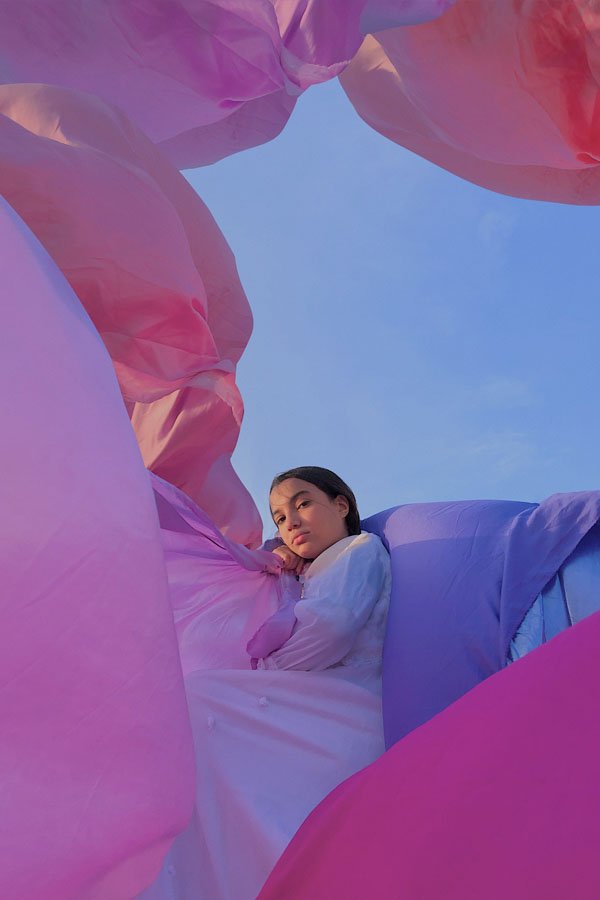
Emaho: The project *3aila* explores lack of communication, distance between siblings and parents, and family estrangement—things many people experience but rarely discuss openly. You’re making work about silence using the very family members you love. How do those conversations happen at home, and has the work changed your relationships?
Ismail: Those conversations do not always happen directly or easily, and that is part of why the work exists. *3aila* came from things that are often difficult to say openly – distance, silence, emotional gaps inside families, especially in environments where love is present but not always expressed through words. Working with my siblings made it possible to speak through images when language was not enough. At home, it was less about formal conversations and more about building trust together through the process. I do think the work changed something between us. It created another kind of closeness, another kind of understanding. Even when the images speak about disconnection, the act of making them became a form of connection.
Emaho: In 2020, you held your first solo exhibition at Riad Yima, the space of photographer and artist Hassan Hajjaj, who discovered your work. That same year, you won the CAP Prize for *3aila*. Which moment felt more real, and which still feels slightly unreal?
Ismail: They felt real in different ways. The solo exhibition at Riad Yima was deeply emotional because it was the first time the work existed physically in a space, in front of people – it made everything tangible. It was an intimate kind of reality. Winning the CAP Prize felt different – it was recognition beyond my immediate circle, confirming that this work, made simply with my siblings and my phone, could travel and resonate widely. If I’m honest, the CAP Prize still feels slightly unbelievable, but the first solo show felt most real in my body.
Emaho: In 2022, your work appeared on digital billboards in Times Square. You’ve said you had only seen that place in films. What did that moment actually feel like?
Ismail Zaidy: It felt surreal. Times Square was something I knew through films and imagination, never something connected to my own life. So waking up and seeing my work there was hard to process. It felt like reality was delayed, like my mind needed time to catch up. What stayed with me most was the contrast—images born from something intimate and personal suddenly appearing in one of the most public places in the world. More than excitement, I felt disbelief mixed with gratitude. My instinct was to share it with the people closest to me, because the work has never felt like something I built alone.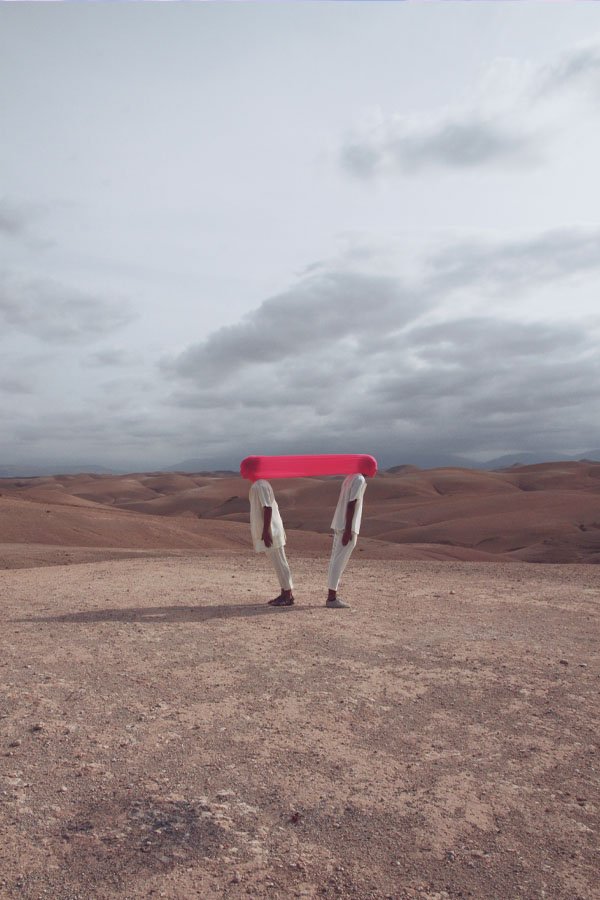
Emaho: Your work has been shown in Paris, London, and at international fairs. When audiences encounter your work outside Morocco, what do you want them to understand about Marrakech?
Ismail Zaidy: I don’t want people to leave thinking they’ve “understood” Marrakech in a fixed way. I want them to feel its complexity—intimacy, tenderness, tension, poetry, and modernity all at once. Too often, Marrakech is reduced to clichés. I hope the work offers another access point—quieter, more interior, more emotional. Not the postcard version, but the lived, psychological one. Marrakech is not just a backdrop; it is a space full of memory, contradiction, and beauty.
Emaho: As your work becomes more international, what is the one thing about that rooftop in Marrakech you are determined never to lose?
Ismail Zaidy: The honesty of that rooftop. Not just the place, but what it represents—working with what is available, staying close to where I come from, trusting intimacy, and creating from emotion rather than spectacle. Even as the work travels, I don’t want to lose that raw starting point. The rooftop taught me that you don’t need excess to create something powerful. You need vision, feeling, and truth. That’s what I want to protect.