Emaho: Your work often blurs the boundary between figuration and abstraction, exploring the human body, energy, and existence. How did your earliest experiences with art and your upbringing in Chile first open you up to these themes?
Katarina: My grandmother was a painter and teacher. I grew up watching her work, and I think that planted something in me early on. I studied art formally in Chile and did a postgraduate in art education, but honestly, it was the feeling of depression what really pushed me to understand what art could do. I had to face difficult periods, and painting became the way I stayed alive and healed myself. That’s when I started to see the body not just as form but as energy, as something that carries emotion and that is constantly changing. Chile gave me a foundation, but some painful feelings brought up all the questions.
Emaho: You describe your artistic journey as inseparable from your life journey. How have your travels, residencies, and nomadic lifestyle influenced the way you see the connection between the physical body and the invisible energy you depict on canvas?
Katarina: I’ve lived and exhibited in Croatia, Honduras, Vietnam, Mexico, and now I’m moving to Portugal. Each place changes how I see and feel. Living between countries, between my Chilean roots and my Croatian-Montenegrin heritage, I exist in these in-between spaces. That cross-continental identity shows up in my palette, my symbols, the way I think about belonging. When you move so much, you realize the body is just a vessel. What stays constant is the energy, the essence. That’s what I try to paint – not the fixed form but the invisible thing that moves through it.
Emaho: Your creative process has been described as starting from observation and interaction with reality, then transforming elements into new contexts. Can you walk us through how a small detail might evolve into a fully realised painting?
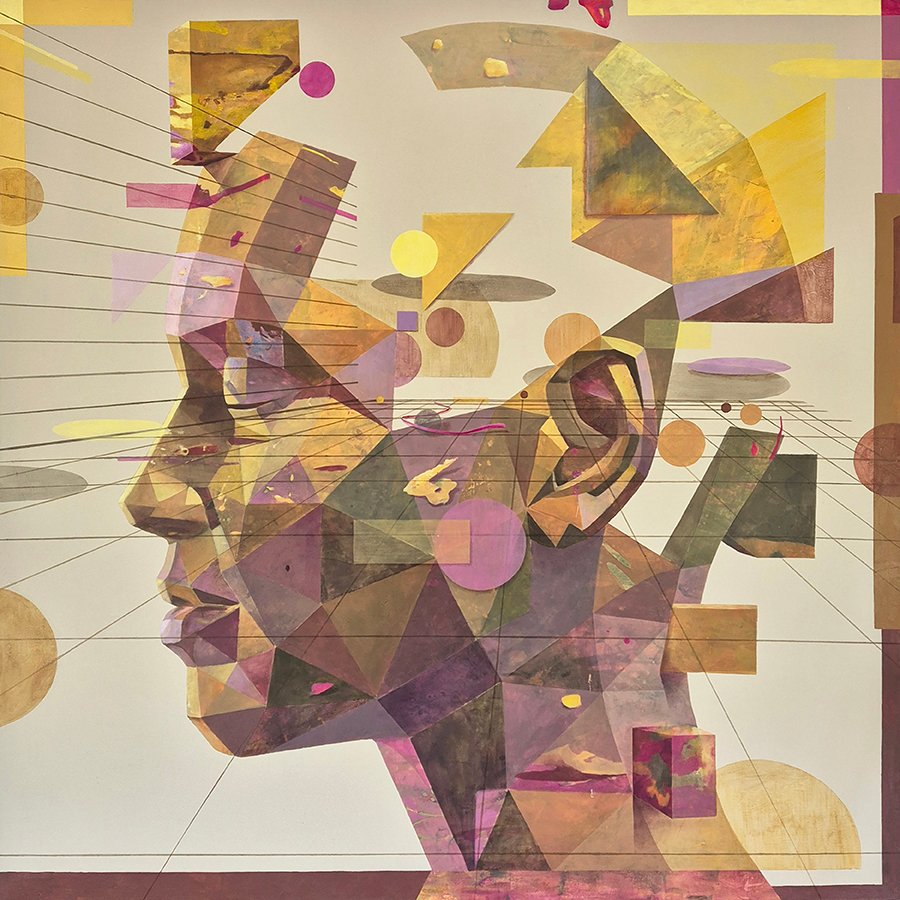
Katarina: There’s a phrase I write all the time: “hay un espacio que habito que no sé explicar”—there’s a space I inhabit that I can’t explain. For a long time, I also had this image in my head of a three-dimensional head, like an architectural plan with an open section showing the interior. Eventually those two things came together in a painting. I started asking myself: where does my consciousness actually live? Is it inside my body or outside? Is my brain a receiver for something bigger? I don’t have answers, but when I paint, that space reveals itself. The head becomes secondary. What matters is the interior—the volume, the colors, the geometric shapes having a conversation I don’t fully understand. That’s how a small question or image grows into a work. I follow it until it shows me what it needs to be.
Emaho: You’ve exhibited in diverse environments—from hotels and boutique spaces to cultural centres in Vietnam, Honduras, and Chile. How do these unique exhibition contexts affect the way audiences interact with and understand your work?
Katarina: Hotel spaces are intimate. People encounter the work while they’re traveling, while they’re in transition themselves. That creates a different kind of attention. They’re already open, already in a state of change. In cultural centres or galleries, the context is more formal, but I think my work still asks for the same thing: presence. I want people to stop and feel something, whether they’re passing through a boutique hotel in Roatán or walking into a gallery in Santiago. The setting changes the audience, but the work stays honest.
Emaho: Nature, movement, and human spirit often appear as motifs in your work. What is it about these themes that keeps bringing you back to them, and how do you use visual language to express their dynamic interplay?
Katarina: These are the things that kept me alive. Nature, especially in places like Bali, taught me about cycles and transformation. Movement is how I paint—I developed a methodology I call Dynamic Painting that channels emotion and energy directly into the canvas. And the human spirit is the constant question: what are we? Where do we exist? I use organic shapes, dynamic lines, transparencies, geometry underneath. The interplay happens naturally when I let the body move and the paint respond. It’s not something I plan. It’s something I let happen.
Emaho: Your use of materials, texture, and surface is rich and layered. How does materiality influence the emotional or conceptual resonance of your paintings, and what role does experimentation play in developing your visual vocabulary?
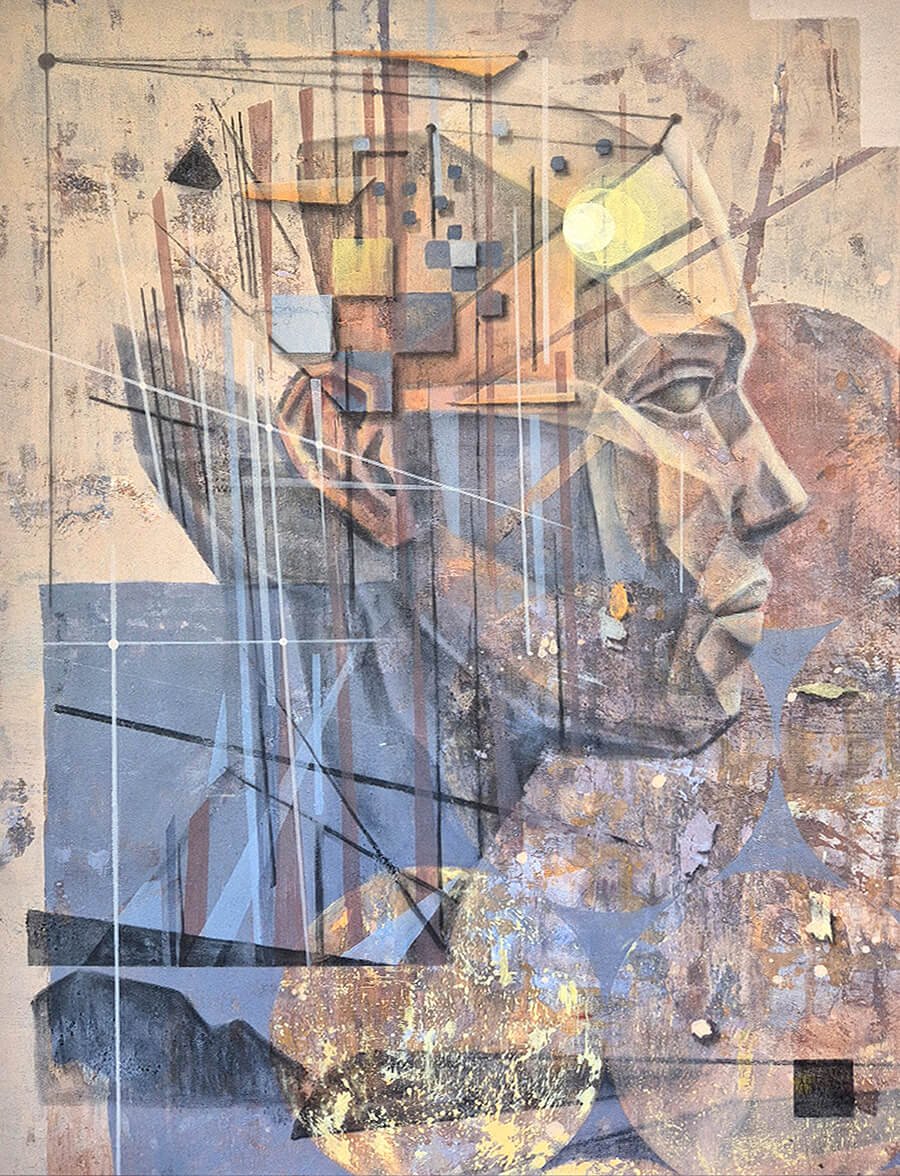
Katarina: I work with acrylics, oils, and mixed media. Each material has a different energy. Acrylics dry fast, so they hold movement and spontaneity. Oils are slower, more meditative. Texture adds a physical presence—it makes the painting breathe. I experiment a lot because I need to stay curious. When I find a new way to layer or scrape or blend, it opens a new way to feel and express. The material is part of the message. It’s not just what you see, it’s what you sense.
Emaho: In some phases of your work, you returned to black-and-white compositions, and in other periods you embraced vibrant colour. How do you decide when to use colour or when to strip back to monochrome, and what does that choice signify for a given project?
Katarina: It depends on what I’m feeling and what the work is asking for. Sometimes color is too loud. When I need to focus on structure, on the essence of a form or a movement, I go to black and white. It strips away distraction. Other times, color is the whole point—it’s joy, it’s energy, it’s life. I didn’t plan it in advance. I listen to what wants to come through.
Emaho: Your art often evokes a sense of impermanence and constant transformation. What do you hope viewers feel or think about when they experience this sense of flux in your paintings?
Katarina: I want them to feel alive. Present. I want them to recognize that everything is moving, changing, and that’s not something to fear. It’s just the truth. My work is meditative but also dynamic. If someone stands in front of one of my paintings and feels a shift—a moment of presence, of vitality—then the work did what it needed to do.
Emaho: Looking ahead, what themes, materials, or places are you excited to explore next, and how do you see your practice evolving in the coming years?
Katarina: I have solo shows coming in Porto this July and Paris in October. I’m excited to keep moving, to keep exhibiting in new places, and to develop my painting further. I want to keep asking the questions about body, soul, consciousness, and transformation. And I want my work to reach more people—collectors, museums, audiences who are ready to feel something real.
Katarina Abovic Instagram