Bangladesh –
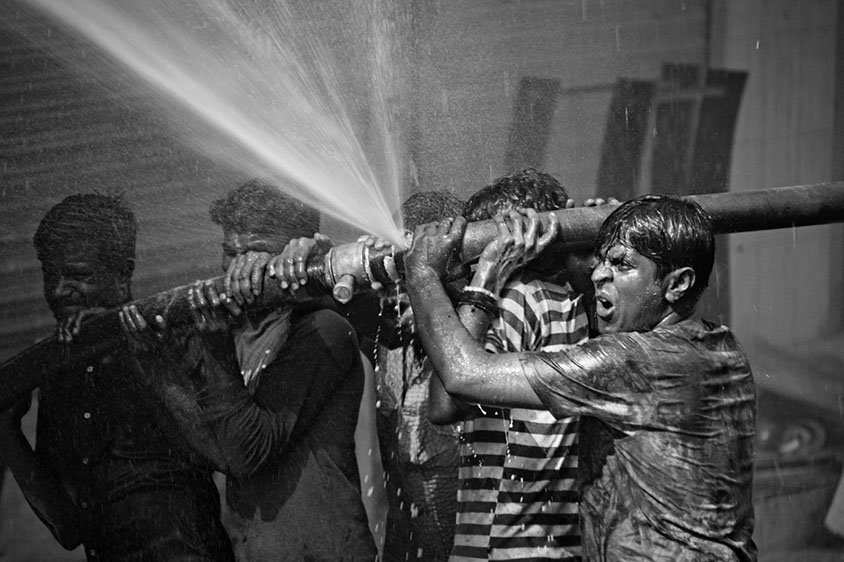
The Alexia Foundation has announced that the winner of the 2013 Alexia Professional Grant: Abir Abdullah. The Alexia Foundation promotes the power of photojournalism to give voice to social injustice, to respect history lest we forget it and to understand cultural difference as our strength, not our weakness. The grant, in the amount of $15,000 will be used by Abdullah to produce his final project documenting the continuous threat fire presents for the working class communities of Dhaka, Bangladesh in basti (slums), garment factories and shopping malls
Says Abdullah:
“Corrupt officials who ignore building codes, and greedy businessmen who bypass fire protection have ensured that both home and work spaces are death traps. Because the city has grown too quickly, lack of fire safety precaution is everywhere.
The impact, however, is most visible in the garment industry of Bangladesh, which is also the country’s most successful business sector, earning $19 billion from exports last year alone. Factory fires have killed 600 garment workers since 2005.
Global headlines came with the horrific fire at Tazreen Fashion factory in November 2012. At least 112 people were confirmed dead in the fire (and activists claim more bodies were “disappeared” by authorities), making it the deadliest factory fire in the nation’s history… 53 workers bodies could not be identified due to severe burns and were buried in mass grave.

Body of an unidentified female garments worker lies down on the floor of a under constructed mosque. The death toll rises to 112 and hundreds were injured after the fire incident due to electrical short circuit at night on 24 November, fire service reports. Nischintapur, Savar outskirts of Dhaka, Bangladesh.
Tazreen’s clients, either directly or through subcontractors, included global giants Walmart, Sears, Disney, and Enyce. As a result, this fire became the symbol for the high cost paid by third world workers for western consumer’s fashion desires. The issue has been brought all the way to US President Barack Obama, via a letter signed by US Senators.
In one haunting instance, a son called his mother, knowing he would not survive. “Ma (mother), I have no way to save my life,” Palash Mian told her on the phone, calling from inside the factory. “I cannot find any way to get out. I am in the bathroom of the fifth floor. I am wearing a black T-shirt. And I have a shirt wrapped around my waist. You will find me in the bathroom.”
Dead bodies were lined up with white bags in a school ground near the factory. Palash’s mother, Ms. Begum unzipped a bag and found a corpse wearing a black T-shirt.

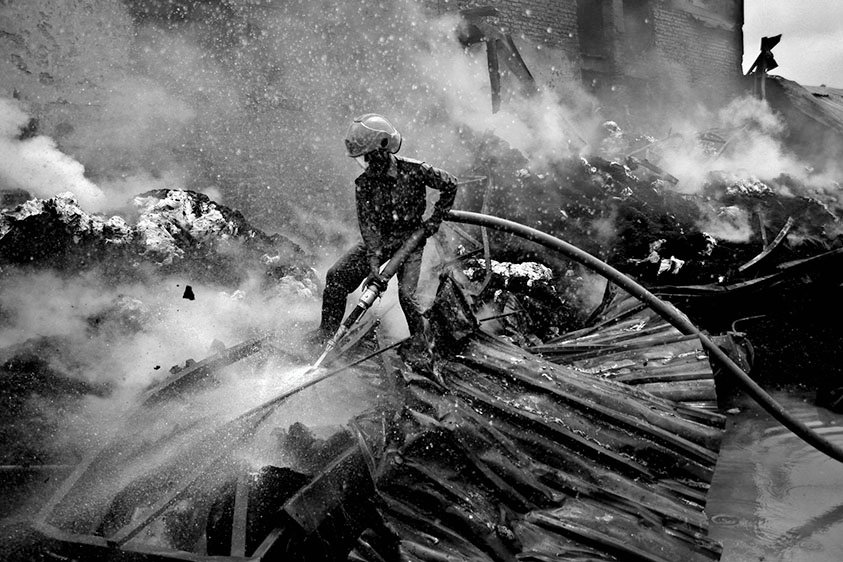
A fireman attempts to extinguish a fire at Kung Keng textile factory. Unsafe working conditions have led to repeated accidents. Export Processing Zone, Dhaka. 26 August 2005.
With the support of Alexia Foundation, I will continue to document the living and working conditions and vulnerability of the garment workers. I want to use photography to raise global awareness and pressure powerful global brands like Walmart, Nike, and Disney to pay fair prices so that labour and safety standards can be implemented in these factories. Photography can convey the stories in a way that endless essays, op-eds, and seminars cannot. I want to dedicate my work to saving this industry, bringing an end to the exploitation of 3 million workers (60 per cent of whom are women) who toil away in the shadows of this industry. Let us not wait for another tragedy, before we take action.”