Emaho: You work across art, architecture, and mixed media. Can you tell us about your early journey, growing up between cultures, and how that shaped your visual language?
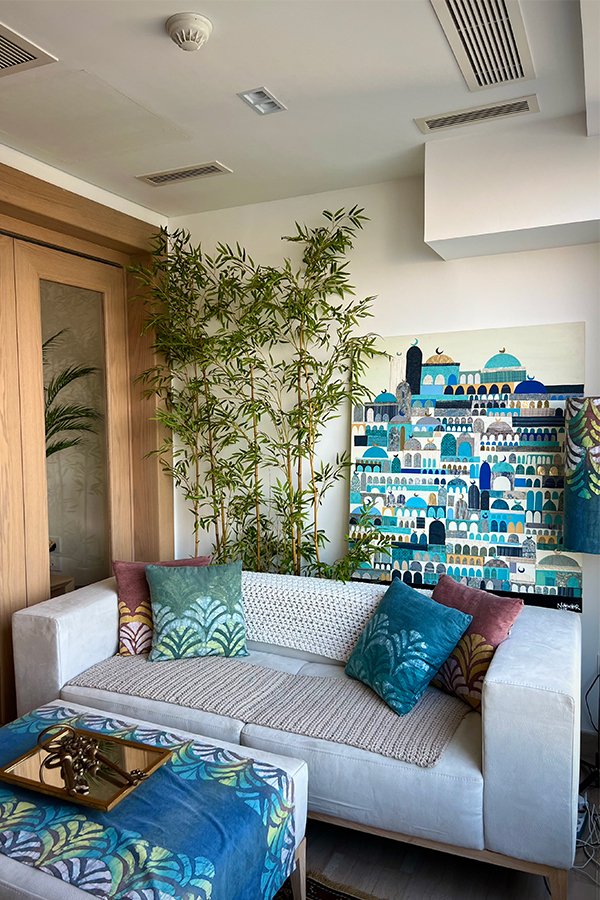
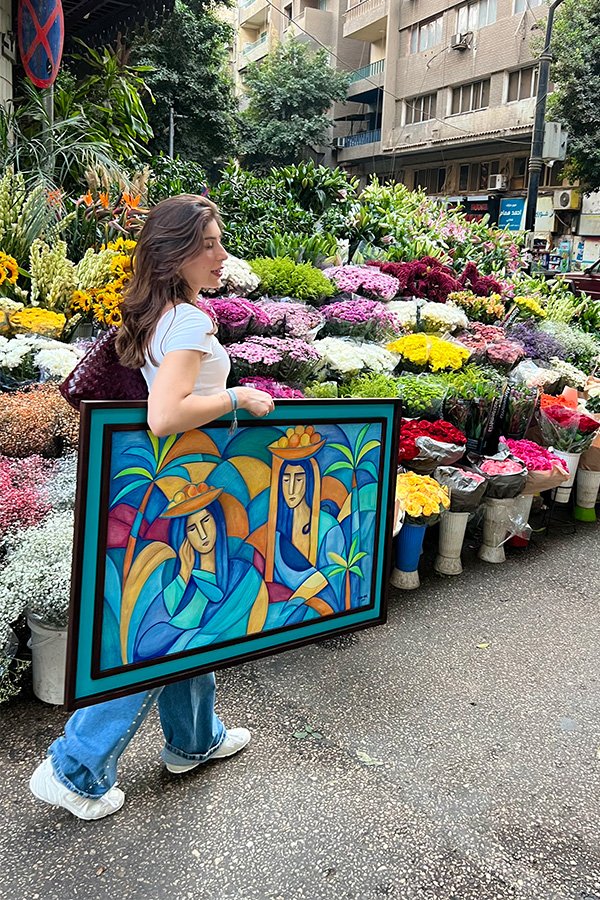
Nour Al Asadi: My work comes from navigating between two places that never fully overlap. I’m originally Iraqi, but I was raised in Cairo. While they’re geographically close and part of the Middle East, they carry different histories, rhythms, and ways of seeing. That shaped how I understand identity.. rather than having a fixed sense of place, I sometimes found myself navigating between what was physically around me and what I imagined through inherited stories. Over time, that slowly translated into how I think about space. Instead of something stable, it became something layered. That thinking now sits at the core of my visual language. My work doesn’t try to represent a single place, but instead builds compositions that exist somewhere between realities, where architecture, abstraction, and emotion come together.
Emaho: Your work exists specifically between art and architecture. How did this intersection become your way of exploring emotion, identity, and storytelling?
Nour Al Asadi: Studying architecture gave me a framework for thinking, in terms of composition and proportion. But over time, I realized I was more interested in what those spaces could hold emotionally and sentimentally, rather than how they functioned. That shift naturally led me to work between architecture and art. Architecture still informs how I build a composition, but art allows me to loosen that structure; creating something more open, where emotion, abstraction, and storytelling can exist more freely.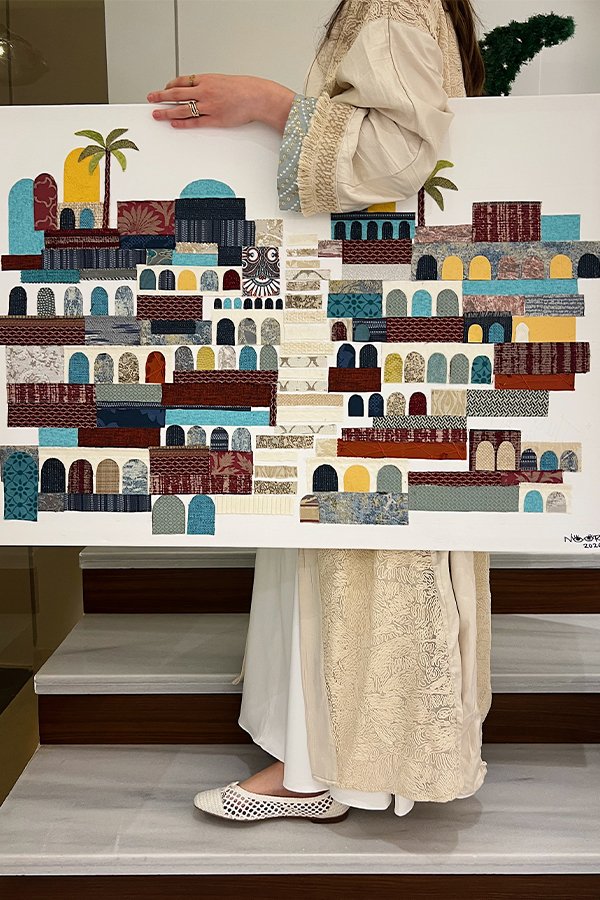
Emaho: Growing up Iraqi in Cairo, your connection to place is layered and complex. How has this shaped the way you approach space, form, and narrative in your work?
Nour Al Asadi: Growing up as an Iraqi in Cairo meant my relationship to Iraq was never direct, it was something intangible that I was always curious to construct over time. In each piece, forms become fragments rather than complete structures, and compositions are built through accumulation rather than clarity.
Emaho: Your compositions often feel architectural yet abstract. How do you translate cultural references or inherited stories/memories into visual forms without being literal?
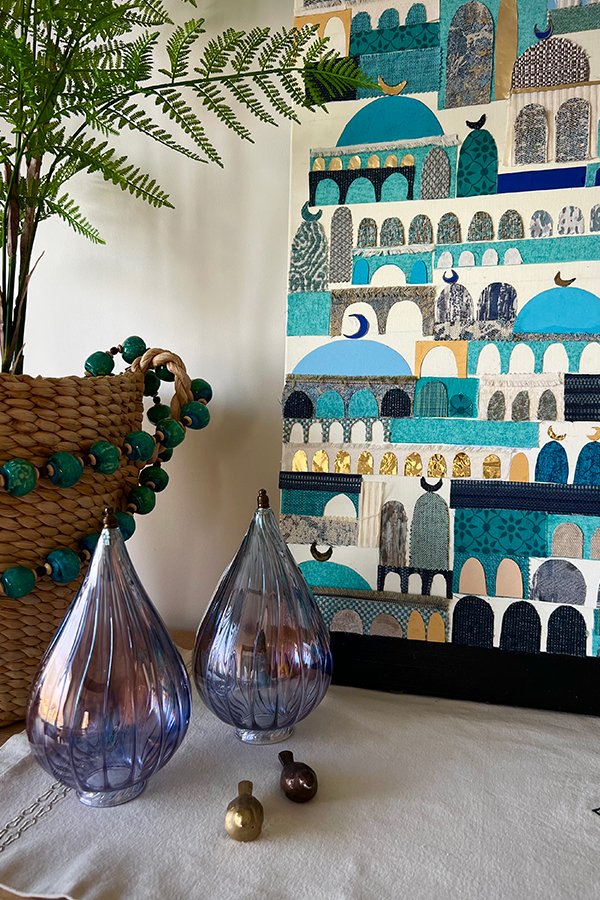
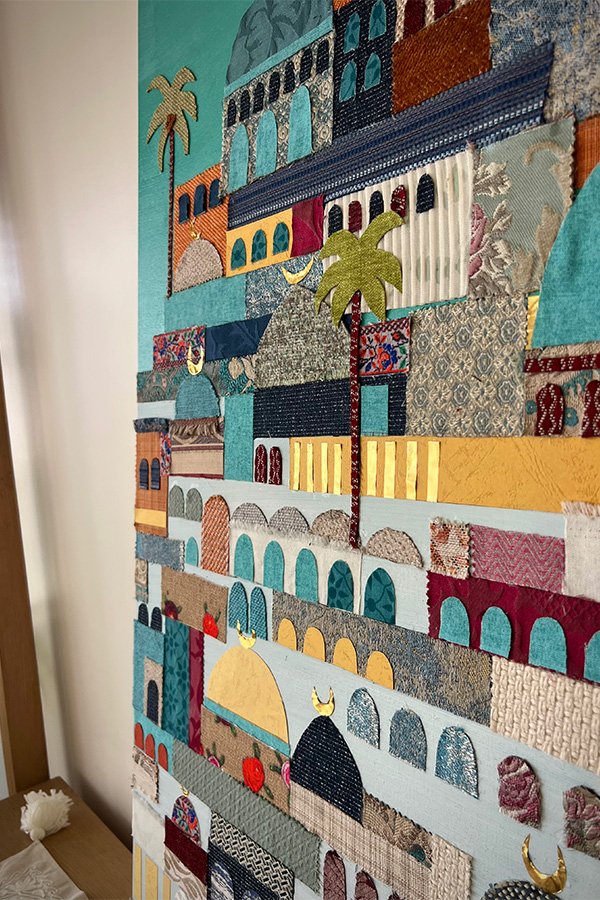
Nour Al Asadi: I try to avoid translating references in a direct or illustrative way. Instead, I work through reduction; simplifying forms and abstracting geometries to simplify interpretation. Cultural references often enter the work indirectly, through spatial cues or compositional rhythms/shapes rather than recognizable symbols. Architectural elements might be present, but they’re usually fragmented so they don’t point to a single place or meaning. That distance is important to me. It allows the work to remain open to interpretation; where the reference can be felt by many.
Emaho: Layering is central to your process. How does working through layers, textures, and materials allow you to build meaning within your work?
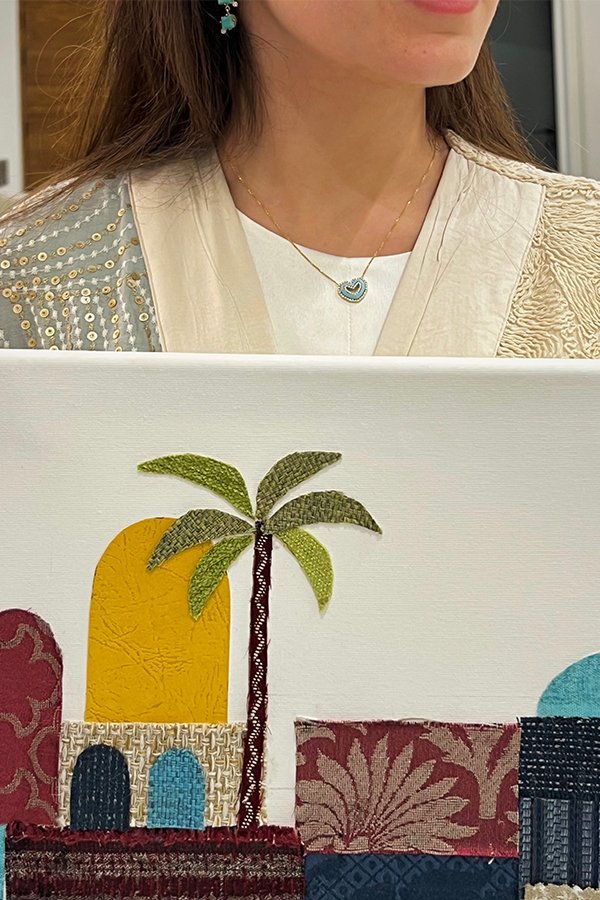
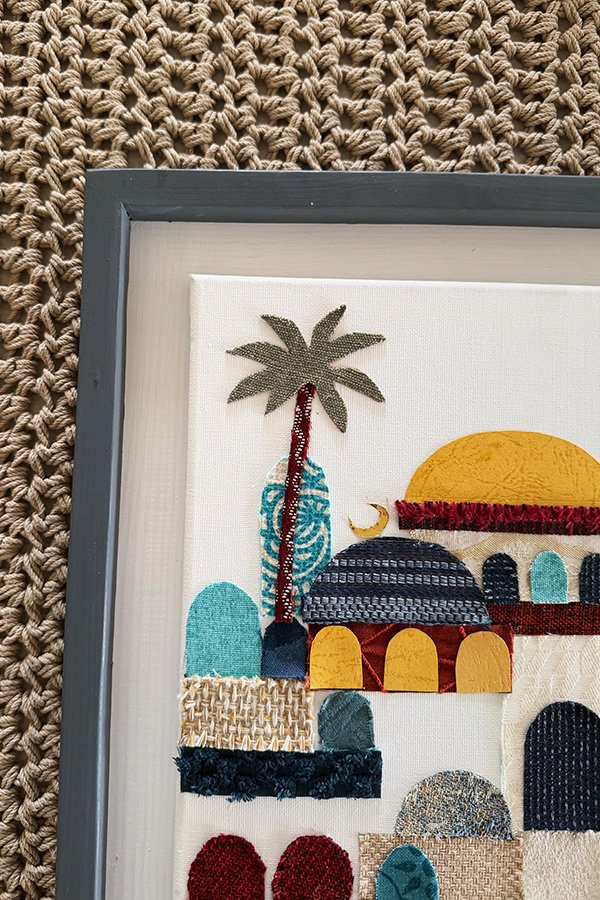
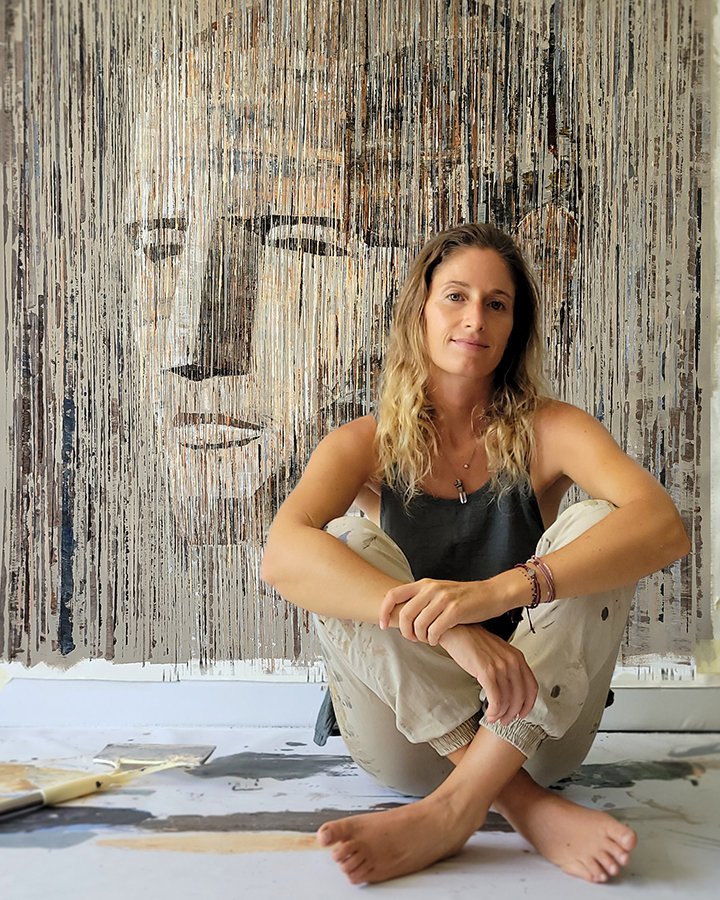
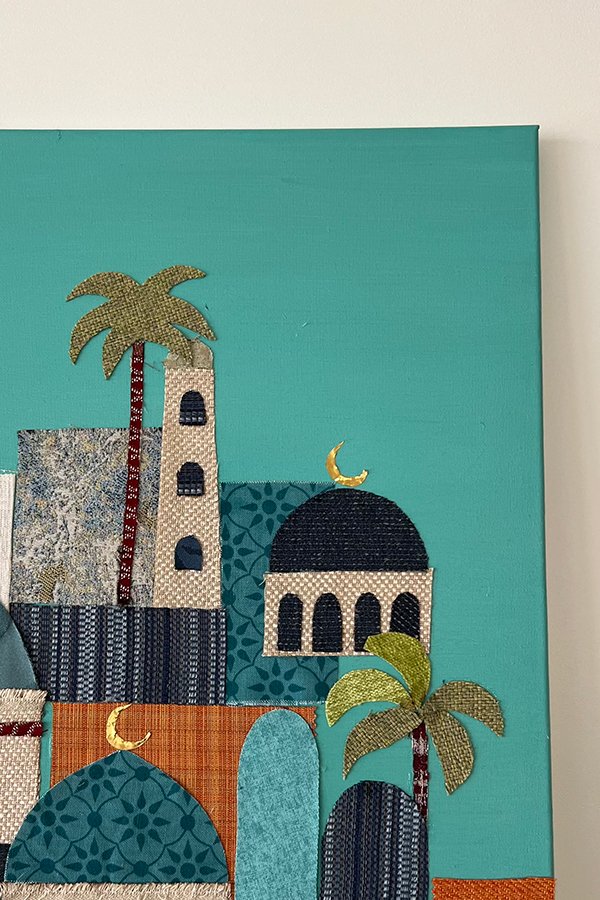
Nour Al Asadi: Having explored different mediums over the past few years, mixed media became my most natural form of expression. It allows me to build stories the same way memory works. Layers translate into rich textures, while moments and nostalgia take shape as abstract forms. To me, layering has become a mode of thinking. It allows my work to develop gradually, through adding, removing, and reworking elements.
Working with different textures and materials introduces a sense of variation and sensitivity. Some areas feel more structured, while others remain more open or unresolved. I sometimes like to create a gradient between the two, where the bottom of the piece is looser, more intimate in scale, and gradually becomes more structured as the layers and fabrics move upward.
Emaho: The contemporary illustration scene in Cairo and the wider Middle East is evolving quickly. How do you see the local creative community developing, and what excites you about being part of it?
Nour Al Asadi: There’s definitely a shift happening in the region. More artists are moving beyond defined categories and working across disciplines, which is opening up a more experimental way of making. In Cairo, it feels immediate. The pace of the city, the density, the constant friction, it truly pushes you to respond, not overthink. What excites me most is the growing confidence in personal identity. People aren’t trying to generalize their work anymore, they’re leaning into what’s specific to them, their references, and their own sense of individuality.
For me, that means carrying an Iraqi presence into my work. It’s not always obvious, but it’s there; in the forms, the colors, and the way I build space. And I think that’s where the strength of the scene is.. it holds all of that complexity without asking you to simplify it.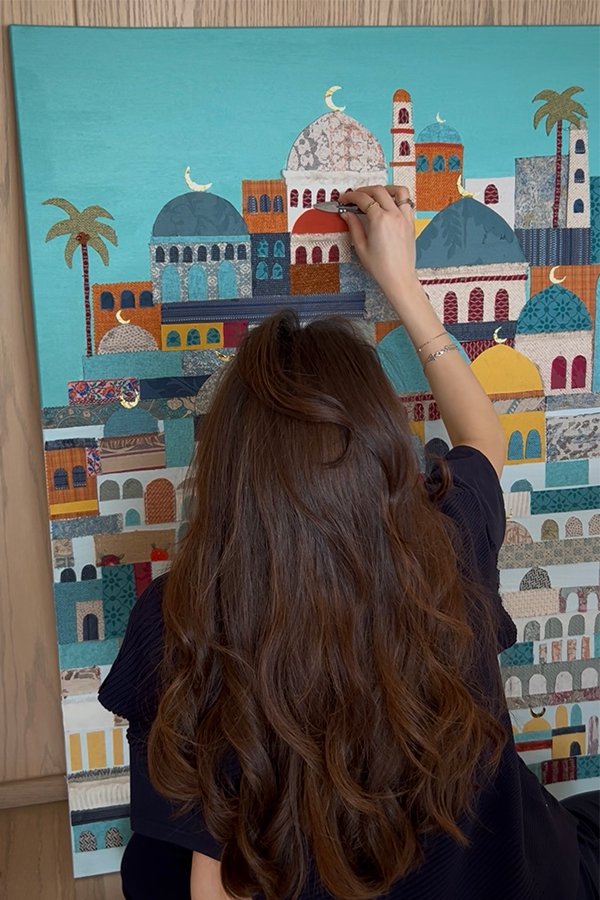
Emaho: As a young artist working across disciplines, what goals or directions are you currently pursuing; whether in publishing, exhibitions, or collaborative projects?
Nour Al Asadi: At this stage, I’m interested in expanding the work beyond the canvas, both in scale and in form. I am now exploring how my visual identity can translate into larger pieces and different formats/mediums without losing it’s integrity.
Emaho: Finally, looking ahead, what kind of visual legacy or impact would you like your art to have, both locally in Egypt and internationally?
Nour Al Asadi: I would like my work to continue expanding: into new spaces, new scales and new contexts, while still feeling honest to itself.