Emaho: The role of the curator has evolved significantly, from gatekeeper to collaborator, mediator, and cultural strategist. In today’s context of rapid technological change, how do you define the curator’s responsibility and agency?
Auronda Scalera & Dr. Alfredo Cramerotti: Today the curator’s responsibility is less about selection and more about positioning: positioning artists within complex technological, social, and ecological systems, and positioning institutions within broader cultural conversations. The curator operates as a translator between disciplines, art, science, technology, policy, and the public, while remaining accountable to artistic integrity. Agency now lies in designing contexts rather than controlling narratives, enabling artists to operate critically within infrastructures that are increasingly algorithmic, accelerated, and uneven.
At a deeper level, the curator also assumes an ethical and ontological role: to question how meaning, value, and knowledge are produced in a world shaped by automation and abstraction. Curating becomes an act of care and responsibility toward uncertainty itself, holding space for ambiguity, contradiction, and non-linear thought at a time when systems increasingly demand clarity, efficiency, and optimization.
Emaho: Artificial intelligence is no longer a speculative tool but an active presence in artistic production and exhibition-making. From your perspective, how is AI reshaping not only artworks themselves but also curatorial thinking and authorship?
Auronda Scalera & Dr. Alfredo Cramerotti: AI destabilizes traditional ideas of authorship, originality, and intentionality, which forces curators to rethink attribution, process, and responsibility. Curatorial thinking increasingly shifts from object-based logic to systems-based logic: datasets, training biases, infrastructures, and invisible labor become part of the exhibition discourse. The curator’s role expands to framing how intelligence, human, machinic, collective, is produced and governed, rather than simply showcasing outputs. For that reason, we call our practice a co-creation, co-curated process.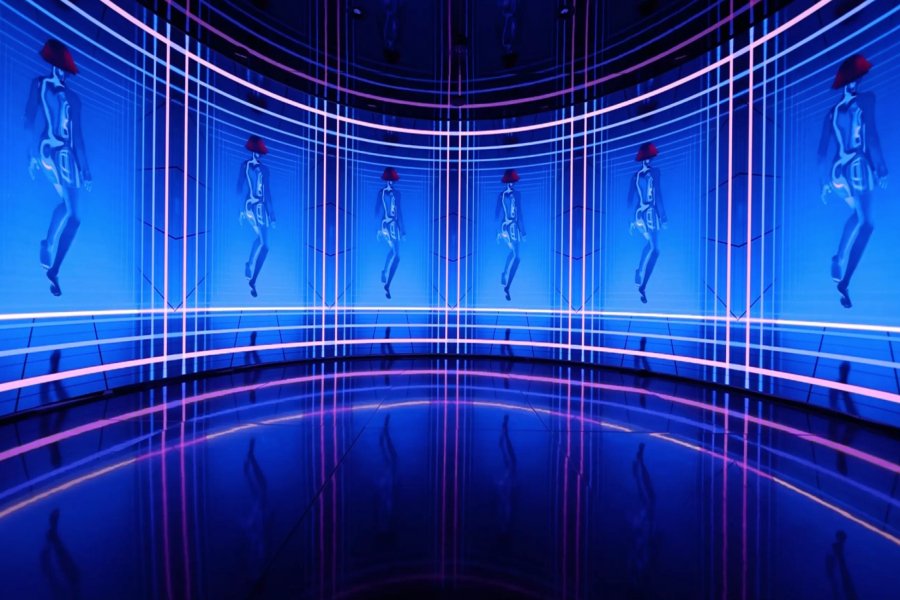
Emaho: Technology has accelerated the circulation of images, ideas, and markets. How do curators balance speed and visibility with depth, criticality, and long-term cultural relevance?
Auronda Scalera & Dr. Alfredo Cramerotti: Speed is unavoidable, but it should not dictate curatorial values. We see curatorial practice as a form of slow intelligence: creating temporal friction against constant circulation. This can mean privileging research-led projects, long-term collaborations with artists, or exhibitions that unfold over time rather than peak instantly. Visibility should be a consequence of relevance, not its substitute.
Auronda Scalera & Dr. Alfredo Cramerotti: One key difference is intentionality. Many Middle Eastern art ecosystems are being built with clear cultural and geopolitical awareness, rather than evolving accidentally through market forces alone. There is also a stronger openness to hybrid models, where museums, research labs, education, and technology coexist, allowing art to function as a form of future-building rather than only historical reflection.
Emaho: Many Middle Eastern institutions are being built in real time, rather than inherited. How does this condition of “newness” enable alternative curatorial models, experimentation, or risk-taking that older systems struggle to support?
Auronda Scalera & Dr. Alfredo Cramerotti: Newness has its advantages: it allows institutions to bypass rigid hierarchies and outdated disciplinary boundaries. Curators can experiment with formats, governance models, and modes of public engagement without being constrained by legacy structures. This cuts both ways: in the best case scenarios, creates space for speculative exhibitions, cross-sector collaborations, and curatorial risk that older institutions often approach more cautiously due to institutional inertia. In the worst case scenarios, it abandons historical memory and long-fought struggle for best practices, somehow undermining the achievements in terms of art and cultural expressions that we now take for granted. It is indeed a balance and an awareness we have to keep an eye on.
Emaho: In a region often framed through geopolitical narratives, how can curators use technology and AI to shift the focus toward artistic agency, complexity, and future-oriented storytelling rather than fixed identities? What critical questions must curators urgently address to remain relevant?
Auronda Scalera & Dr. Alfredo Cramerotti: Technology and AI can be used to decentralize narrative authority, allowing multiplicity, contradiction, and non-linear storytelling to emerge. Curators must ask: who controls technological infrastructures? Whose data is being used, and at what cost? How does automation reshape labor, memory, and authorship? Addressing these questions moves discourse away from identity as representation and toward agency as action.
Emaho: As digital tools redefine exhibition formats, bringing in virtual spaces, hybrid shows, immersive environments, and so on, how do you see the future of exhibition-making evolving, and what curatorial skills will become essential?
Auronda Scalera & Dr. Alfredo Cramerotti: Exhibitions will increasingly function as environments rather than containers. Essential curatorial skills will include spatial literacy across physical and digital realms, ethical awareness of technology and power structures in enabling that, and the ability to collaborate with technologists, architects, and scientists. Equally important is editorial clarity: immersive does not mean incoherent or superficial.
Emaho: Looking ahead to 2026, what should artists, collectors, and institutions realistically expect from the Middle East’s art scene?
Auronda Scalera & Dr. Alfredo Cramerotti: We expect an expanded institutional maturity combined with a redefinition of what an art hub can be. Rather than mimicking Western models, the region is on its course, and likely to do more so, in proposing alternative metrics of value, where research, cultural diplomacy, and long-term vision matter as much as market visibility or institutional validation of that market.
Emaho: When identifying artists shaping the next phase of contemporary art, what qualities matter most to you today?
Auronda Scalera & Dr. Alfredo Cramerotti: Conceptual rigor remains essential, but it must be paired with critical technological literacy and some forms of ethical awareness. We are particularly attentive to artists who understand systems, economic, ecological, algorithmic, and can intervene in them both poetically and critically.
Emaho: Finally, could you share five artists to watch in 2026, particularly those engaging with technology, AI, or new curatorial frameworks, and explain why their practices feel urgent now?
Auronda Scalera & Dr. Alfredo Cramerotti:
• Yang Yongliang – for his critical use of digital imaging to reflect on urbanization, memory, and ecological collapse.
• Hito Steyerl – for her continued interrogation of power, circulation, and technology with unmatched conceptual clarity.
• Lawrence Lek – for his speculative worlds that merge AI, gaming, and cinematic storytelling as tools for cultural analysis.
• Aziza Kadyri – for her nuanced engagement with digital aesthetics, networked identity, and post-Soviet imaginaries conflate, making visible how power, history, and computation intersect.
• Tabita Rezaire – for integrating technology, spirituality, and decolonial thinking into networked, future-oriented practices.
Their urgency lies in novelty of approach, and equally in their ability to critically shape how technology participates in culture, rather than simply reflecting it.